
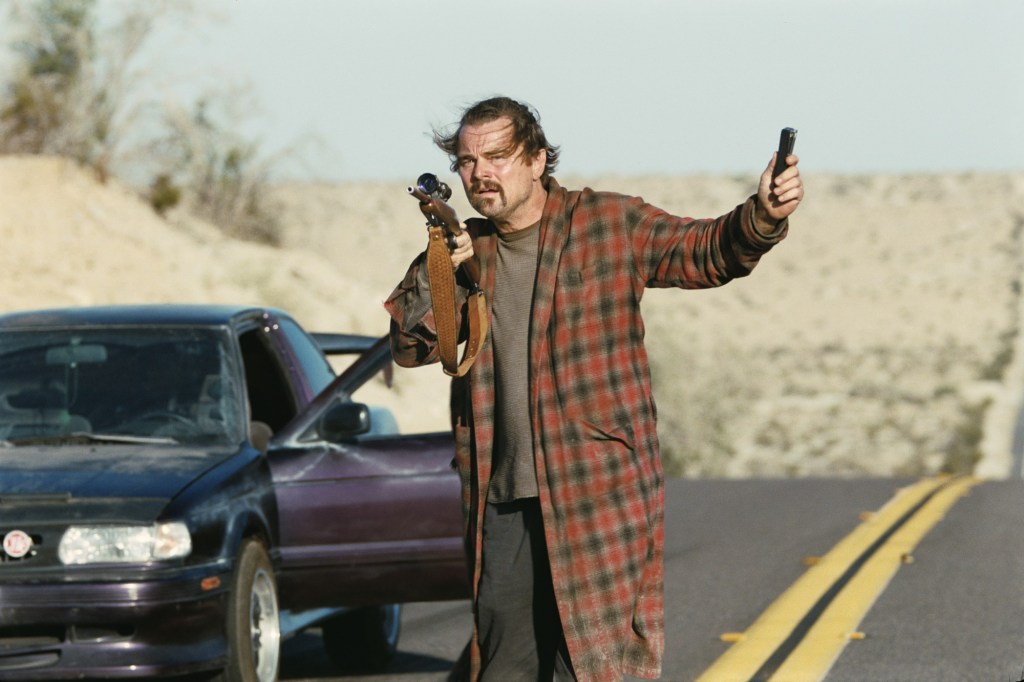
San Diego County is having a Hollywood moment as the backdrop for several scenes in the Oscar-nominated “One Battle After Another.”
But its extensive movie-making history goes much farther back in time and includes hundreds of titles. The county’s intriguing film history ranges from an attempt at a West Coast movie empire in Coronado to Michael Douglas drinking a scotch and soda at the Rancho Bernardo Inn. And even now, there are continuing local efforts to keep the county in the movie-making business, such as the new Chula Vista Entertainment Complex.
Here are some of the interesting stories of movie history in San Diego County in chronological order.
1. San Diego was the scene of one of the first films on the West Coast.
Before there was Hollywood, an electric company known as Edison Company produced some of the first motion pictures at the end of the 19th century. James White and photographer Frederick Blechynden took a new portable camera, a kinetograph, on a tour of the West Coast to collect footage for a new screening technology known as a kinetoscope.
In San Diego, they filmed “Street Scene,” which showed a trolley car moving back and forth along Broadway in downtown. They also visited Coronado to film scenes near Hotel del Coronado.
2. Coronado saw a short-lived attempt to become the West Coast precursor to Hollywood.
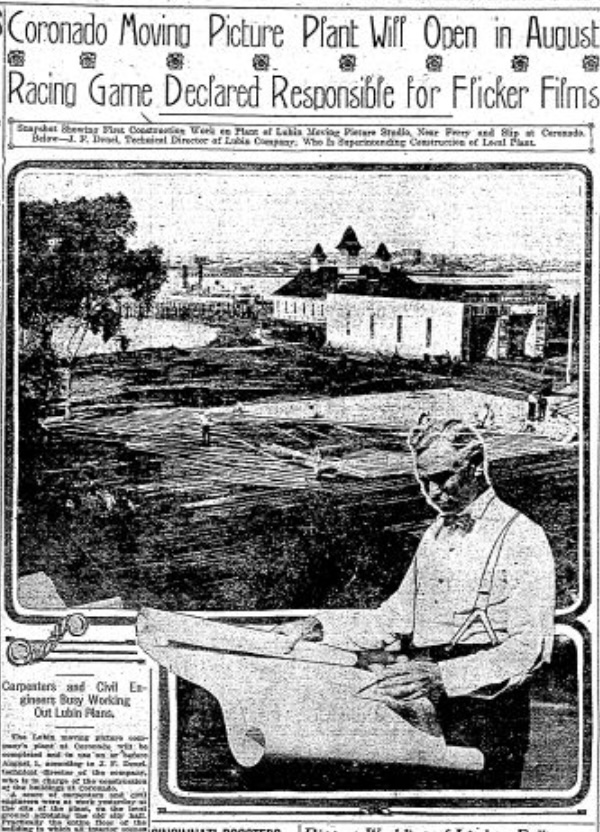 The San Diego Union, July 14, 1915. (Union-Tribune Archive)
Before movie-making was consolidated in Los Angeles, one of the biggest names in the business attempted to make Coronado the capital of West Coast film production. Siegmund “Pop” Lubin, referred to at the time as “the father of motion pictures” and who built a silent film empire in Philadelphia, turned to Coronado in 1915 for the second home of his studio. At the time, the San Diego Union called Lubin Company “the oldest movie making firm in the United States.”
Movie-making in San Diego County was well underway at that point, including American Film Manufacturing Company, which set up shop for a few years in La Mesa, but there was major fanfare over the arrival of Lubin, including a celebration of “Lubin Day” at the San Diego Panama-California Exposition in 1915.
“While San Diego, Coronado and surrounding territory has long been declared by motion experts to abound in splendid natural scenes and conditions otherwise excellent here for the production of motion pictures, Lubin is the first great concern to establish a permanent plant,” said a report in the Evening Tribune on July 10, 1915.
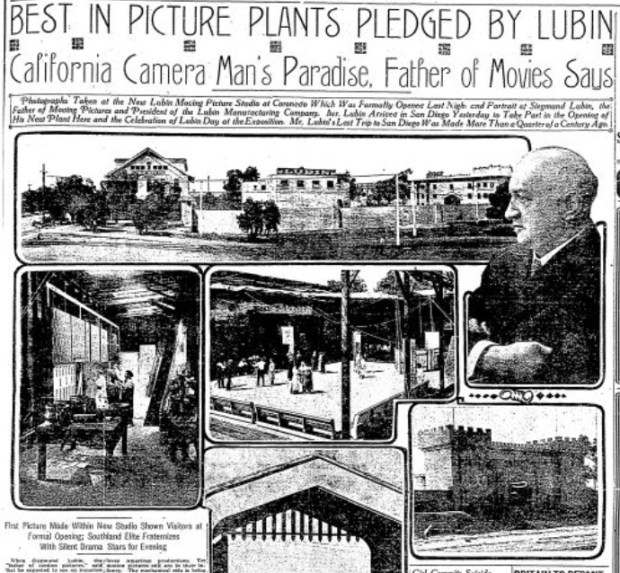 The San Diego Union on Sept. 25, 1915. (Union-Tribune Archive)
The facility was built facing the San Diego Bay at the corner of First and Orange and looked like a medieval castle. There were massive expectations and talk of expanding in years to come.
“Why if this goes through we will be bringing some of the greatest actors and actresses in the world to San Diego,” Lubin is quoted as saying in the Evening Tribune on Sept. 25, 1915, the day after the studio officially opened.
But it would be closed in the next year and torn down in 1917. The downfall is attributed to a cultural shift during World War I, legal trouble and other financial issues for Lubin, who eventually went bankrupt.
The Evening Tribune said the Coronado studio “came in a blaze of glory and wound up in a fizzle.”
3. San Diego’s Balboa Park can briefly be seen in the legendary film “Citizen Kane.”
 The San Diego Union, Dec. 21, 1940. (Union-Tribune Archive)
“Citizen Kane,” often referred to as one of the best films ever made, includes a few brief moments filmed in San Diego. An Evening Tribune article from Dec. 21, 1940, stated that Orson Welles — the star, director, writer and producer — was in town on Dec. 20 to shoot scenes in Balboa Park of the California Tower, Cabrillo Bridge, Plaza de Panama and the American Legion building. According to the news report, no actors were filmed there.
Staff at the San Diego Museum of Art have record of this and added the lily pond and El Cid statue to the list. Eagle-eyed San Diegans will easily spot these locations, which the movie used at the beginning to represent the Xanadu palace.
4. Military bases in San Diego have collaborated on many films, including Camp Pendleton Marines working on the John Wayne film “Flying Leathernecks.”
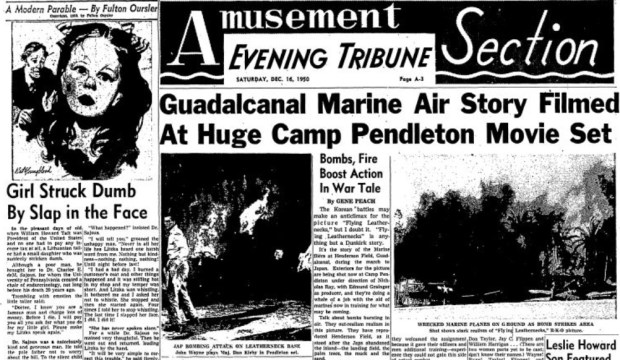 An article in the Dec. 16, 1950, edition of the Evening Tribune about the filming of “Flying Leathernecks.” (Union-Tribune Archive)
To re-create the WWII battle of Guadalcanal in “Flying Leathernecks,” producers built of a replica of Henderson Field at Camp Pendleton.
“Talk about bombs bursting in air,” said a reporter for the Evening Tribune on Dec. 16, 1950. “They out-realism realism in this picture.”
News articles from the time say several hundred Marines were involved with the filming and that the base benefitted from the realistic combat production.
“Marine officers on the set said they welcomed the assignment because it gave their officers and men additional training — experience they could not gain this side of actual combat,” The Evening Tribune said.
The number of military films shot in San Diego County is more than 100, according to the San Diego History Center, including “Tell It to the Marines,” “They Gave Him a Gun,” “The Outsider” and “MacArthur.”
5. Filming of ‘Some Like it Hot’ in Coronado put Marilyn Monroe in between a battle of two mayors.
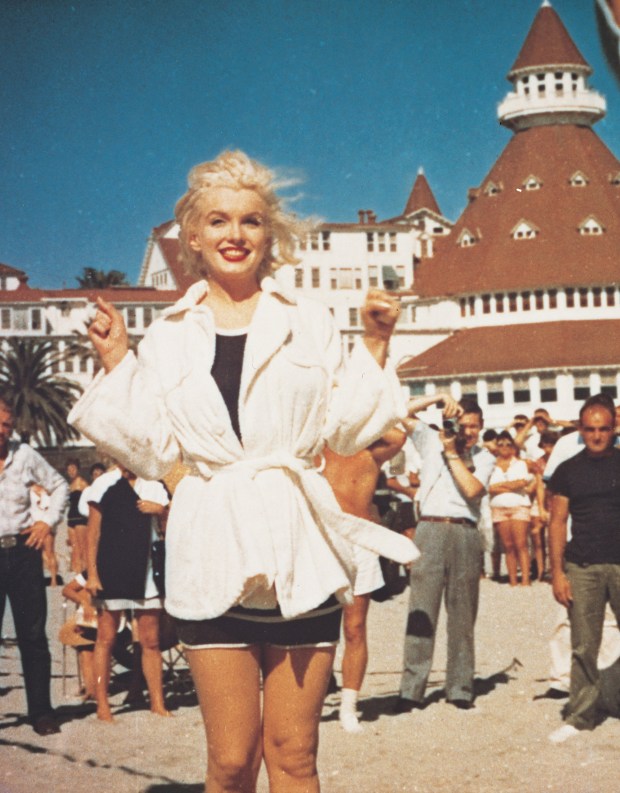 Marilyn Monroe stands outside the Hotel del Coronado during filming for “Some Like it Hot.” (Hotel del Coronado)
Among the most famous movies filmed in San Diego is “Some Like it Hot,” which stars Marilyn Monroe and won a Golden Globe award for Best Motion Picture – Comedy in 1960. In 1958, Monroe, cast and crew roomed inside and filmed outside Hotel del Coronado, which still celebrates its connection to the film with displays onsite.
“I still get people today that will come into the museum and say, ‘Can you show me exactly where on the beach she stood?,” Gina Petrone, the property’s heritage manager, said of Monroe. “There’s still this fascination. We have a large photo of Marilyn in front of the turret in our museum that we use as kind of a selfie spot and daily people come in and take their picture next to her.”
The choice of venue, which in the film is the fictional Seminole Ritz Hotel in Miami, caused some grief to Monroe when Miami’s mayor contacted her to complain about filming in San Diego. On Sept. 18, 1958, the Coronado Eagle and Journal reported that Coronado’s own mayor, Beverly Harrison, responded on her behalf.
” ‘Some Like It Hot’ but not as hot as Miami in September,” the newspaper clip says of Harrison’s note. “You forgot to mention gnats, mosquitoes and hurricanes. Give them my best. I spent a year in your city during the war as Commanding Officer Naval Training Center. Come yourself to the original Garden of Eden, Coronado and let me buy you a cooling drink.”
6. “Almost Famous” is based on Cameron Crowe’s real life, and he has a piece of the Sports Arena to prove it.
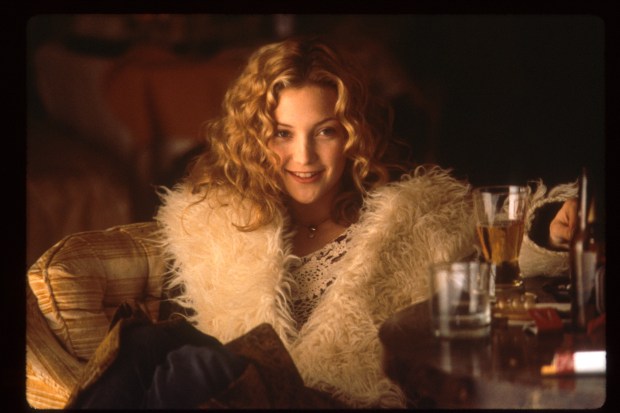 Kate Hudson in “Almost Famous.” (New York Daily News Archive)
“Almost Famous” is typically at the top of any conversation about San Diego movie history, considering its writer and director, Cameron Crowe, wrote it with inspiration from living in San Diego. It depicts Crowe’s real-life experience improbably becoming a music reporter for Rolling Stone as a teenager. It also features performances by some of the biggest names in Hollywood history: Frances McDormand, Kate Hudson, Philip Seymour Hoffman and Jimmy Fallon.
From the second the film starts rolling, it’s unmistakably showing San Diego, especially Ocean Beach and Balboa Park. And the story starts taking off when Crowe’s character William visits the San Diego Sports Arena, which now goes by Pechanga Arena San Diego. He’s sent on an assignment to write about a performance there by Black Sabbath, and approaches the back of the arena, ringing the doorbell at the bottom of a ramp leading into the arena.
The movie unfolds much like Crowe’s real-life experience, and a bouncer at the door shuts him down multiple times before he finally makes it inside the arena. Filming for “Almost Famous” took place at the arena in 1999, where the actor playing Crowe pushed the same doorbell he pushed in 1972.
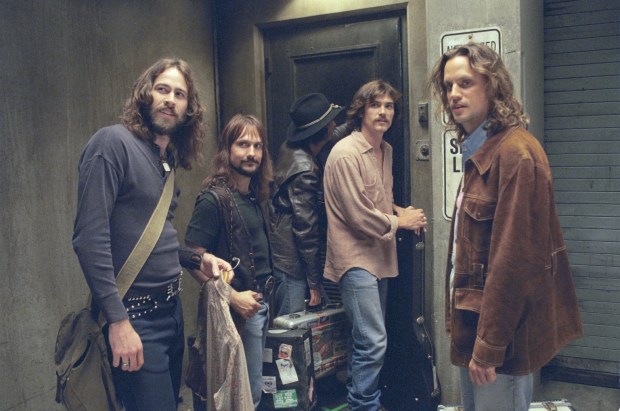 (Left to right) Lead singer Jeff Bebe (Jason LEe), drummer Ed Vallencourt (John Fedevich), manager Dick Roswell (Noah Taylor), lead guitarist Russell Hammond (Billy Crudup), and bass player Larry Fellows (Mark Kozelek) are intercepted at the stage door by a rock writer in DreamWorks Pictures’ “Almost Famous.” (New York Daily News Archive)
Crowe won Best Original Screenplay for the film at the 2001 Academy Awards and published a memoir in 2025, “Uncool,” which shares much about his early life in San Diego. In the book, Crowe shared a picture of that buzzer and wrote, knowing the arena will be torn down eventually, that he asked to own that buzzer. Current Pechanga Arena staff obliged, confirming with The San Diego Union-Tribune that they removed it for him in 2024.
7. Benicio del Toro, a star of “One Battle After Another,” has more history with San Diego.
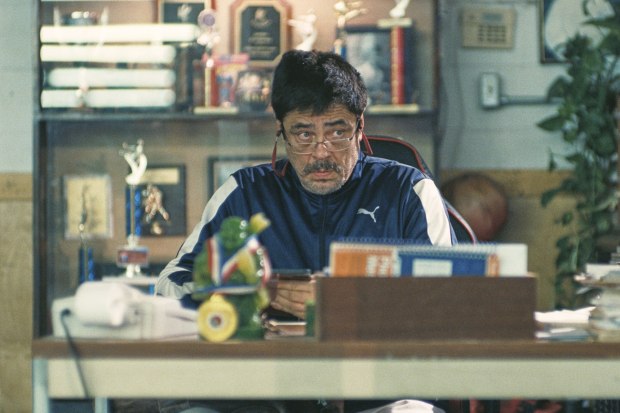 This image released by Warner Bros. Pictures shows Benicio Del Toro in a scene from “One Battle After Another.” (Warner Bros. Pictures via AP)
Before becoming a massive Hollywood star who has appeared in Marvel and Star Wars movies, Benicio del Toro was briefly a student at UC San Diego. The Department of Theatre and Dance there has a record of del Toro attending in 1985 and 1986 before moving on to acting schools in New York City and Los Angeles.
It would also be San Diego where del Toro had one of his biggest breaks as an actor. The 2000 film “Traffic,” which also stars Michael Douglas, Don Cheadle and Catherine Zeta-Jones, takes place in and was extensively filmed in San Diego.
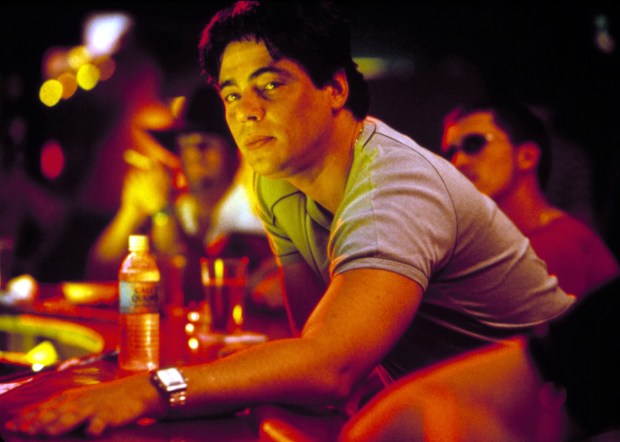 Benicio del Toro in a scene from “Traffic.” (USA Films/courtesy Everett Collection)
In the movie, del Toro can be seen filming in locations such as the Marriott Marquis San Diego Marina. There are also scenes where Douglas and Zeta-Jones can be seen enjoying food and drink at the Rancho Bernardo Inn.
For the role of Javier Rodríguez in “Traffic,” del Toro won and Oscar for Best Actor in a Supporting Role.
8. “One Battle After Another” films in San Diego.
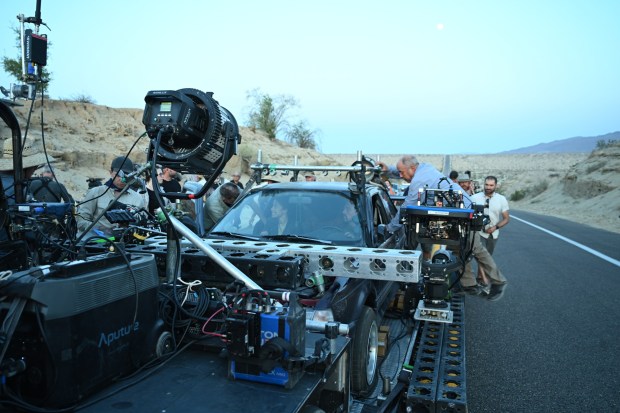 This image released by Warner Bros. Pictures shows Chase Infiniti and Leonardo DiCaprio in a scene from “One Battle After Another.” (Michael Bauman/Warner Bros. Pictures via AP)
In 2024, director Paul Thomas Anderson brought cast and crew to San Diego County to film in multiple locations.
“Otay Mesa Immigration Detention Center” can even been seen on screen toward the beginning of the movie, and filming really took place in Otay Mesa, where the crew built a detention center set.
“We would have Border Patrol and immigrants crossing in as we were shooting,” production designer Florencia Martin told Variety magazine.
Other locations include The Westgate Hotel, Ocotillo Wells and an area known as the Texas Dip in Borrego Springs.
Other notable movies filmed in San Diego County, according to records from the San Diego History Center:
“The Scorpion King”
“Pearl Harbor”
“Bring It On”
“Hunt for Red October”
“Demolition Man”
“My Blue Heaven”
“Top Gun”
“The Stunt Man”
“Attack of the Killer Tomatoes”
“Doctor Dolittle” (1967)
“Sands of Iwo Jima”