
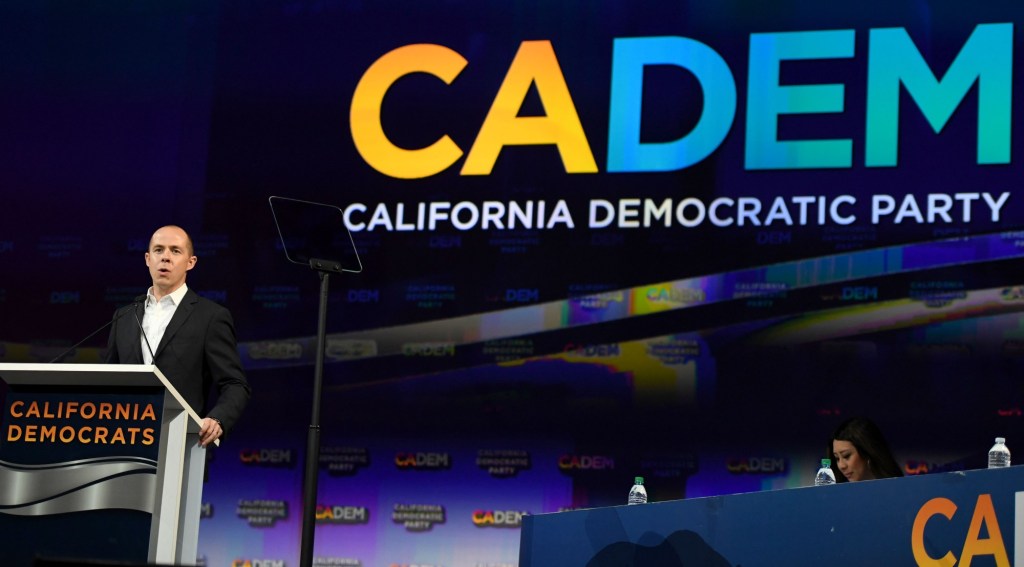
Leading up to the June primary election, the California Democratic Party will release a series of polls showing where candidates stand with voters in the crowded race to become the state’s next governor.
The unprecedented decision — with an estimated price tag of “multiple six-figures” — by the California Democratic Party to take this next step was announced on Tuesday, March 10, exactly one week after CADEM Chair Rusty Hicks penned an open letter urging non-viable Democratic candidates to drop out before the candidate filing deadline.
That deadline came and went on Friday, and only one candidate, former Assembly Majority Leader Ian Calderon, heeded that call; the other eight better-known Democratic candidates — many of whom are polling in single digits — have remained in the race.
And some candidates and political observers have even criticized Hicks’ letter, saying it suggested Democratic party leaders are trying to manipulate the outcome of the elections.
Asked during a call with reporters whether the upcoming release of this series of polls will amount to public shaming of low-polling candidates to pressure them to bow out, Hicks said it’s not his intent to humiliate anyone but to “ensure that we have clarity as to what is and is not happening in this race.”
“This is simply conducting credible, real-time, publicly available information,” Hicks said. “And if you feel shamed by information and data that’s available, then I think everyone has to inquire exactly why.”
However, Loyola Marymount University political science professor Fernando Guerra said releasing the polling data — dubbed the California Voter Opinion, Trend, & Engagement Research (VOTER) Index — will “absolutely” put pressure on lower-ranking candidates and impact how donors, influential endorsers and voters view them.
“Will it have an impact on lower-polling candidates? Yes. Will it lead to them dropping out? Hard to say,” said Guerra, the founder of the Leavey Center for the Study of Los Angeles at LMU and whose research has focused on state and local politics.
With less than three months to go before the June 2 primary, there is no clear frontrunner yet among the crowded field of Democratic candidates seeking to replace termed-out Gov. Gavin Newsom.
In California’s gubernatorial race, the candidates who land in the top two spots after the primary election advance to the runoff, regardless of party affiliation.
That has some Democrats worried that candidates may split the votes enough during the primary that two Republicans will end up in the runoff while Democrats get locked out of the November election.
Political observers and pundits say that possibility is low — but have not ruled it out entirely.
Candidates still in the running include former Rep. Katie Porter, billionaire environmental advocate Tom Steyer and Rep. Eric Swalwell, all Democrats.
Other Democratic candidates who have been trailing in polls include former U.S. Health Secretary Xavier Becerra, California Superintendent of Public Instruction Tony Thurmond, former Los Angeles Mayor Antonio Villaraigosa and former state Controller Betty Yee.
San Jose Mayor Matt Mahan entered the race later than the other candidates, but his campaign has projected confidence about the Democrat’s viability.
Riverside County Sheriff Chad Bianco and former Fox News host Steve Hilton, both Republicans, have consistently polled in the top five among all candidates.
Now, adding to previously published polls, the California Democratic Party will release a set of six polls showing where candidates stand, starting on March 24. The first poll will reflect responses from 2,000 likely voters, surveying them on the Democratic and Republican candidates.
Subsequent polls, to be released every seven to 10 days after that and running through early May, will be based on a sample size of 1,200 likely voters.
EVITARUS Research, a public opinion research firm, will conduct the polling.
Hicks, who estimated the VOTER Index will cost somewhere in the “multiple six-figures,” said it makes sense to launch the project as candidates are expending resources and communicating their messages with voters across the state.
“There is an appropriate time for everything. Certainly, I think this is the appropriate time for more information to be in the hands of all of us,” he said.
Matt Lesenyie, an expert in political psychology who teaches at Cal State Long Beach, said Hicks’ urging of low-polling candidates to exit the race may have given the impression that Democratic party leaders are “bullies” attempting to filter out candidates without giving voters the chance to elect who they want.
“It is far too early to be telling anybody to leave the race,” Lesenyie said. “The party needs to let … the candidates fight it out. There’s no need to intervene yet.”
On the other hand, he called the VOTER Index “a good use of the state party” because it will help voters, many of whom have not started to think about the primary election in earnest, to consider the poll results as they make up their minds which candidate to get behind.
Guerra agreed that putting out polling data is a better move for state party leaders than last week’s letter calling for long-shot candidates to drop out.
“It definitely felt like the powers that be were trying to sway the elections,” Guerra said about Hicks’ letter.
Instead of publishing that letter, Guerra said the state Democratic Party should have gone straight to releasing the VOTER Index and framing it simply as an opportunity to inform voters about the state of the race for governor. That would have been the better optics, he said.
Lesenyie, in the meantime, doesn’t believe that in California — where Democrats have a 20-percentage point voter registration advantage over Republicans — voters will allow two Republicans to advance while locking out Democrats from the general election.
Voters just need time to sort out which candidate they’ll vote for, he said.
“In a race like this, minds won’t be made up until the final weeks. Lots of voters are undecided,” Lesenyie said. But, he added, “in those final two weeks, they’ll wake up.”
“They’re going to converge around the folks with (higher polling) numbers,” he said.