

The city of Clovis is on its way to approving a local law that could require developers to set aside at least 5% of the units in new residential projects as affordable housing — unless they pay a fee, provide land or choose another way to help affordable housing get built.
Clovis doesn’t have much say in the matter. It agreed to implement its pending Mixed-Income Housing Ordinance, or MIZO ordinance, after two court rulings found the city violated affordable housing requirements mandated by the state.
Whether through fees or selling units at below-market-rate prices, developers say the ordinance will increase their own costs and, by extension, the price of market-rate housing in the area.
“Some builders are able to absorb certain fees in order to qualify a buyer in certain instances,” Darren Rose, president of the Building Industry Association of Fresno/Madera Counties, told The Fresno Bee. “But in a case such as the MIZO ordinance, no, it’s simply going to get passed on to the home buyer.”
California cities and counties have for years used such ordinances, widely known as inclusionary housing ordinances, to increase production of affordable units — especially in the Bay Area and Southern California. The impacts have “varied widely,” said David Garcia, deputy director of policy at UC Berkeley’s Terner Center for Housing Innovation.
He told The Bee the results depend on how the ordinances are structured, and how much they are balanced with incentives that offset the increased costs to developers.
The city has said that because it’s a new policy, several unknowns remain. Staff are prepared to monitor its impact and “respond to any impediments which may arise to the development of new housing units,” Chad McCollum, the city’s director of Economic Development, Housing and Communication said in a statement to The Bee.
Clovis’ ordinance would require new developments of 11 or more units to make at least 5% of the units affordable. It’s based on a city study from last year that found a requirement of up to 7% is feasible on for-sale projects. Under current market conditions, rental projects are not feasible in Clovis with or without affordability requirements, the study found.
The proposed ordinance is one of six concessions related to affordable housing, zoning and development Clovis agreed to in a 2024 settlement agreement. The deal followed a 2019 lawsuit from Fresno-area housing advocate Dez Martinez, who accused the city of zoning practices that discriminated against low-income people and people of color. A Fresno County court in 2021 found the city had violated state law by not providing enough sites for affordable housing and, after the city appealed the decision, three appeals court judges in 2023 ruled the same.
The city’s planning commission OK’d the proposed ordinance in late February, and the city council is expected to review it in April.
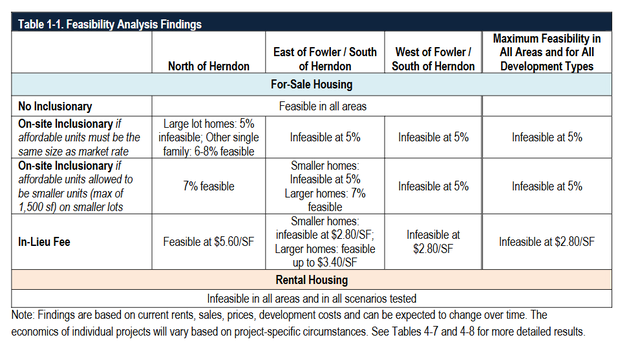 A study commissioned by the city of Clovis last year looked examined the level of affordable housing requirements that would be feasible in Clovis. CITY OF CLOVIS Fresno/Madera builders says ordinance will increase costs
Rose, of the Building Industry Association, said the fees developers pay because of ordinances, like the one proposed in Clovis, add onto building costs that are already high.
He said most residential development firms don’t have the profit margins to justify absorbing those extra costs. He added if a project doesn’t pencil out financially in a given area, developers will not be able to obtain the lending necessary to build.
“In capitalism, they’re going to deploy their capital where it makes the most sense,” he said. “If you tax them and impact fee them into oblivion, they’re just not going to build in a certain locality.”
Rose said a starting point for building more affordable housing in the Fresno area is to reduce the cost of building so more home production can increase. In California, fees and regulations create “many different headwinds facing a builder,” he said.
“The more supply that we build, it keeps homes more affordable,” he said. “We need to produce a lot more homes in the future, and because of cost, it’s kind of hard to.”
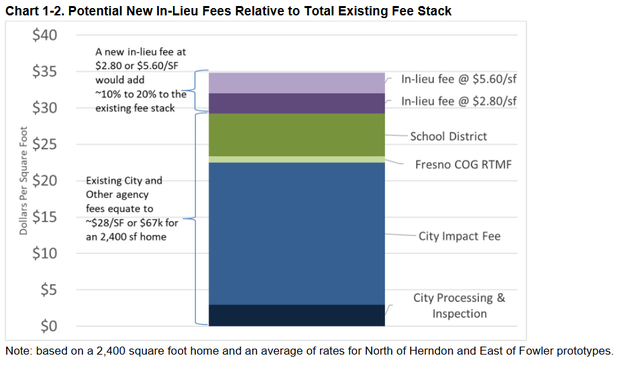 The affordable housing ordinance feasibility study commissioned by the city of Clovis last year also examined how much the fees developers could pay instead of building affordable housing would add to their overall city fee stack. CITY OF CLOVIS Is Clovis’ proposed affordable housing ordinance balanced?
Garcia, of UC Berkeley’s Terner Center, said it’s possible for affordable housing ordinances to achieve their targets, which is the inclusion of affordable units in new market-rate communities.
“The challenge is that a lot of cities don’t go through that exercise of determining what the right balance is,” he said.
Garcia said some California cities have seen all new development slow down because their ordinances required too high of a percentage of new units be affordable. He said the 5% requirement in Clovis’ proposed ordinance is “fairly low in terms of what other cities do, though it may not be for the Central Valley.”
Instead of building the affordable housing, developers in Clovis would be allowed to pay $2.80 per square foot of residential floor area in each market-rate unit they build. They could also build the affordable units on land they own elsewhere in the city or donate land for affordable housing, among other alternative compliance strategies.
The city says the goal of its various compliance options is to provide developers “the maximum amount of flexibility allowed by the court judgment.”
But Garcia said cities also should balance affordability requirements with incentives, so developers can “deal with the extra costs.” That means reducing certain fees or waiving some requirements for builders who voluntarily choose to include affordable units in a project, he said.
“Those end up being really successful because they are considerate of how the market for housing works,” Garcia said.
Related Stories from Fresno Bee

The Fresno Bee
Erik is a graduate of the Missouri School of Journalism, where he helped launch an effort to better meet the news needs of Spanish-speaking immigrants. Before that, he served as editor-in-chief of his community college student newspaper, Riverside City College Viewpoints, where he covered the impacts of the Salton Sea’s decline on its adjacent farm worker communities in the Southern California desert. Erik’s work is supported through the California Local News Fellowship program.