
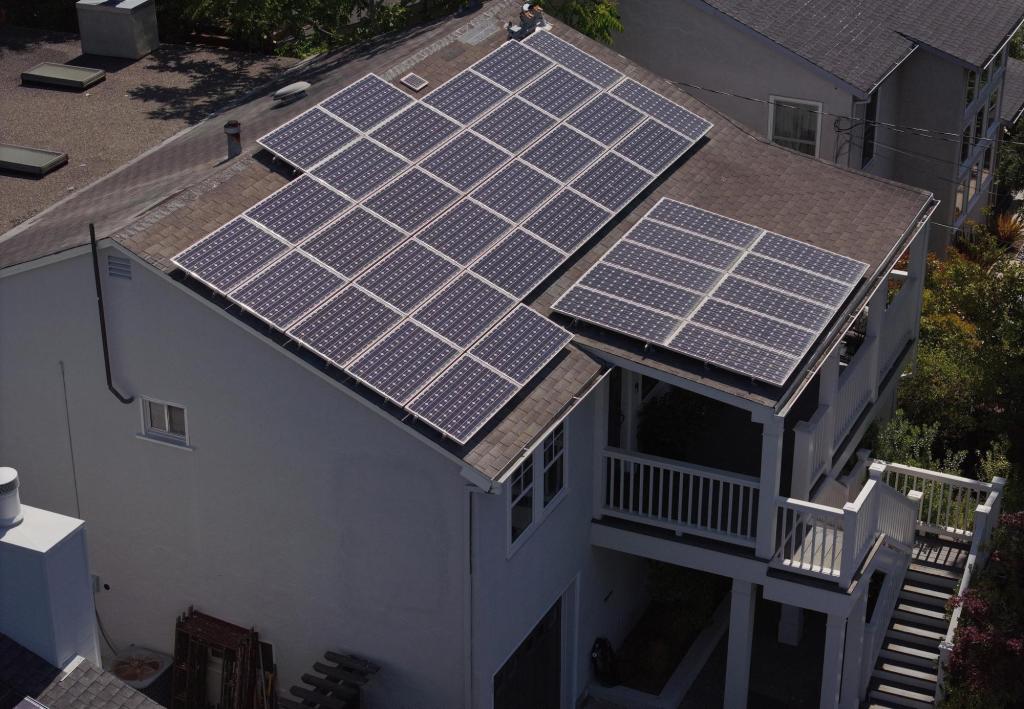
A ruling from the California First Appellate District Court of Appeals keeps in place a controversial overhaul of rooftop solar rules that the California Public Utilities Commission put into place almost three years ago.
In a 3-0 decision, the appeals court determined the CPUC was within its authority when the commission passed an update to the state’s net energy metering tariff program, colloquially known as NEM 3.0.
The commission, through a spokesperson, said it “welcomes the court’s decision” but one of the environmental groups that took the CPUC to court said the ruling “sets California back a decade when it comes to building a clean energy future.”
What is net energy metering?
Under a net energy metering billing mechanism, customers with rooftop solar receive credits that are applied to their utility bills when their systems produce excess power.
The NEM 3.0 rules adopted in a unanimous decision by the CPUC in December 2022 included incentives to encourage customers to pair their solar installations with battery storage systems.
But the update also decreed that new rooftop solar customers would no longer be credited at the retail rate of electricity when their systems generated surplus energy. Instead, they get paid at the “actual avoided cost,” which is lower.
The CPUC’s commissioners said the change, which went into effect for new solar customers as of April 2023, sends “more accurate price signals that encourage electrification” across the state.
But opponents said reducing the rate of compensation undercuts the incentive for potential customers to put solar on their roofs because it will take longer to recoup the tens of thousands of dollars customers typically spend to install the systems.
The legal battle
The Center for Biological Diversity, the Environmental Working Group and San Diego-based Protect Our Communities Foundation filed suit, challenging the new tariff rules.
Despite initially losing at the court of appeals, the environmental organizations took their case to the California Supreme Court. And in August 2025, all seven justices said the appeals court afforded the CPUC too much latitude when the commission passed NEM 3.0.
The Supreme Court said it was not concluding that the new solar rules are “correct or incorrect” and kicked the case back to the appeals court in San Francisco to decide whether NEM 3.0 should be upheld.
The environmental groups focused on Assembly Bill 327 by the state Legislature that includes a provision directing that any NEM tariff put into place by the CPUC “ensures that customer-sited renewable distributed generation continues to grow sustainably” across California. That provision is also a statute in the Public Utilities Code, Section 2827.1.
The trio argued NEM 3.0 violates the statute and the Legislature’s intent. They also said the tariff does not go far enough to enhance solar adoption for residential customers in disadvantaged communities.
Attorneys for the CPUC countered by saying the statute in the Public Utilities Code calls for the commission to weigh the pros and cons of any new rules.
“The Commission did exactly that,” when it passed NEM 3.0, California Attorney General Rob Bonta and Deputy Solicitor General Mica Moore said in their supplemental response brief to the appeals court. “It conducted a cost-benefit analysis for the successor tariff and used the results to inform the design of the tariff.”
The state’s three big investor-owned utilities — Pacific Gas & Electric, San Diego Gas & Electric and Southern California Edison — were listed as parties of interest in the case and their attorneys filed briefs in support of the CPUC.
The legal case also involves the long-running “cost shift” debate.
The utilities insist that the growing number of rooftop solar installations leaves customers who don’t have solar paying an unfair share of the fixed costs that come with maintaining the electric system — substations, transformers, poles and wires, etc.
Opponents dispute that, saying it does not properly take into account the benefits of rooftop solar, such as reducing the need for utilities to spend ratepayer dollars on building more infrastructure.
The CPUC says even without credits at the retail rate, customers who install rooftop solar under NEM 3.0 can recoup their upfront costs in about nine years.
The appeals court’s decision
In the 33-page ruling handed down late Monday, the appeals court said, “we remain unpersuaded that petitioners have shown the Commission’s Decision fell outside its lawmaking authority,” as delegated by the Legislature.
Further, the court did not buy the argument that NEM 3.0 runs counter to Section 2827.1 of the utilities code, adding that it doesn’t “preclude the Commission from revising the tariff in the future upon new or additional evidence regarding the total benefits and costs of the tariff to all customers and the electrical system.”
CPUC spokesperson Terrie Prosper said the court ruling “recognizes that the CPUC appropriately addressed its responsibility under state law to ensure that rooftop solar programs remain fair, sustainable, and aligned with California’s clean energy goals.”
Bernadette Del Chiaro, senior vice president for the Environmental Working Group, said, “Instead of looking at this case with fresh eyes and doing the due diligence of reading and interpreting the statute, the court of appeal rushed to judgment, siding with the pro-utility CPUC and its utility allies.”
Roger Lin, senior attorney for the Center for Biological Diversity, did not rule out filing another appeal. “We are evaluating all of our options,” he said.
Who is affected by the rules now in place?
NEM 3.0’s rules apply only to customers with systems installed in April 2023 or later.
Solar customers who had their systems installed under earlier iterations of the tariff still get compensated at the retail rate for 20 years from the time their systems became operational before the new rules affect them.
For example, a customer who had a system installed in 2018 gets credited at the retail rate until 2038. But after that, the customer will be credited at the lower NEM 3.0 rate.