
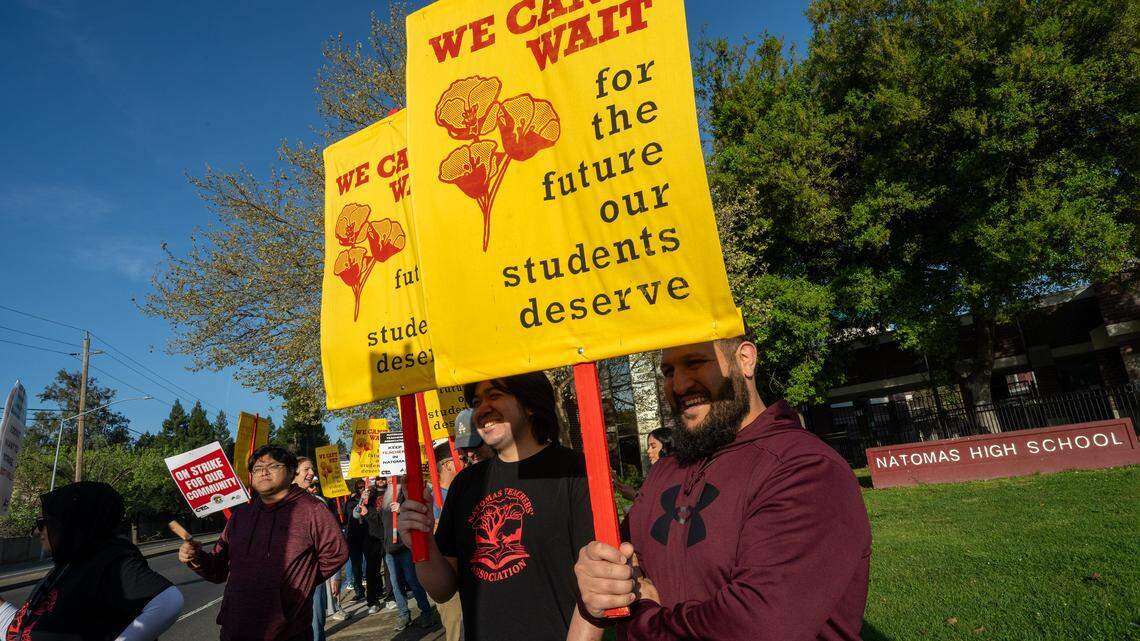
Teachers from Natomas Unified School District went on strike Tuesday, becoming the second group of Sacramento-area teachers in a week to take to picket lines.
Hundreds of people demonstrated and marched near campuses while classes continued with substitutes.
Teachers followed through on a strike plan after negotiations with the district stalled, days after teachers for the 25,000-student Twin Rivers Unified School District went on a strike. The Twin Rivers teachers strike was in its fourth day with bargaining talks resuming Tuesday afternoon at the request of Assemblymember Maggy Krell, D-Sacramento.
Teachers and officials for the 17,000-student Natomas district have been unable to agree on pay, benefits and staffing levels for school support staff.
In a Tuesday morning email to families of students, a district spokesperson acknowledged that the morning’s student drop off “likely looked different.” But the spokesperson noted results of a recently issued report that called the district’s offer to teachers reasonable.
“Picketing will not change the fiscal realities facing our district today,” the spokesperson wrote.
At a noon rally at North Natomas Regional Park, Natomas Teachers Association President Nico Vaccaro told attendees that the district has the means to pay competitive wages and invest in its students.
“We are on strike for our students,” Vaccaro said.
Where negotiations stand
As The Bee reported Monday, the strike follows an 11-hour negotiating session on Sunday. The Natomas union has sought a two-year cumulative raise of 8.5%, while the district is offering 4% in that span. The union would also like better health care for teachers and their families and minimum staffing for social workers, nurses and school psychologists.
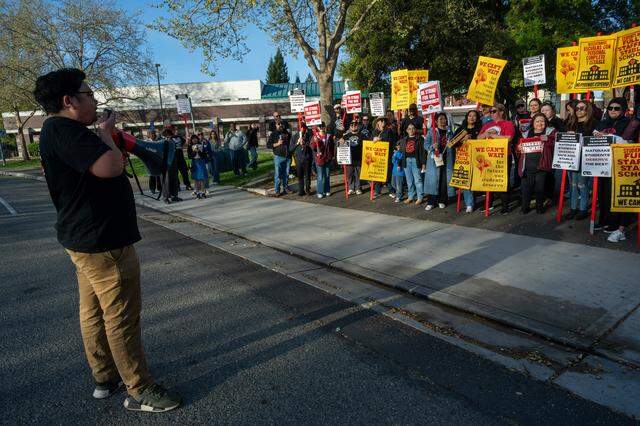 Nico Vaccaro, president of the Natomas Teachers Association, speaks to strikers in front of Natomas High School in Sacramento during the first strike at the Natomas Unified School District on Tuesday, March 10, 2026. RENÉE C. BYER rbyer@sacbee.com
The district officials said they had most recently adjusted their proposal Friday, offering an increased raise and a restructured health benefit plan with a fully-paid option for teachers and their dependents for the next two years. They maintain that the district’s offer is consistent with the findings of a third-party fact finder and improves conditions for teachers while being mindful of the suburban district’s “fiscal reality.”
“At the end of last week, the neutral fact finding report confirmed the district’s proposal is aligned with an independent, neutral voice that they determined is reasonable within the fiscal realities facing our district,” Superintendent Robyn Castillo said at a Monday news conference.
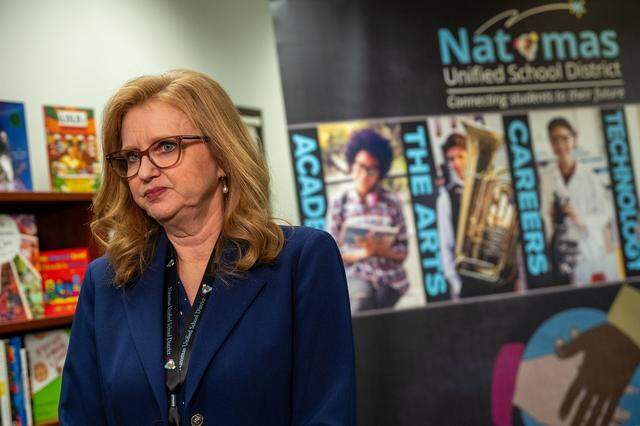 Natomas Unified School District Superintendent Robyn Castillo waits to answer questions during a press conference at district headquarters in Sacramento on Monday. RENÉE C. BYER rbyer@sacbee.com The scene at Heron School
In North Natomas on Tuesday morning, around a 100 Heron School teachers chanted “the teachers united will never be defeated” as they marched around the campus grounds and through nearby streets.
Melinda Lai, a seventh grade science teacher at Heron School, said she’s striking to urge better learning conditions for students. Lai, who also has a student at the school, said over two dozen empty positions have left students without a full-time teacher. “We’re on strike today because our kids deserve safe and stable schools,” Lai said.
Lisa MacMillan, a first grade teacher at Heron School, was hit by a car on the first day of a recent school year. MacMillan spent a year in recovery. She said she had to pay $1,300 per month out of pocket for her medical insurance. MacMillan said low insurance coverage and fair pay are the most pressing issues for teachers.
“It’s an issue for everybody. The district is only covering 60%,” MacMillan said. “Health care keeps going up and up. That’s a major issue.”
Parents and other guardians were determining whether to send students to schools in the district, which remained open Tuesday as the strike got underway.
Machelle Mack is a grandmother of a Heron School second-grader. She supports the strike, but is concerned about the low number of teachers at the school.
“I am supportive of the teachers in the strike,” Mack said. “It’s been a long time since they’ve had any increases, so my only concern is what’s going to happen when there are no substitutes for the kids, right?”
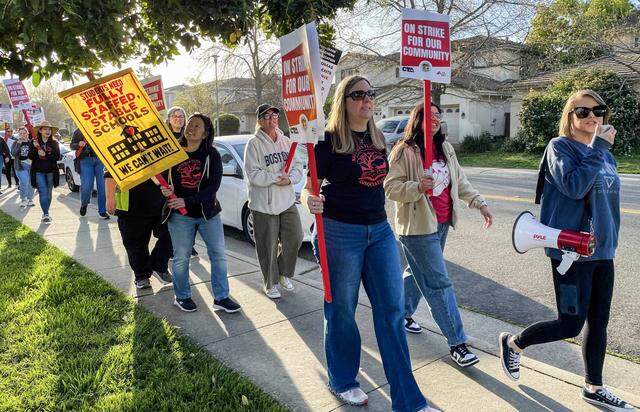 Teachers picket at Heron School in North Natomas on Tuesday. EMMA HALL ehall@sacbee.com
Ashley Puerta, a parent of a third-grader at Heron School, said she supported the teachers going on strike. “It’s just really disappointing that the district doesn’t see value in our teachers and getting our classrooms open,” Puerta said. “But they see value in their own salaries…it’s really sad that’s their priority versus all these kids.”
Some students were out supporting the teachers. Puerta was joined by her daughter, Adeline.
“I feel sad for my teachers. I feel sad for my class,” said Adeline, who added that she was missing school “because my mom says the money would go to substitutes and not the teachers.”
Paul Rahul dropped off coffee for the Heron School teachers, who were posted on the sidewalk next to the campus. He said the 4% raise doesn’t do much for the teachers, especially with the increasing cost of living in Sacramento.
“It doesn’t even cover the cost of living or inflation,” Rahul said. “We need the administration to do a better job of supporting the teachers.”
Rahul’s seventh grader, Jaden, helped his dad in providing coffee to his teachers. He was also in support of the strike. “I believe that they give us education, and they’re the ones who actually taught me,“ Jaden said. “I believe they deserve more.”
Rally outside Natomas High School
About the time that teachers were marching at Heron School, around 100 people were rallying in front of Natomas High School.
The main issues on the bargaining table, they said, are health benefits, wages and class sizes. Attendees said health benefits cut deeply into teachers’ paychecks, exacerbating turnover.
“We have a teacher retention crisis here,” said Jeff Bryan, an English teacher of 13 years at Natomas High. Bryan said neighboring districts outcompete Natomas on benefits and wages.
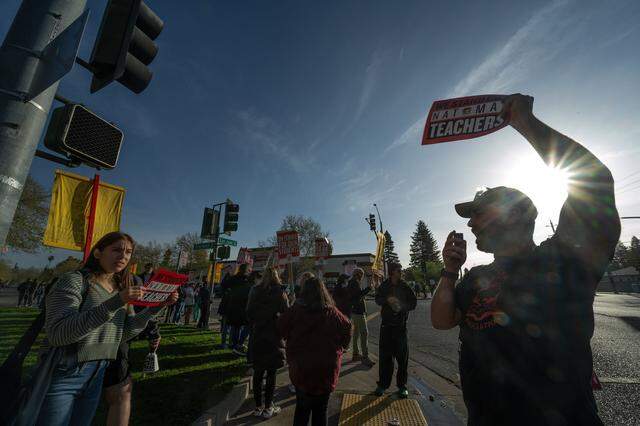 Jeff Bryan, an English teacher at Natomas High School, leads a chant with strikers on Tuesday, March 10, 2026, in front of the Sacramento school on the first day of the first strike in the school district’s history. RENÉE C. BYER rbyer@sacbee.com
“We want to get back in the classroom ASAP,” Bryan said. “Every day lost that we’re not in the classroom is a missed opportunity for learning.”
Ashley Battle, a mother of two children in the school district, said short-staffing in classrooms, and a lack of aides, is a security risk.
“I know teachers who have two to three jobs,” she said.
Battle said her husband teaches at Inderkum High School, and the family’s health benefits take about one-third of his paychecks.
“The benefits are the biggest thing,” she said. “None of these teachers wanted to strike.”
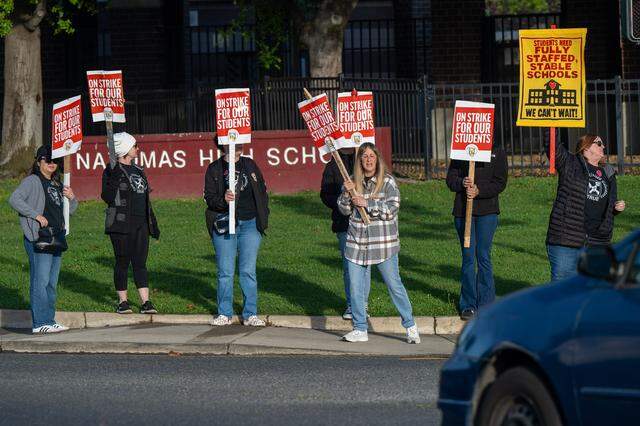 Supporters hold signs in front of Natomas High School in Sacramento during the first teacher strike in the Natomas Unified School District on Tuesday, March 10, 2026. RENÉE C. BYER rbyer@sacbee.com
Vaccaro, the union president and also a special education teacher, said members pay $1,500 per month for health care. Vaccaro said the union is pushing for fully funded benefits with Kaiser, the health system used by many of the district’s employees.
Vaccaro said 106 educators left the district last year, switching to other districts for better pay or leaving the profession altogether.
Hundreds attend midday rally near Inderkum
Hundreds gathered Tuesday for a noon rally at North Natomas Regional Park, across the street from Inderkum High School.
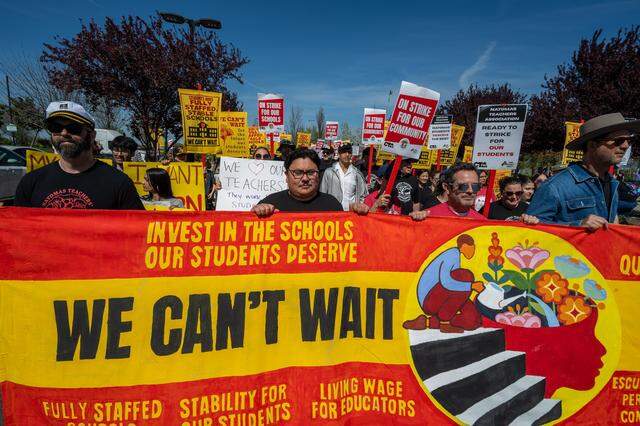 Union leaders and supporters join in a march for the first ever Natomas educators strike at North Natomas Regional Park in Sacramento on Tuesday, March 10, 2026. RENÉE C. BYER rbyer@sacbee.com
Jlay Tor, a mother of four from Natomas, said she has been in the district since 2011, first with two students who graduated Inderkum, and now with two at Paso Verde. She said she has watched qualified, experienced educators leave the district. Some have begun to view Natomas as a “training district” for early-career teachers.
“I’ve seen the slow decline,” Tor said.
One of her children had experienced teachers for kindergarten and first grade, but first-year teachers for second and third grade.
“Educators across the state have had it,” said California Teachers Association President David Goldberg. “You can’t keep balancing the budget on our backs and our students’ backs.”
People marched from the farmer’s market marquee in the park to the North Natomas Library, past Interkum High, chanting and carrying signs.
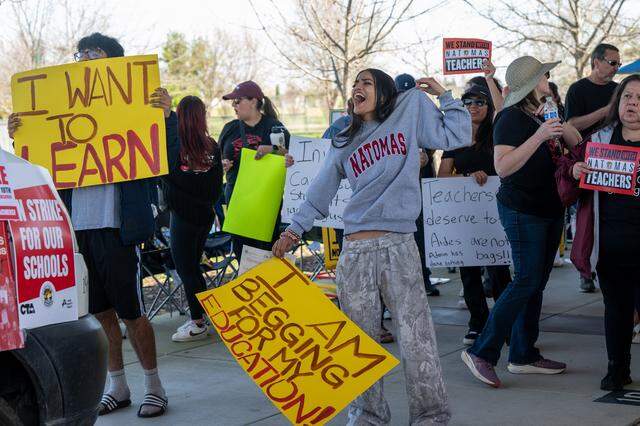 Natomas High School senior Ashlyn Aradhna, center, holds a sign at a rally during the first ever Natomas educators strike on Tuesday, March 10, 2026, in Sacramento. RENÉE C. BYER rbyer@sacbee.com
The teachers are part of a wave of Northern California strikes led by CTA. The Dublin Teachers Association began a strike Monday. Richmond teachers walked out for the first time in December, for four days, said United Teachers of Richmond President Francisco Ortiz.
Ortiz said the Richmond teachers had similar complaints: they were among the lowest paid in the region, with the highest health care contributions in Contra Costa County. Plus, turnover was dramatic. The union, which represents about 1,450 people, saw 1,500 educators leave over the course of five years.
They won 8% raises over the course of two years, and fully-funded health benefits, he said.
The Bee’s Jennah Pendleton contributed to this story.
 California Teachers Association President David Goldberg speaks at a rally on Tuesday, March 10, 2026, at North Natomas Regional Park in Sacramento during the first day of the Natomas school district teachers’ strike. RENÉE C. BYER rbyer@sacbee.com
The Sacramento Bee
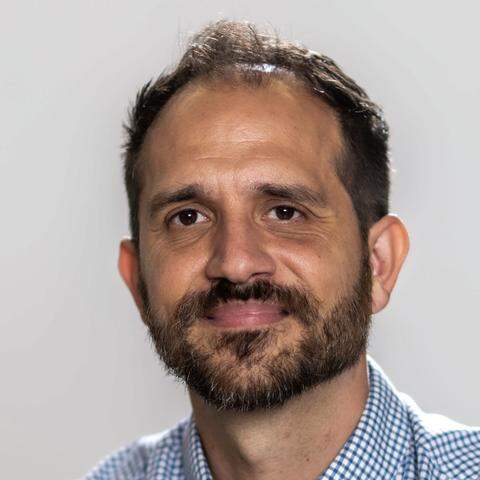
Graham Womack is a general assignment reporter for The Sacramento Bee. Prior to joining The Bee full-time in September 2025, he freelanced for the publication for several years. His work has won several California Journalism Awards and spurred state legislation.