
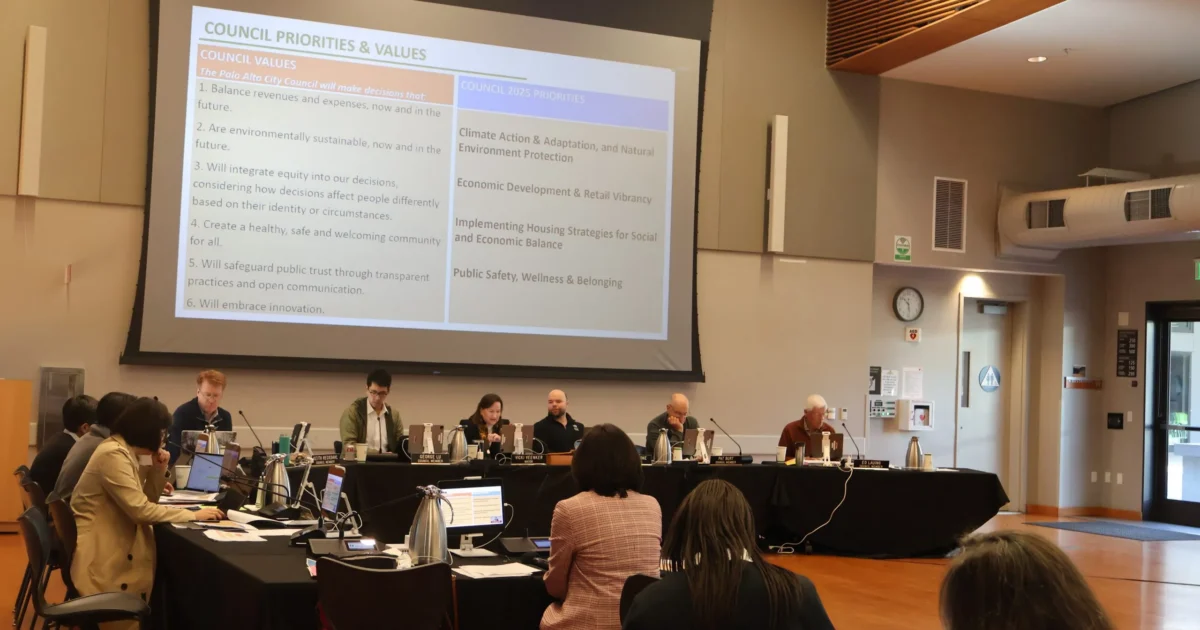
Palo Alto leaders set themselves up for a busy year on Monday when they approved a list of 42 measurable goals to carry out for the next year — an agenda that includes adopting a new area plan for neighborhoods around San Antonio Road, crafting a policy for managing consultants, completing a new bike master plan and advancing “quiet zones” near railroad crossings.
The City Council’s debate over objectives for 2026 follows up on its adoption of annual priorities in January and its revision of council values, which are meant to be more permanent.
Although council feedback to staff on the list of objectives was exhaustive, only two substantive changes were made: the removal of a traffic calming item due to a lack of clarity, and the addition of a pilot “council support” position to assist city leaders with scheduling and other administrative items.
The approval from council follows the annual retreat in January, where the city strategized to nest its goals as “values,” which are ideas that require special attention that year, “priorities,” which are chosen at the retreat every year, and “objectives” that represent specific projects or milestones.
The priorities were set at the retreat, and the Policy and Services Committee recommended last month an update to the values that were first adopted in 2022. The council wordsmithed the list of seven values at the meeting Monday, focusing largely on the areas of equity and housing.
Debating equity
One of the values, “Equity & Shared Prosperity,” specifically referred to housing and social policies and the desire to “center equity in every decision.” Councilmember Pat Burt questioned the city’s ability to feasibly do so. He referred to the consent calendar on the agenda that evening, where several items are voted through as a single motion under the assumption that they require little to no discussion.
Councilmember Julie Lythcott-Haims pushed back against that characterization.
“I found myself almost voting to pull an item on the consent calendar related to our emergency council because it happens to be seven people who are all white,” she said. “It’s an example of how, unless you are bringing a lens of equity into every decision, you can overlook things.”
Upon debating the removal of the phrase, Vice Mayor Greer Stone also questioned whether there was any decision the council could make where equity was not part of the process.
The equity vocabulary was ultimately shifted into the “Accountable Governance” value, with the addition of the phrase “centering equity in decision-making.”
Councilmembers also debated the prominence of housing in the list of values, and the “Equity & Shared Prosperity” value transformed into “Shared Prosperity and Housing Leadership,” with the mention of equity in “every decision” removed from the language after shifting similar verbiage into the “Accountable Governance” description.
A busy agenda
With the values and priorities locked in, the council proceeded to the objectives list. Staff split the goals into two tiers, with the first tier of 42 objectives described as “mission critical” and the 24 in the second tier reserved for “value-add” items or ongoing projects. While all 66 goals were discussed Monday, only the first tier required council approval, according to the staff report.
“While progress will be tracked for all objectives in Groups 1 and 2, quarterly reporting will focus on Group 1 objectives to align with City Council’s highest priorities,” the staff report states.
As a reminder, each objective must report back to a specific council priority or value. The priorities the council landed on in January were: “achieve near-term priority housing milestones, Cubberley acquisition and renovation funding, enhance business vibrancy and government efficiency.” Twelve of the 42 objectives fall more broadly under a council value instead of a specific priority.
The tiers give a more refined look into how the city is planning to prioritize its priorities. For example, every objective related to government efficiency falls under “tier 1,” as are the two goals for improvements at the Cubberley Community Center. The other three categories are split between tier 1 and tier 2.
“At the end of the day, this is really an exercise in trying to match up what we’d like to get done with what we believe we have the resources to do,” City Manager Ed Shikada told the council.
The goals in tier 1 include adopting zoning changes that encourage different types of housing, including microunits and intergenerational housing, opening the Homekey “transitional housing” complex at 1237 San Antonio Road, adopting an ordinance that expands retail opportunities and enhancing enforcement relating to oversized vehicles, while also adding more services for the residents who occupy them.
Only a handful of the objectives were hotly debated on the dais Monday, including renter protections, retail vacancies and traffic calming.
Most of the council feedback was in line with staff’s intent for the goals. Stone questioned why all of the renter protection objectives were in the second tier as opposed to the first, and Councilmember George Lu inquired about the housing objectives related to implementation of state law.
At odds over traffic
But the real contentious objective related to traffic calming. The objective, which falls under the government efficiency priority, indicates that staff will explore options related to “quick build” projects such as daylighting and update the city’s Traffic Calming Policy to align with other existing policies, such as Safe Routes to School.
“The city currently has a traffic calming policy, and the policy is aimed at filtering requests that come into the city to find which ones are worthy of moving forward,” Chief Transportation Official Ria Hutabarat Lo told the council. “Unfortunately, it’s filtering everything, so we’re doing a lot of analysis but we’re not producing things on the street as a result.”
But in reviewing the proposed language of the objective, councilmembers struggled to understand the specific milestones that could track the item’s success.
Lu directed staff to remove the item and bring it back to the council at a later date.
“This item is fairly broad. … But it still doesn’t propose any framework or goals of delivering X projects with X budget,” Lu said.
In its place, multiple councilmembers expressed an interest in introducing a new objective to hire a temporary, part-time council executive assistant to help with administrative tasks like scheduling. Stone also first raised the idea of an assistant role during the retreat in January.
Not everyone was onboard with it.
“I think the optics of us adding a staff when we’re telling the rest of the community to cut would make me feel uncomfortable,” Councilmember Keith Reckdahl said.
Burt also expressed his opposition to the motion, but the remaining five councilmembers prevailed in the vote.
While the council hoped to also approve the work plans for the city’s Policy and Services Committee and Finance Committee and several ad hoc committee purpose statements, these were pushed to a future meeting due to a lack of time.
“We do have our objectives in early March. It is not May like last year,” Veenker said. “At least, yay, we got that done.”
This story originally appeared in Palo Alto Weekly. Riley Cooke is a reporter at Palo Alto Weekly and Palo Alto Online focusing on city government.