
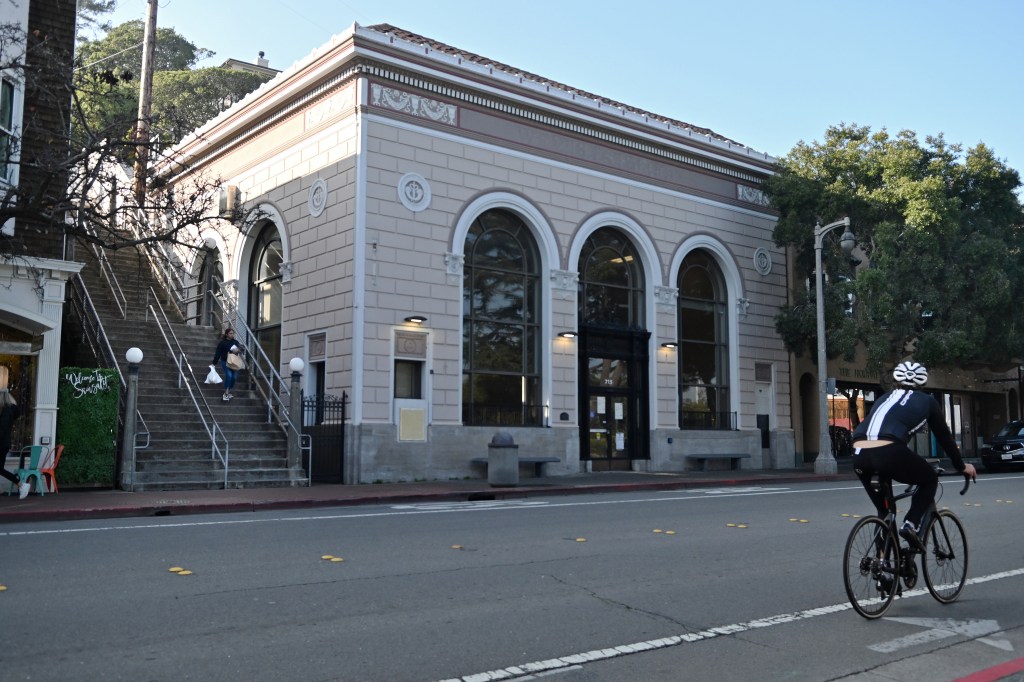
A lawsuit to stop a rooftop patio from being part of a new Sausalito hotel has been settled.
The plaintiff, Sharon Conn, objected to the patio provision in a plan to convert the old Wells Fargo bank into a restaurant and inn. Conn lives uphill from the building on Bridgeway.
Her lawyers reported the settlement Monday in Marin County Superior Court.
“The settlement achieved exactly what Ms. Conn sought — the elimination of the party deck,” said attorney Elizabeth Brekhus. “The parties ultimately found a practical solution and that Ms. Conn’s property will not be permanently burdened by an outdoor entertainment venue right at her property line.”
The developer, Kent Ipsen, declined to comment other than saying he looks forward to moving ahead.
The building will be remodeled to include a ground-floor restaurant with three hotel suites upstairs. Ipsen owns a similar enterprise in Carmel called Inn the Pocket.
The project has been controversial for more than a year. Nearby residents opposed the remodel, citing potential noise issues. Business boosters defended the project as a welcome addition in a prominent vacant building.
The Planning Commission approved the remodel in December 2024. Conn appealed to the City Council, which remanded it to the commission.
Ipsen scaled back plans for the rooftop to include outdoor seating, a viewing deck, a hot tub and two fire pits. He agreed to limit the hotel occupancy to 28 people, including overnight guests and visitors. City officials approved the plans last summer.
Conn, who has lived behind the former bank for 42 years, filed the first of two lawsuits in August.
The first alleged the city amended local zoning to benefit the project, which she said was “illegal and unconstitutional spot zoning.”
Last May, the council, acting on the recommendation of city planners, repealed the requirement that the second floor of business district buildings be reserved for affordable housing. The action came after city staff said inclusionary zoning failed to produce more housing and noted that several established businesses expanded to their second floor, placing them in noncompliance.
Conn’s lawsuit said the city “abused its discretion by changing its zoning laws for the benefit of a single development project.” That litigation was settled late last year.
The second lawsuit, the one settled Monday, challenged the project approval.
“This case was unfortunately a textbook example of what happens when a city decides it wants a project before it has finished reading its own rules,” Brekhus said.
Mayor Steven Woodside said the settlement is “simply a compromise to remove the deck feature.”
“From a design point of view, the commission and the council agreed that the deck had been modified in such a way that it was allowable,” he said. “But some of the neighbors didn’t like it.”
City planners praised the conclusion of the litigation.
“Putting a beloved but vacant landmark back to work as a destination restaurant and hotel does not just fill an empty storefront, it stitches a gap in the fabric of this community and invites people back,” said Brandon Phipps, planning director and assistant city manager.
“Our most important assets are not museum pieces,” he said. “They are living and breathing vessels waiting to be reimagined.”