
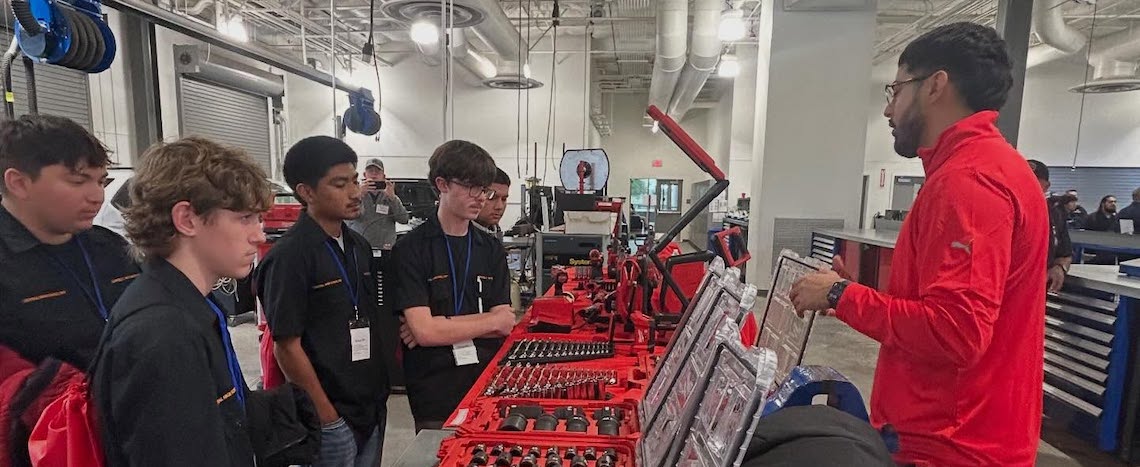
Students work on engine assemblies and vehicle systems inside Fresno City College’s Advanced Transportation Center, gaining hands-on experience in a lab designed to mirror today’s professional automotive shops. SCCCD photo
Fresno City College’s new Advanced Transportation Center is helping students prepare for a workforce feeding a nationwide technician shortage, boasting a 96 percent completion rate and graduates who arrive on the job nearly factory-certified. Students at the Advanced Transportation Center aren’t just learning how to rotate tires or change oil.
Students train on 800-volt electric trucks, recalibrate advanced driver training assistance systems, rebuild heavy-duty diesel engines and much more in a state-of-the-art facility that is designed to replicate the modern transportation industry.
The 90,000- to 100,000-square-foot Advanced Transportation Center, which broke ground in 2020 and welcomed its first full semester of students in early 2024, is nearly triple the size of the college’s old automotive facilities on the main campus.
It’s located at the West Fresno campus of Fresno City College.
Marty Kamimoto, the instructor and coordinator of automotive and diesel technology, said the expansion is more than just the square footage, noting the success the students are having in the new facility and how that ties into a rapidly changing job market.
“We’re almost three times the size of what we had before,” Kamimoto said. “And our success and completion rate is around 96 percent to 97 percent.”
The center trains over 150 students per semester across automotive, diesel, collision repair and introductory welding programs, with additional enrollment during the summer. Students move through specialized labs equipped with high-voltage battery simulators, air brake trainers and alignment systems that are capable of servicing full truck-and-trailer combinations.
In one bay, students work on servicing battery electric vehicles, including a zero-emissions truck manufactured by Volvo. Instead of traditional fuel tanks, battery packs line the chassis and students must learn how to diagnose and maintain as fleets move towards electrification.
Just as California is pushing towards a shift to more electric and advanced technology vehicles, hybrid electric vehicles, plug-in hybrids and fuel cells — those platforms are a key part of the curriculum. The program helps prepare students to work on light-, medium- and heavy-duty platforms that are powered by alternative fuels.
High-voltage safety is also an important part of training for students. Orange cabling marks electrical systems that can carry 300 to 800 volts of direct current. Before touching a live vehicle, students work on battery simulators and learn proper personal protective equipment protocols to safely disarm systems for repairs, which range from air conditioning compressors all the way to drivetrain components.
The facility also holds an Advanced Driver Assist Systems calibration unit and technology that is needed for windshield replacements or collision repairs. The system uses lasers and communication software to recalibrate lane-keep assist, adaptive cruise control and blind-spot monitoring features.
Beyond the equipment, Kamimoto, who joined Fresno City College in 1996 and is entering his 30th year with the institution, credits industry partnerships for keeping the curriculum current.
Fresno City is able to keep up with educational agreements with several original equipment manufacturers, which helps students complete factory-backed certifications before graduation. In some cases, graduates enter the workforce with 85-90 percent of required factory training already completed.
“If a service facility had to take someone off the street and train them to that level, it could cost $150,000 to $180,000 in time and resources,” Kamimoto said. “Our students show up nearly fully certified and ready to work.”
Some of the partnerships include the General Motors Automotive Service Educational Program, certified by General Motors and the Honda Professional Automotive Career Training program. Students also have access to certifications tied to manufacturers such as Ford, Toyota, Subaru and Stellantis.
Diesel technology students work on medium- and heavy-duty trucks that are aligned with industry partners that include Volvo, Peterbilt, Kenworth and Cummins. The teaching helps address a nationwide shortage that has caused strain to freight and fleet operations.
One of the many highlights for students of the Advanced Transportation Center is its tool-access model. Students aren’t required to purchase professional level toolboxes before enrolling. The college provides tools during training, and students receive discounts of up to 50% or 60% from manufacturers while they are enrolled, which helps mitigate a common financial hurdle to entering the industry.
Collision repair students are set to work in dedicated prep and paint booths that come equipped with breathing stations and sealed mixing rooms. Welding students are introduced to beginning skills with advanced fabrication and certification programs available at the main campus.
For Kamimoto, the most rewarding experience is watching former students build long-term careers. He said several graduates have returned as instructors after gaining dealership and industry experience, which he called a “full-circle” pipeline.
“They may start as entry-level technicians,” he said. “But they move up — shop foreman, service manager, even field service engineers for manufacturers.”