
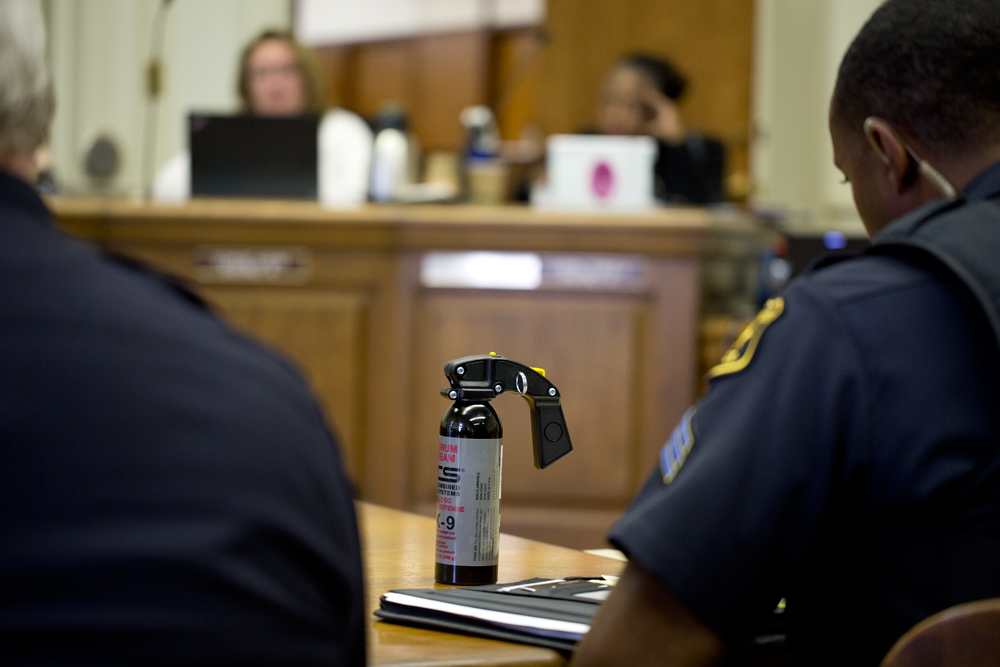
 The Berkeley City Council has rescinded a 29-year-old directive on pepper spray reports it says duplicate work police officers already do. Credit: Emilie Raguso/Berkeleyside
Berkeley police now have to file less paperwork after they use pepper spray. The City Council voted unanimously Tuesday to repeal a 1997 bureaucratic directive that the department report every use of pepper spray to the council, on top of requirements to document all uses of force elsewhere.
The change takes place in the middle of a months-long and ongoing rollback of restrictions on the department’s uses of weapons and expansion of its access to surveillance technology and other equipment.
While Berkeley Police Department officers use pepper spray only a handful a times of year if at all, several people who spoke out Tuesday said the excruciating experience of being on the receiving end of it merited the additional layer of scrutiny.
“The question we’re asking is not, ‘Will police have less time to do whatever other important work they do?’ But whether on a handful of occasions a year, officers are willing to write two paragraphs about the use of a chemical weapon,” said Nathan Mizell, a former Police Accountability Board member.
As is typical in law enforcement, BPD officers are required to report all uses of force, pepper spray included. BPD voluntarily publishes data from those reports on its online Transparency Hub. But the 1997 council directive, mandating separate “use of pepper spray reports,” predated that portal by several decades.
And while Tuesday’s vote rescinded that mandate, it did nothing to change when and how BPD officers are allowed to use pepper spray.
“The two processes run side by side and track nearly identical information, which creates extra work without adding anything meaningful to the record,” Councilmember Rashi Kesarwani, who authored the rescission, wrote in her summary.
First aid is a sticking point
The pepper spray reports were meant to go straight to the City Council within a week of an underlying incident, and required greater detail, such as whether officers render first aid. But like most of the more common use-of-force reports in California, they were not considered public records.
BPD Chief Jen Louis said her officers are already required to render first aid every time they use pepper spray. Council members asked about getting data on first aid into the Transparency Hub. Since the portal automatically populates by pulling data from officers’ use-of-force reporting system, Louis said, “We will have to check with the vendor and ask them to rework the system to allow us to have that.”
Berkeley adopted its 1997 directive after a state law the year before de-regulated the use of pepper spray, and its use expanded in California .
Compared to other types of force, Berkeley officers only rarely use pepper spray, deploying it between zero and four times per year over the last five years, according to BPD’s Transparency Hub. By comparison officers used less-lethal ammunition like beanbags between five and 13 times per year. Several unarmed uses of force — strikes, takedowns, holds — were more common still.
As an added backstop, and at the urging of the Police Accountability Board, the council ordered City Manager Paul Buddenhagen to prepare an amendment to the city’s ordinance on military equipment that will require BPD to include pepper spray deployments in its annual report on martial hardware.
Barbara Atwell, a Berkeley Friends Meeting representative, backed the PAB’s recommendation Tuesday.
“Transparency and police accountability matter,” she said during public comment. “Do not make the police use of pepper spray a secret.”
Berkeley cops are rewriting rules, seeking new hardware
That ordinance itself represents another recent paring-back of BPD’s bureaucratic oversight and administrative responsibilities. Previously, the department had to compose two similar but separate reports on military hardware, one mandated by a 2021 city ordinance, the other by a state statute enacted just five months later. Earlier this year the City Council voted to sub out Berkeley’s specific requirements for the ones the state uses, condensing BPD’s reporting requirements.
Last week, police supervisors rolled out a thoroughly rewritten use-of-force policy over the objections of the Police Accountability Board, which has asked the City Council to weigh in.
And later this month the council is tentatively scheduled to vote on a proposal to expand the city’s contract with Georgia-based Flock Safety, the vendor whose automated license plate readers are already in Berkeley, to include drones, fixed surveillance cameras and new software to link police systems.
Tuesday’s vote, and the ones scheduled for later in March, come at a particularly trying time for BPD’s civilian oversight bodies. The Police Accountability Board is down to fewer than half of its intended nine regular members plus one alternate. And the city is currently without a director of police accountability since the council fired Director Hansel Aguilar last month.
“*” indicates required fields