
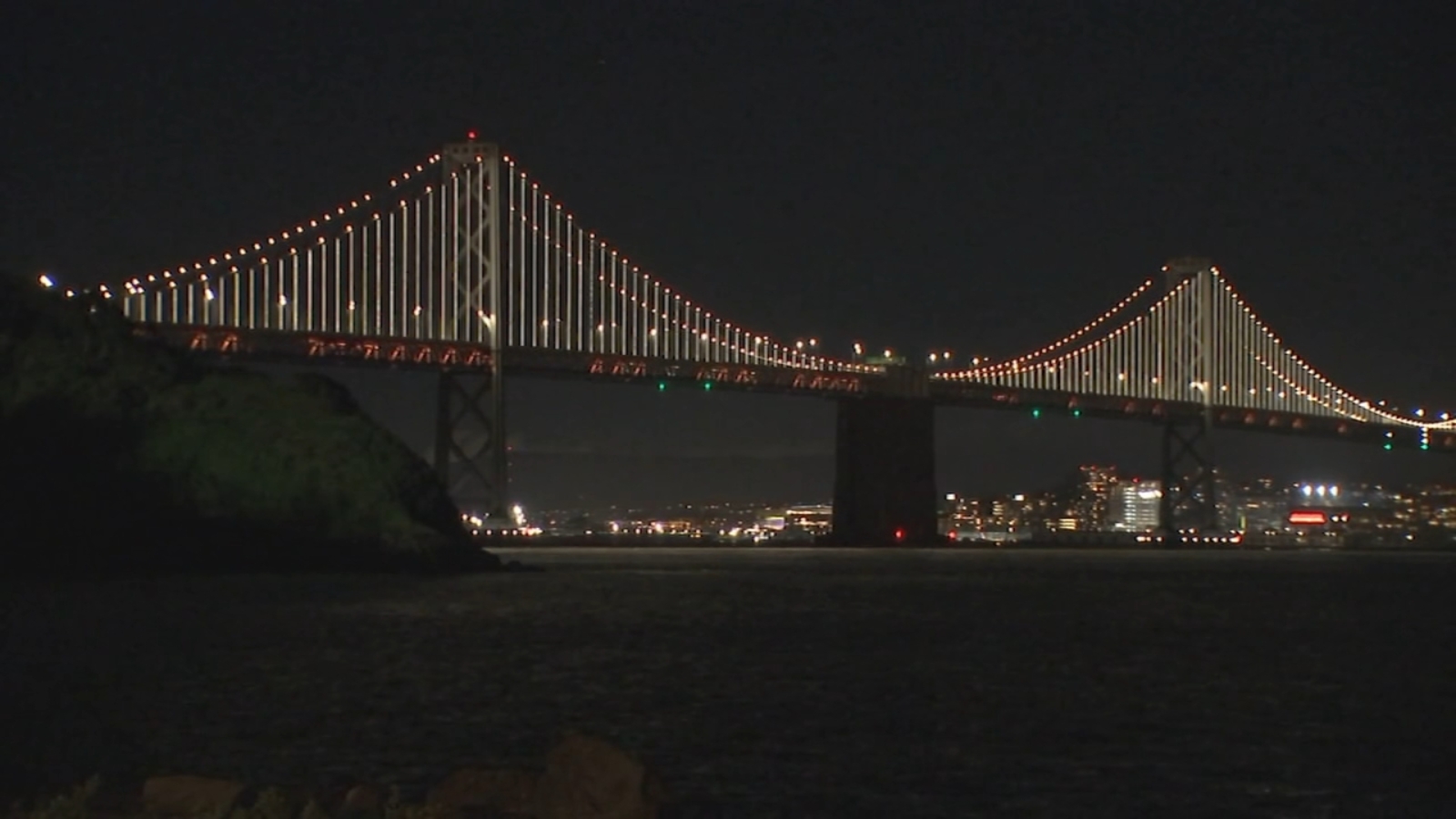
SAN FRANCISCO (KGO) — The Bay Bridge lights are back, returning with a newly-engineered LED system and a redesigned sequence of movement, with an official lighting ceremony scheduled for March 20.
Long admired by locals but often overshadowed by the Golden Gate Bridge, the western span of the San Francisco-Oakland Bay Bridge has rarely been celebrated beyond the Bay Area. That began to change several years ago, when artist Ben Davis reimagined the bridge as a massive canvas of light. Those original lights have now been replaced with a custom-designed system built to endure the bridge’s punishing environment.
“Rather than stand up to do the interview, why don’t we sit down so we can contemplate the bridge, we suggested during a conversation overlooking the span. I get the daddy chair,” expressed Davis.
Davis has often described the western span as a “Cinderella” bridge – overlooked and underloved – until the lights transformed it. “I’ve heard you say that there wasn’t much love for this bridge, which you’ve referred to as Cinderella, and when you brought those lights, you gave her a gown and people loved her,” said Davis. “So what are you giving Cinderella? Well, I guess a more durable gown, a real place in the castle. This is a really hard human challenge to create electronics that work in a really extremely difficult environment.”
That challenge includes constant vibration, wind, rain and even lightning. The new installation includes 48,000 LED lights designed and built by Musco Lighting of Iowa. The company previously provided lighting for the eastern span of the bridge.
RELATED: New Bay Bridge lights being tested, just weeks away from full comeback
“Our team at Musco put in a lot of time and effort to develop a very unique and specialized system that is going to be out in the Bay Area for the next 10 years,” said Adam DeJong, a project manager at Musco. “We’re really excited to see that happen.”
During the day, the lights are visible wrapped tightly around each suspension cable on the north side of the bridge. Crews spent three to four months installing them, working overnight between 11 p.m. and 5 a.m., suspended along the side of the span. There are two sets of lights wrapped around both sides of the cables. One faces San Francisco, while the other faces Oakland and Richmond. The second strand will be activated later, pending additional testing. Caltrans officials say they want to ensure the lights do not affect drivers’ visibility.
“We have to test those lights first,” said Bart Ney, a Caltrans spokesperson. “The original Bay Lights were in place for almost a decade. We’re pretty confident with how they performed. This new set of lights, we have to get testing protocol in place and actually go through it before we light them.”
The project is more than decoration. It is a large-scale public art installation created by artist Leo Villareal, who designed the lighting sequences using algorithms that allow the lights to move in synchronized patterns.
“And some people who may never go into an art gallery or museum can come here and see this artwork, and it really is transformative,” Villareal said. “It’s like a visual instrument in a way/ Instead of creating sound, I’m creating patterns of light.”
RELATED: Iconic Bay Bridge lights set to return in 2025 thanks to over $10 million in donations
The system is controlled by several computers housed inside the bridge’s center anchorage – the massive concrete structure in the middle of the Bay that contains more concrete than the entire Empire State Building.
The western span of the bridge is officially named after former San Francisco Mayor Willie Brown, a fact that some people are unaware of and others find difficult to accept.
The lighting ceremony will be held on Brown’s 92nd birthday.
“A lot of people will know that I’ve been lying about my age for years,” Brown joked. Brown was sent to San Francisco as a child by his mother, who believed he would be safer there than in segregated Mineola, Texas.
“I was that little boy, and I had plans,” Brown said when asked what he might have been thinking at the time. “I didn’t even know that I would see a bridge. There are no bridges in Mineola.”
The return of the Bay Lights carries an estimated cost of $11 million. Funding came largely from private donors, including philanthropist Jean-Pierre Conte, CEO of Lupine Crest Capital.
“My parents were immigrants,” Conte said. “My mom came from revolutionary Cuba, my dad after World War II. This is a special city in America, a city where people come to dream. This bridge and this light structure is going to be the heartbeat of the city and will be iconic.”
The return of the Bay Lights comes as San Francisco works through what many see as a broader recovery.
“I’m excited about the next few years,” Davis said. “It’s important for our city to not just recover but to really be a beacon of possibility and hope for the rest of the world.”
Davis calls San Francisco the city of “Awe” – AWE.

Copyright © 2026 KGO-TV. All Rights Reserved.