
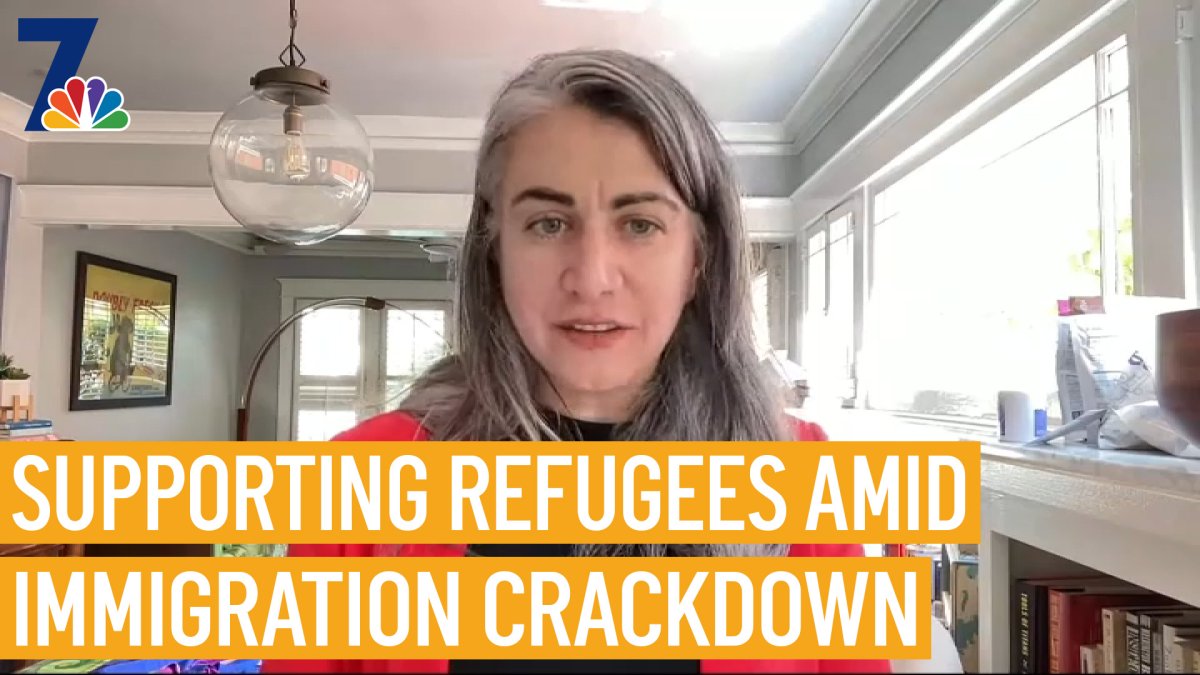
As Americans digest a daily deluge of headlines about the Trump administration’s crackdown on immigration and now the war in Iran, the CEO of a global refugee resettlement network wants to ensure policy changes impacting refugees remain in the spotlight.
Beth Oppenheim of HIAS is this week’s Politically Speaking guest to discuss how refugee resettlement has been changed over the first year of the Trump administration.
A transcript of the conversation is below.
Safchik: Immigration continues to dominate the political zeitgeist, as a showdown over ICE funding holds part of the government at a standstill. Linked to policies about immigration are impassioned discussions about refugee resettlement. And while we’ve spoken to politicians and party leaders about these issues today, we’re talking to the boots on the ground. Beth Oppenheim is the director of HIAS, one of the biggest refugee aid agencies in the world. Thanks so much for joining us.
Oppenheim: Thank you for having me.
Safchik: So this is a bit of a change of pace for us. Like I said, we usually talk to politicians. So I want to know why you think it’s important for us to hear from the ground forces, if you will.
Oppenheim: Yeah. Of course. You know, in my role as CEO of a national organization and international organizations such as HIAS, we represent both. We represent the boots on the ground, as you say, the local community organizations doing the work, meeting with people, serving people where they are and linking that to the broader discussions of immigration, refugee resettlement, both at the national and the global level. What the local folks bring to that is the ability to actually communicate what they’re experiencing, the fear, the angst, the inability to feel safe. These are things that we’re hearing directly from the folks that we work with on the ground, both here in California and around the country. And it’s important to make those voices heard, because that is what the politicians and the folks responsible for passing policies really need to be made aware of as they think about the ramifications of their decisions.
Safchik: What part does California play in this show?
Oppenheim: A large part. California is one of the largest, both obviously economies, in the United States, but also states who have resettled many, many thousands of refugees over the course of the last four decades that the refugee resettlement program, the United States Refugee Admissions Program, has been operating. HIAS has been an implementing partner of that program for those entire four and a half decades. California, right now for us is, I would say, ground zero for, being able to understand the ways in which refugees who have come here, seeking safety with the full approval and vetting of the United States government now feel unsafe and insecure, and whether or not they’re going to be able to remain, whether their families might be able to join them, and new policies that we’ve never really seen before, taking, root in a state that has been such a host and a loving place for people to go and experience while gone. We as an organization have four affiliate offices throughout the state, one in San Diego, Jewish Family Services in San Diego. And they are one of our strongest partners in being able to welcome people through the refugee resettlement program before it was stopped on January 20th, 2025. And highest really led the charge at bringing that case to court, to challenge the Trump administration’s policies on banning all refugee admissions last year. And, JFS is our really strong partner, in making sure that the refugees who are in our local communities are still able to be served. And so California has played an incredibly important role in making sure that people are still receiving the services that they need.
Safchik: How has the work that you do changed over the course of this administration?
Oppenheim: Yeah. So in a word, drastically. And also, not at all. It’s been really kind of a combination of those two things. We’ve obviously been on the receiving end of funding cuts. We have been an implementing partner of the US government, both at the National level and at the state level through, through the Department of State and through the Office of Refugee Resettlement. And that funding has either been cut or reduced. So we’ve had to contend with that reality and how it impacts the number of staff we’re able to have at local offices, such as the one in San Diego. But at the same time, our work has remained the same because we have the same, if not increased needs for the communities we serve. They still need legal services. They still need integration services or what we call services for newcomers. Job placement services. The ability to seek health care and help have people help navigate the complicated system that exists both in California as well as the many other states that we do resettlement in. And I would say the other way that our work has changed has really been, in our real responsibility as an organization, as a faith based organization, to make sure that we also invest in advocacy and the ability to do our work loudly and boldly, because that has become even more needed in an, in, administration, that has really devalued, the bipartisan, history nature of refugee resettlement. And we’ve been very clear as an organization that that’s not a position we hold. We want to be able to welcome refugees, the communities we work with want to be able to do that work, too. And so we’re continuing to ramp up that in terms of how our work has changed up until now.
Safchik: Has the notion of refugee resettlement become partisan?
Oppenheim: An interesting question. I think in some ways, immigration as a topic more broadly, not only refugee resettlement has always been a partisan issue because it has benefited one party or the other, in particular, speaking about it in a different way. And I think, refugee resettlement, which historically has had bipartisan funding, has had bipartisan support in, in, you know, Congress and at the state level as well really started to pick off as a partisan issue in the first Trump administration and has continued on that. I think one of the other things that we struggle with, is the fact that it easily can slip into a partisan issue, if the information is not accurate. Right. We deal with misinformation all the time. And that’s something that we’re really trying to debunk as an organization, but more broadly, as a community. The one thing that has really remained, not only bipartisan but nonpartisan, has been the ways in which our communities have shown up for immigrants and refugees. That is always, you know, a really warm reminder for me that things could feel political inside the Beltway or inside state legislatures. Doesn’t feel that way at the community level. People want to welcome each other, be kind to each other, employ one another, help one another, understand their lived experience. And I think for me, that remains true and remains a nonpartisan issue at the community level.
Safchik: You all are involved in a whole slew of litigation regarding immigration and refugee policy. Has that been effective?
Oppenheim: Yes. And I think, even more specifically, it’s been one of the hallmarks of HIAS’s response in this moment. We are not, I guess, wilting violets, in the face of really hard policy. We challenge policies and practices that go against U.S. and international law. We were the first organization, this past February to file suit alongside two others in a landmark case called Pacito v Trump. That challenged the refugee resettlement ban. We’ve now been in, involved in nine other pieces of impact litigation, some of which are just getting started now. That involves, what’s become known as, refugee re-interviewing. So policies within the Department of Homeland Security that are actually seeking to re-interview refugees who have already entered through the resettlement program to prove after the one year mark whether or not they are still considered a refugee or maybe should not have been admitted at all. Under that category, which is unprecedented, instilling tons of fear in the refugee community. And our litigation was done completely alongside our partners, both at the local level and at the national level, and who we couldn’t do this work without. They’re critical to making two points. One. Some of the practices of this administration go against the law and need to be challenged in court. And two, that impact litigation shows people that there’s nuance in what we’re talking about here. And court cases help people to understand that nuance, even if they may not understand it in the kind of deluge of media hits that these topics can get at any one time. So I think for us, it’s an advocacy tool as well as one that is really, hitting hard at some of the illegal practices.
Safchik: What gets misconstrued or misunderstood about the work that you do?
Oppenheim: I think, part of it is, that that work is, somehow partisan. So to go back to your question on something that’s become markedly political, you know, refugees by definition, are people who are fleeing a credible fear of persecution where they come from. And, the U.S. Refugee Admissions Program has been a program that has run for many decades, essentially following, you know, with some fluctuations, a risk, a response to the humanitarian crises around the world and with sound bites and with social media. It is sometimes hard to help people understand that that work has been going for decades and that it has been done in partnership with our government, in co-design with our government and the communities around the country, and that people have supported this program for decades. I think that’s one of the things that gets the most misconstrued. And then obviously the other, is that we are doing this without the support of the local communities who host, and who live alongside, refugees who have come from many countries around the world. One of the things that I hear in my day to day that warms my heart greatly and in pretty dark moments, is the fact that that continues to be the feeling in communities that they understand the economic contributions, the cultural contributions, and the real lifestyle contributions that refugees bring to their communities, and that they are wholly an economic and, you know, well-being value. They are people that you live alongside. And that’s something that is sometimes misconstrued in the political debates that we have about this issue.
Safchik: Let’s talk about the war in Iran. The Trump administration ended a refugee pathway for Iranian religious minorities during this time of war. What could the consequences of that be dire?
Oppenheim: And probably already are, making themselves felt inside Iran. Obviously we have less knowledge, outside of Iran, of everything that is going on inside. But as you rightly point out, the administration ended the program that HIAS ran for approximately six decades, that was resettling religious minorities from Iran, through our offices in Europe to the United States. And that was a critical pathway because it was really one of the only pathways to safety that some of the most vulnerable people inside Iran had. And a lot of people, especially here in California, who are of Iranian descent or who represent the Iranian community, have been former refugees themselves, worry about the fate of folks who do not have access to that resettlement pathway and the real life saving support that it has given to people. And so your question about consequence, really is human life, how people are not able to access protection, they’re not able to access that pathway, to a country where they might be safe and the ramifications that are dire.
Safchik: How does this conflict complicate the work that you do in the Mideast overall, not just looking at Iran?
Oppenheim: Yeah. Great question. I think, any time there is a conflict anywhere in the world, you think about this number of approximately 120 million people who are displaced around the world right now, the highest number in history. And the fact that conflict, something that drives flight, people who don’t want to leave where they live, and who may be forced to that that puts more strain on the humanitarian system that has really, been decimated by the cuts of this administration and administrations around the world who are sort of following the US model of dis investing, both financially, and politically in the plight of people who are displaced and so particularly this war that spans multiple countries, that spans, basically a continent, will only increase the pressure on those systems that are not funded robustly enough to, to help everyone who needs it.
Safchik: To wrap this all up, given the onslaught of headlines every single day. Do you think this issue of refugee resettlement has gotten enough attention over the last year?
Oppenheim: So of course I’m going to say no. And part of that is, because it is a topic, that I would say, you know, I’ve been in this sector for 25 years. And one of the things that I always say about this work, is that it is really human work. It is work that’s done, through individual stories, through communities and through, obviously, policies that affect all of those things in the noise of the current moment, the refugee resettlement issue, can get subsumed. And that has only been increasing as global conflicts, including the war in Iran, dominate the headlines. But one thing I’ll say is that it’s always a relevant story to be told. The human stories of what is going on across our country, former refugees are a part of every single community here in the United States. Refugee resettlement has been in all 50 states and has been done for many decades across many agencies. And therefore, whatever we’re talking about in the headlines today, it involves the lived experience of people who have been refugees in the past. And for me, that’s kind of what carries my passion and my work forward, is trying to get out the attention that those folks now still don’t feel safe in a country that welcomed them. And we have to keep reminding people that that really is the story of America best.