
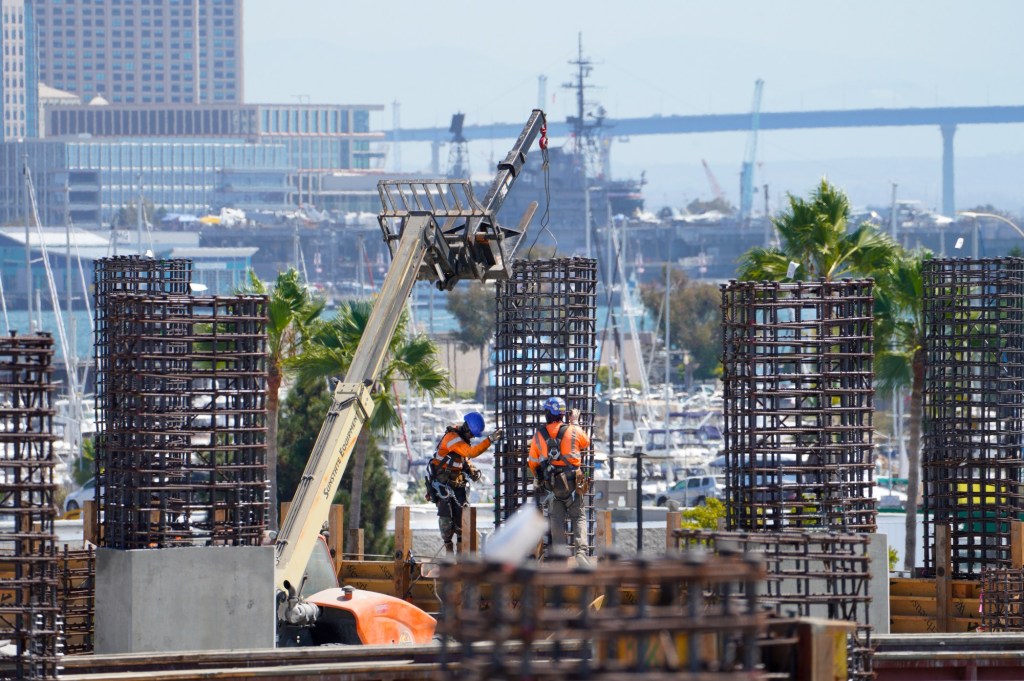
It might feel like San Diego County is constantly under construction, but 2025 was a down year in typical busy sectors.
Office, industrial, and retail construction fell from recent highs and were far below 20-year averages, said CoStar data analyzed by The San Diego Union-Tribune. Only the construction of hotel rooms and apartments was above average.
The biggest drop was in office construction, which had zero construction starts in 2025. It’s the only time there was no office space built in records dating to 1999. This comes after a particularly slow 2024, with 136,848 square feet under construction. For context, more than 3.7 million-square-feet of office space was under construction in 2006.
It isn’t just office space that had a downturn. Retail construction fell to a nearly 20-year low, with 114,456-square-feet under construction, and down 73% from 2024. Industrial construction fell by 47% from the previous year but came on the heels of several record-breaking years building biotech lab space and warehouses next to the U.S.-Mexico border.
Office vacancy hit 12.9% in San Diego County in early March, its highest since late 2011. So, it’s not surprising no one would rush to build offices as remote work trends continue. Retail is a little trickier: While there has been a bit of resurgence in brick-and-mortar shopping, most major retail projects have been refurbishing existing malls, not building something from scratch.
Still, some experts worry a downturn in previously busy sectors is not a great sign for the region’s economic health.
“Construction, to me, symbolizes growth and renewal,” said Murtaza Baxamusa, a San Diego multifamily housing consultant who served as the director of planning and development for more than a decade at the San Diego County Building Trades Council.
He said the construction industry has been good at flowing between office and multifamily building, or whatever was needed at the time. While that industry may be fine, Baxamusa said recent slowdowns in office construction (which includes biotech lab space) may be a negative economic indicator for the region. Even with remote work trends, he said office space construction is often a bellwether of economic health because it usually houses companies that contribute a lot to the region’s overall economy.
Industrial construction is coming off a surge of activity, led by the buildup of warehouse space in Otay Mesa, from importer/exporters to Amazon’s 3.4 million-square-foot facility, one of the largest buildings in Southern California. In 2020, 5.9 million square feet of industrial space started construction, by far the most in records going back to 2005. It also hit its second-highest level in 2023 with 4.1 million square feet, so no one interviewed for this article seemed particularly concerned about a slight slowdown.
Even a collapse in new office construction, and big slowdowns in retail and industrial, was not enough to shake the workforce. There were 89,718 people employed in the construction industry last year in San Diego County, said annualized state labor data. That was down roughly 500 jobs from the previous year but still within the same range it has been since 2022.
Employment in the construction industry reached a 20-year high in 2006 of 92,700, but fell to a low of 55,200 in 2011 during the Great Recession.
Despite what looks like a steady workforce on paper, industry leaders aren’t so sure. Shandon Harbour, CEO of the Associated Builders and Contractors of San Diego, said most of the time the issue the local industry faces is not a lack of jobs, but a lack of workers.
“There’s no doubt there is a shortage of workers in our industry,” she said.
Harbour’s trade association provides training and other services for primarily small and midsize contractors. She said they’ve seen an increase in Generation Z interest, which she said is driven by a desire to be free of college debt and, from the more forward-thinking prospects, to avoid work that could be eliminated by artificial intelligence.
Harbour said last year was a bit rough in the second half because of rising material costs tied to tariffs, stricter immigration controls and the federal government shutdown as contractors in San Diego are particularly reliant on military infrastructure work. Yet she said construction is picking up again and new workers are making their way through apprenticeship programs.
“We are cautiously optimistic” to start the year, Harbour said.
She noted that the national Associated Builders and Contractors has pressed Trump administration officials to create a market-based visa program for immigrants to work in the U.S. The association envisions a type of construction worker visa tied to demand, rather than arbitrary numerical cap that is in place now.
Construction work is not always captured by data collection in major sectors. Building of single-family homes, large public art installations, road infrastructure and big public projects like the new airport terminal, and improvements to old buildings would not be captured by construction starts data.
Experts said the biggest projects for the construction industry in recent years have been IQHQ’s Research and Development District in downtown San Diego and the airport’s new Terminal 1. Huge projects that have struggled to start — Seaport San Diego, a complete remodel of Seaport Village, and Midway Rising, a nearly $4 billion plan to remake the sports area site — are eagerly anticipated by the construction industry.
In the meantime, high rise apartment construction is keeping a lot of the industry busy. There are nearly 4,000 new apartments under construction in San Diego County. That’s down from 6,927 in 2025 — the region’s highest in 25 years of data — but still above historical averages. Hotel construction has also been a bright spot for the construction industry but was largely led by one massive project, the 1,600-room Gaylord Pacific Resort & Convention Center in Chula Vista.
There is also some hope for office construction, although it is the only office project in San Diego County for the foreseeable future: Swiss drugmaker Novartis broke ground in early February on a 466,000-square-foot lab facility in Sorrento Mesa.
Zach Hammond, a regional vice president of Suffolk Construction, one of the biggest contractors in San Diego County, knows the ups and downs well. His firm is the process of building, or has completed, major projects across the region: Park Boulevard Flats, a mixed-use development in North Park with 194 apartments; The Tiger Trail exhibit at the San Diego Zoo Safari Park; the 21-story Park Summit apartment building, with 241 apartments in Bankers Hill; The Joan and Irwin Jacobs Performing Arts Center at Liberty Station; and Qualcomm’s headquarters in Sorrento Valley.
From ironworkers to project managers and more, Hammond said local workers take pride in completed projects. He said there is something special about construction work in that there is a tangible result, something people who worked on these projects can share with children or friends while just walking by.
Hammond said a lack of skilled labor, higher material costs, a cutback in federal spending in some areas and a slowdown in the life science space after the pandemic surge are all concerns for San Diego County construction going forward.
He said the one big project they are all hoping will happen is Midway Rising, which would include 4,254 total residential units, a 16,000-seat replacement arena, 130,000 square feet of commercial space, 8.1 acres of parks, and another 6.4 acres of plazas and public space on 49.2 acres of land. Yet Hammond said he isn’t overly picky — he just wants everyone to keep working.
“Our next favorite project,” he said, “is always the next one.”