
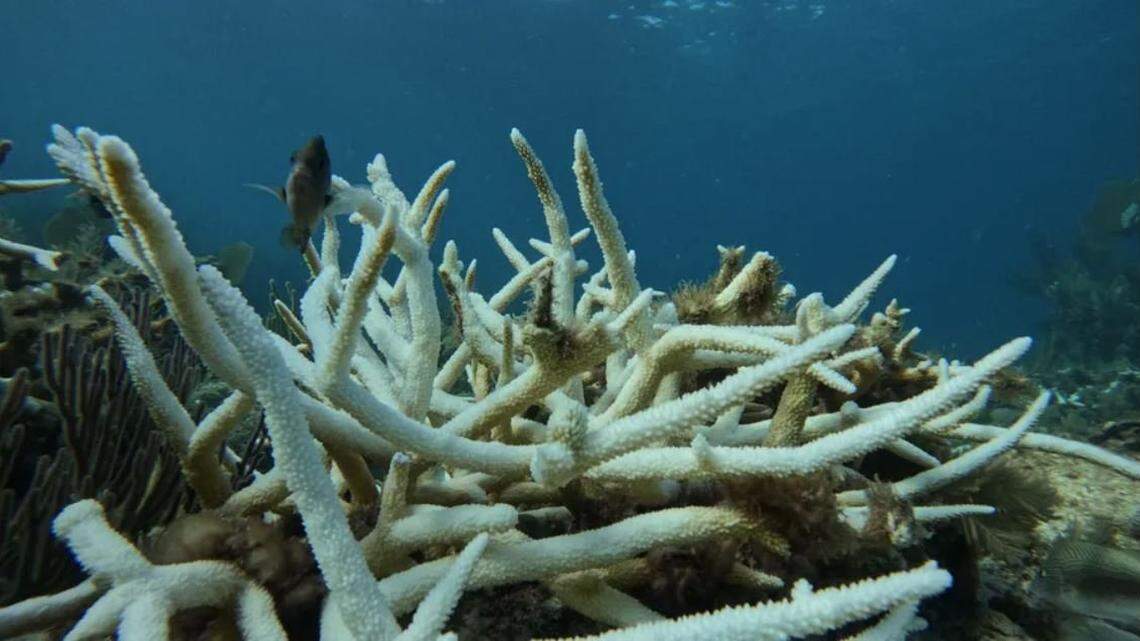

Staghorn coral populations in the Florida Keys are on the brink of extinction due to a severe bleaching event that began in the summer of 2023. On Tuesday, March 10, 2026, a California Assembly committee voted to advance a consumer transparency bill that would restrict sunscreeen products from being labeled as “reef safe” when they contains chemicals harmful to marine life.
Miami Herald file photo
California’s environmental committee legislators unanimously voted Tuesday to advance a consumer transparency bill that would prohibit sunscreen products from being inaccurately labeled as “reef safe,” “reef friendly,” “ocean safe,” “marine safe” when the products contain chemicals harmful to marine ecosystems.
Proposed in February, the Assembly Bill 1744 is co-authored by Assemblymembers Gregg Hart, D-Santa Barbara, and Dawn Addis, D-Morro Bay. Addis stressed that reefs and marine ecosystems are a vital pillar of the state’s biodiversity and economy, with coastal tourism generating about $51 billion a year — and that “manmade factors” are damaging both.
“One of the major problems is that certain chemicals that are commonly found in sunscreen are of a particular concern, because when you get in the water, they wash off your body and into the ocean,” Addis said during the Assembly Environmental Safety and Toxic Materials Committee on Tuesday.
“And these chemicals have harmed coral and other marine life by disrupting photosynthesis, damaging DNA, and causing coral bleaching,” she continued, adding that the bill would provide consumers clarity regarding the products.
While coral reefs cover just 1% of the ocean floor, about 25% of fish depend on these “rainforests of the sea.” The United Nations’ Intergovernmental Panel on Climate Change found that, due to climate change and global warming, the world could see a devastating decline in coral reefs—an estimated 70% to 90% loss—by 2050.
Specifically, the bill targets chemical ultraviolet filters, widely known as UV filters. The U.S. Environmental Protection Agency warns that these filters can go into the environment when people wearing sunscreen swim or bathe and the chemicals wash off into wastewater. The agency has found that, while their impacts on marine environments are still being studied, these chemicals are present in water and sediment, as well as in marine animals.
The National Oceanic and Atmospheric Administration found that specific UV filters chemicals “can harm aquatic life, including corals,” and notes that there are more environmentally friendly options, such as using mineral sunscreens and wearing UV protective clothing instead.
During Tuesday’s hearing, vice chair of the committee, Stan Ellis, R-Bakersfield, shared his own back-of-the-envelope calculation to illustrate why he supports the bill.
“If you take three ounces of this sunscreen and you go in the water, and suppose there are 10,000 people on the beach — that’s 30,000 ounces. That’s 937 quarts…which equivocates to almost one ton per day. That’s significant,” Ellis said.
This story was originally published March 11, 2026 at 5:32 PM.
Related Stories from Sacramento Bee

The Sacramento Bee
Chaewon Chung covers climate and environmental issues for The Sacramento Bee. Before joining The Bee, she worked as a climate and environment reporter for the Winston-Salem Journal in North Carolina.