
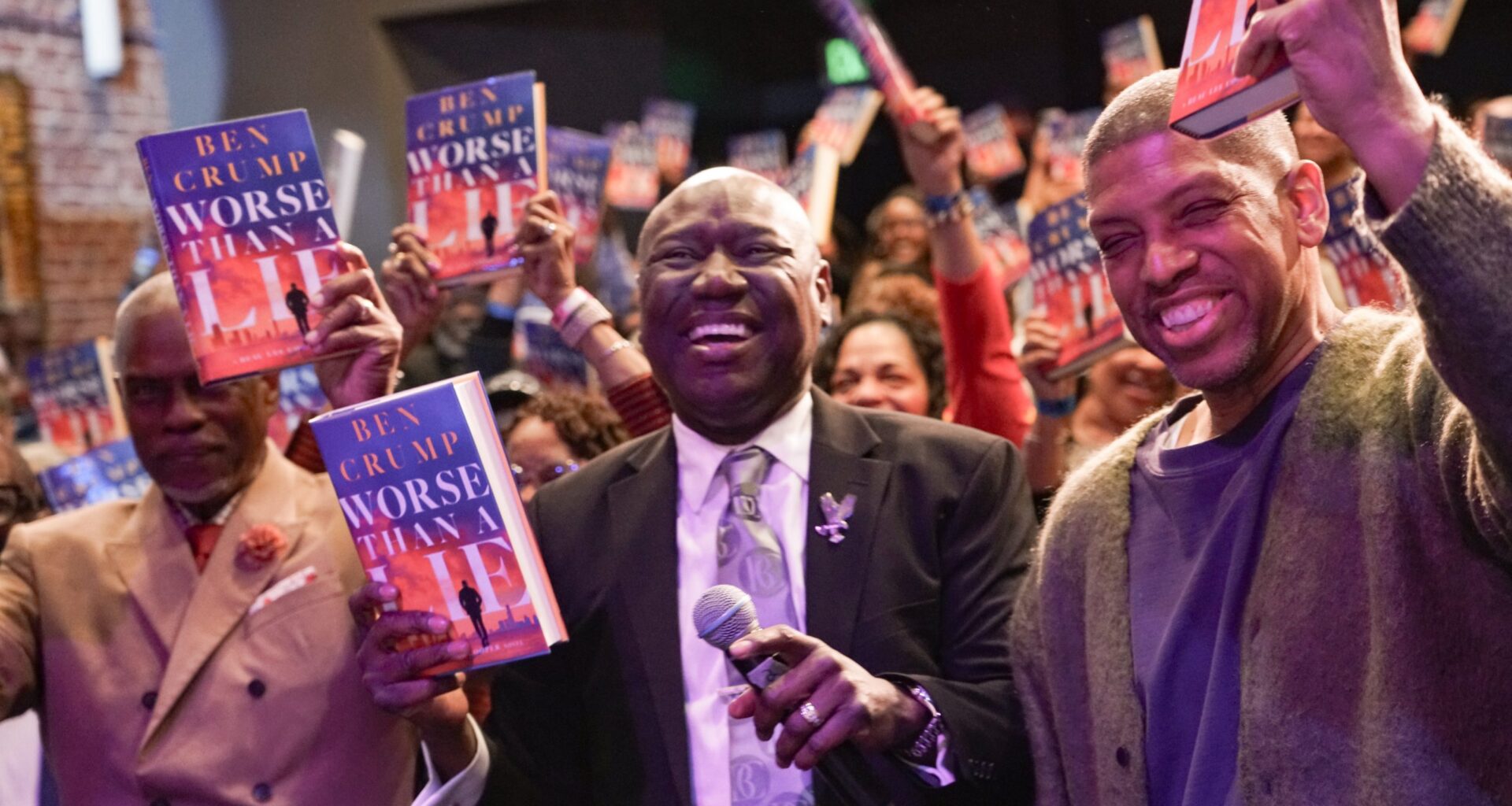
Civil rights attorney and bestselling author Ben Crump drew a standing‑room crowd to the Guild Theater in Oak Park on March 5, captivating attendees with stories from his life, legal battles, and his new book, “Worse Than a Lie.”
The event was part of the Underground Books Speaker Series and was moderated by former Sacramento Mayor Kevin Johnson, who opened the conversation by emphasizing the importance of civil rights advocacy and representation in literature.
Crump, whose legal work has spanned high‑profile cases from Stephon Clark locally to Sacramento native Tyre Nichols in Memphis, Tennessee, opened the evening by acknowledging the collective effort behind civil rights victories. “It’s never just about the individual,” he said. “It’s about all of us rising together.”
He called on lawyers, judges, and members of his fraternity, Omega Psi Phi, to stand and be recognized, reminding the audience that progress is achieved through community action.
He also honored the families in attendance who have endured unspeakable tragedies. “I got to spend a lot of time in Sacramento after the tragic killing of Stephon Clark,” Crump said, acknowledging the presence of Clark’s mother, grandmother, and brother, as well as donors representing Nichols.
Crump reflected on recent national events, including the deaths of Alex Pretti and Renée Good, U.S. citizens who were killed in January by federal immigration officers in Minneapolis during a surge of enforcement operations that has drawn widespread debate over civil rights and law enforcement accountability.
In an interview with The OBSERVER, Crump addressed the Minneapolis killings directly, saying the struggle for justice is ongoing. “We have to keep fighting,” he said. “This administration has been pretty daunting when it comes to fighting for the civil rights of marginalized citizens who’ve been killed or died as a result of excessive force. And so we have to keep fighting.”
Crump recalled something Rev. Jesse Jackson said: “‘You don’t drown because the water is deep, you drown because you stop kicking.’ We can never stop kicking. As long as we keep kicking, we will overcome. Even when they’ve got the cards stacked against you, all the odds in their favor, we just got to keep kicking.”
Crump also pointed to broader federal policy issues, affirming ongoing efforts to recalibrate or redefine qualified immunity for federal officers, which he said could change the legal landscape if implemented and would make it more challenging to hold accountable the federal officers who killed Pretti and Good.
With his debut novel, “Worse Than a Lie,” Crump told The OBSERVER that the overarching mission has been clear: “What we’re really trying to do is to inspire the next generation of civil rights lawyers and social justice warriors because it’s a civil rights legal thriller, and now more than ever in America we need to talk about the importance of civil rights.”
He acknowledged the broader context of ongoing attacks on diversity, equity, and inclusion efforts, and pointed to the decline in representation of Black professionals and civil rights lawyers as part of the backdrop against which his work takes place.
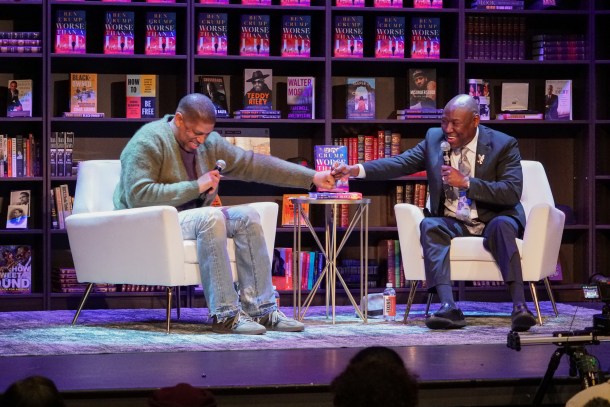 Kevin Johnson shares a light moment during the conversation with famed civil rights attorney Ben Crump. Roberta Alvarado, OBESERVER
“We’ve seen a decrease in Black professionals in general with this attack on DEI, this attack on Black history, Black literature, Black culture,” Crump said. “And so we have to do everything in our power to inspire young people to be able to overcome the efforts of the enemies of equality. That’s why I’m so proud of Mayor Kevin Johnson and the Underground bookstore because this is a beacon of light in a really dark time when it comes to uplifting the culture.”
Crump, 56, recounted how civil rights lawyer and Supreme Court Justice Thurgood Marshall shaped his path. “Thurgood Marshall might have been one of the most courageous people in American history,” he said. “He didn’t get a law degree to protect those who already had access to the Constitution. He got it to fight for those who never had the privilege of its protections. That kind of courage captivated me as a child.”
Crump shared a vivid memory of growing up in Lumberton, North Carolina, where the promise of Brown v. Board of Education remained unfulfilled for decades. “When Brown v. Board of Education ruled in 1954 that schools should integrate, in my town it didn’t happen until years later. I was 9 or 10 years old when I realized that the disparities I saw — new schools with manicured grounds on one side, dilapidated buildings and potholes on the other — were [why] people like Thurgood Marshall fought for us. I said to myself, when I grow up, I’m going to be a lawyer like him, to ensure people in my community have equal opportunities to achieve the American dream.”
Family influence played a pivotal role in shaping his worldview. Crump spoke warmly of his grandmother, whose wisdom guided him from childhood. “She’d say, ‘There’s no such thing as bad weather, only people who don’t prepare for it,’” he said. “And she would ask, ‘What’s worse than a lie? To tell the truth and have nobody believe you.’”
That lesson became the foundation of his book, which Crump said is meant to inspire young people to see themselves as capable, resourceful, and intelligent, able to fight for justice no matter the odds.
The evening included the reading of an excerpt from “Worse Than a Lie,” which Crump described as a civil rights legal thriller rooted in Black culture. The novel follows Bully Cooper, a superhero‑like trial lawyer, and his co‑counsel, attorney Princess Alvarez, as they navigate complex cases involving systemic injustice. The inclusion of returning citizens striving to rebuild their lives was intentional, Crump said, to challenge stereotypes and demonstrate that brilliance and resilience often come from those the justice system has marginalized.
 Ben Crump told the crowd that the fight for civil rights is not over and that “we all have a role to play,” inspiring everyone to do their part. Roberta Alvarado, OBESERVER
“Most of the intelligence in America is locked up in 5‑by‑7 prison cells,” Crump said, referencing a famous observation. “What if those brothers and sisters were given the opportunity to contribute to society? That’s what this book imagines, and that’s the reality we can work to create.”
He recounted a case before he gained national recognition that involved Martin Lee Anderson, a 14‑year‑old beaten to death at a Florida juvenile boot camp. Crump and his partner fought for justice even though ultimately no officers were held criminally accountable. “We learned early that the system is stacked,” he said, “but you don’t stop because the water is deep. You keep kicking. … Our people can never see leaders stop fighting, even when the odds are against us.”
He tied his legal advocacy to broader systemic issues in the criminal justice system. Crump drew comparisons between high‑profile cases, including Hollis Montrose, a Black police officer shot multiple times by white police officers in Chicago, and ongoing cases of excessive force against Black and brown Americans. “Even when there’s evidence, the system can conspire to deny justice,” he said. “The powers that be will try to manipulate perception and process. That’s why we need representation, community involvement, and the courage to speak truth to power.”
Representation, Crump said, extends not just to legal strategies but to cultural narratives. He emphasized the role of institutions such as Underground Books in uplifting voices that often are marginalized in mainstream spaces, providing powerful examples and role models for young readers and future lawyers.
The event also underscored the urgency of collective engagement. Crump spoke about the need for community participation in legal and civic processes, reminding listeners that civil rights advocacy requires collaboration across professions and generations. “We can’t let a discriminatory or racist system define a generation,” he said. “We all have a role to play — families, communities, lawyers, judges, and young people alike.”
Crump’s message was clear: civil rights are not a relic of the past but an ongoing struggle that demands courage, creativity, and collective action. “Now more than ever, we must protect Black literature, Black history, and Black culture,” he said. “We must inspire the next generation, stand up to injustice, and fight for the rights of all people. And as long as we keep kicking, we will overcome.”
Related