
With artificial intelligence firmly entrenched in all levels of academia, and as the technology continues to evolve at breakneck speeds, some teachers, whether they teach kindergarteners or graduate students, don’t have a firm grasp on the technology and its applications in their field.
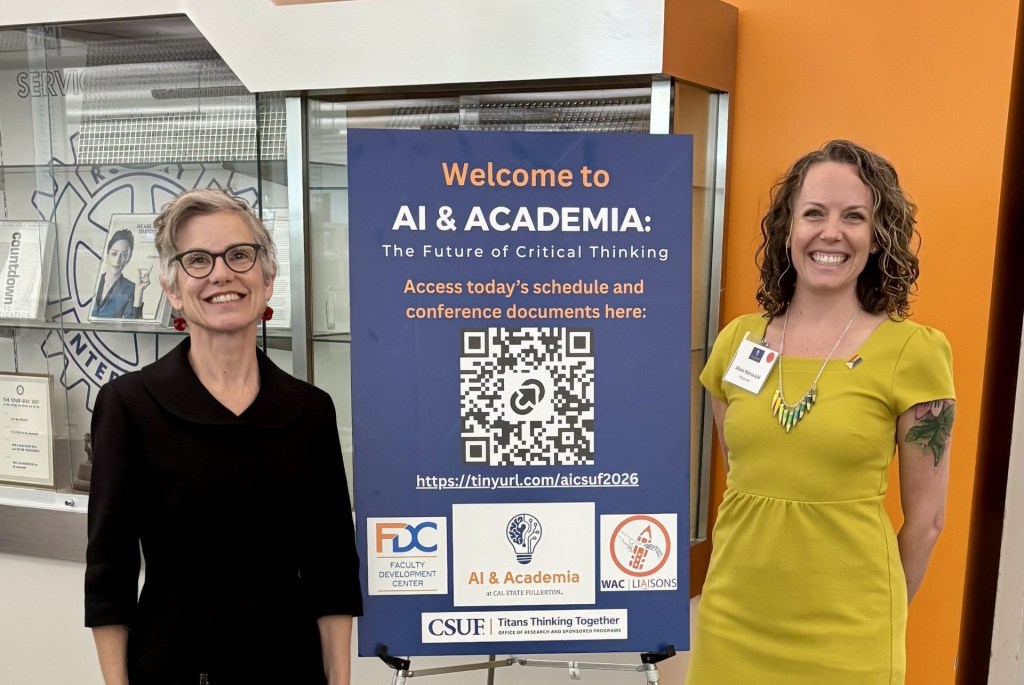
And so, for the second year in a row, educators at Cal State Fullerton organized the AI and Academia Conference.
Held Feb. 20 in the Pollak Library, the conference featured workshops, panel discussions, presentations and a keynote speaker, all designed to increase AI literacy for all experience levels.
This year’s conference, titled “The Future of Critical Thinking,” drew nearly 200 faculty from 14 California State University campuses, a significant expansion from the 2025 conference, when only CSUF faculty were invited.
The conference is beneficial because it provides the opportunity for learning and collaboration around AI, said CSUF mathematics professor Alison Marzocchi, who organized the conference with Leslie Bruce, lecturer in English, comparative literature and linguistics.
Both Marzocchi and Bruce are faculty fellows in the Writing Across the Curriculum LIAISONS Program.
“This event is the for-faculty-by-faculty event,” Marzocchi said. “So, we really wanted to get faculty across the Cal State system together to share ideas and problem solve together, present varying viewpoints and perspectives about how we’re using AI, whether we should be using AI, its impact on critical thinking.”
“I think the conclusion is that it is here to stay,” Marzocchi added. “So, what’s the best way we can use it?”
In contrast to last year, when most participants were new to AI, the 2026 conference gave faculty who had been running AI projects for a full year the opportunity to present their findings, she said.
Bruce said that the conference’s diverse sessions highlighted teaching strategies for focusing students on AI uses that are ethical and that prioritize students’ critical thinking.
Topics included Assessing AI’s Impact on “Critical Thinking,” “Ethical AI Integrations in the Classroom,” “Ethical AI Integrations Beyond the Classroom,” “Challenges and Concerns about AI on Campus” and “AI Faculty Professional Development.”
Faculty who had little or no AI literacy could once again tool around with AI in a casual setting in a session titled “Playgroup for Beginners.”
Added to the schedule for this year’s conference was a roundtable discussion titled “Connections: K-12 and the CSU,” which featured CSUF professors and administrators from the Anaheim, La Habra and Newport-Mesa Unified school districts.
The discussion was in-depth and insightful, focusing on issues and challenges faced by educators from K-12 school districts on up to educators in higher education.
The consensus among the panelists was that AI is here to stay. Students are using it and the technology is not going away.
As such, a question was presented to the panel:
If we removed AI tomorrow, would it feel like a loss, or would it feel like a relief?
“Both,” said Nancy Watkins, director of CSUF’s Educational Doctorate Program and educational leadership professor. “If it was completely gone, then I think there would be a relief, because we’re back in our comfort zone. And so that’s why I go to the other side, which is why it’s a good thing that we have it. This is evolution. It’s been around a lot longer than it’s been open to everyone. And I often say to my doctoral students, it’s going to help you go further faster, but it doesn’t replace the research you’re doing on the ground.”
Jenith Mishne, director of educational technology at the Newport-Mesa Unified School District, said AI can “level the playing field” for students whose families can’t afford a personal tutor.
“We’re in a very high economic-low economic area in Newport-Mesa,” Mishne said. “So, we have low-economic students who don’t have access. … Just the translation alone is huge. But we just have to make sure that we are teaching. Our students are using it, so we have to teach them how.”
Eduardo Perez, a computer science major, was among a group of students who participated in a student roundtable, sharing their experiences on the impact of AI on their critical thinking.
Forbidding the use of AI, instead of establishing parameters for students, would be fighting an unwinnable battle,” Perez said.
Instead, the key for professors is to develop guidelines around AI for their students.
But Perez also offered some cautionary advice for his fellow students.
“Using AI too much will slowly turn off parts of your brain you want to use as a student,” he said.