
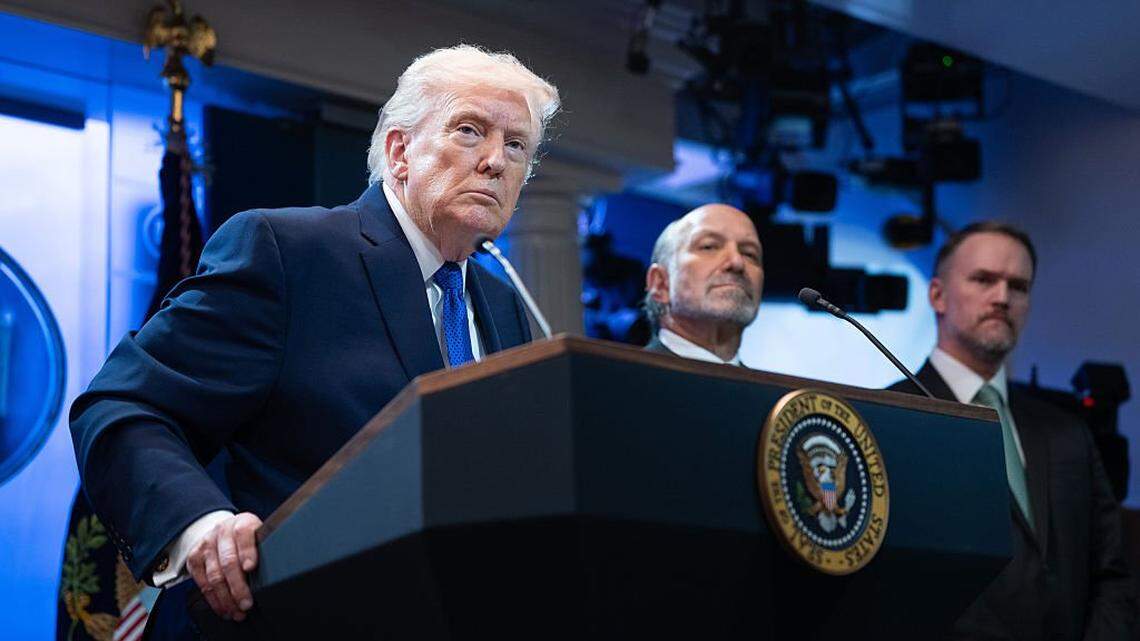
President Donald Trump answers questions during a press briefing held at the White House February 20, 2026 in Washington, D.C., after the Supreme Court ruled against his use of emergency powers to implement international trade tariffs.
Aaron Schwartz
Getty Images
Gov. Gavin Newsom and Attorney General Rob Bonta on Friday announced that California has joined 23 other states in filing a motion with the U.S. Court of International Trade, asking the court to block the Trump administration’s new global tariffs.
The development follows the lawsuit California and other states filed against the Trump administration over the new global tariffs after the Supreme Court struck down the previous “reciprocal” duties on imports.
“These tariffs are nothing more than a tax on working families — shifting the burden of Trump’s failed trade negotiations onto folks who are already struggling to make ends meet. Trump keeps throwing out illegal, reckless policies, hoping something sticks, while everyday Americans pay the price,” Newsom said in a news release.
“Trump’s tariffs were overturned by the Supreme Court, so now he’s inflicting new tariffs on Californians and all Americans like a toddler throwing a temper tantrum. Chaos is not leadership. And we deserve better.”
Trump has placed the tariffs at the center of much of his foreign policy strategy since taking office, butting heads with China and flustering U.S. allies. After the Supreme Court ruled that the president has “no inherent authority to impose tariffs during peacetime” and shot down International Emergency Economic Powers Act tariffs, Trump expressed his frustration and criticized the justices, calling them “fools and lapdogs” for the RINOs, or “Republicans In Name Only,” and the “radical left Democrats.”
According to The Associated Press, more than 1,000 companies have sued the U.S. government seeking refunds of what they paid under IEEPA tariffs. Those companies include global giants such as Nintendo, Costco and FedEx.
Trump’s frustration was quickly followed by the announcement of new global “Section 122” tariffs, which he invoked under the Trade Act of 1974. The catch is that these tariffs are capped at 15% and require congressional approval to be extended beyond 150 days.
“President Trump has inflicted illegal tariff after illegal tariff on the American people — taxes that are weighing heavily on consumers and small businesses nationwide,” said Bonta in a news release.
“Today, we ask the Court of International Trade to put an end to Trump’s obnoxious second attempt to illegally tax Americans — consumers and businesses need relief now.”
California’s clean energy sector has felt great impacts under the new administration that has moved to roll back many relatively new green initiatives from the era of President Joe Biden’s administration as well as longer‑standing international efforts.
In a February interview with The Sacramento Bee following the IEEPA tariffs removal, Andrew Campbell, executive director of UC Berkeley’s Energy Institute at Haas, explained that while the reciprocal tariffs were not the key driver of energy bills for Californians, but they were a “significant contributor” in increasing the costs of large solar projects.
“The new proposal to replace the IEEPA tariffs would just be a similar level of tariff across the board, on all products,” Michael Davison, an associate professor in the School of Global Policy and Strategy at UC San Diego said in February.
“It would have the same effect as the prior tariffs.”
Related Stories from Sacramento Bee

The Sacramento Bee
Chaewon Chung covers climate and environmental issues for The Sacramento Bee. Before joining The Bee, she worked as a climate and environment reporter for the Winston-Salem Journal in North Carolina.