
Oakland police on Friday released a highly produced, incomplete video of the mid-October incident where former NFL running back Doug Martin died in officers’ custody, raising new questions about the man’s death.
The release of the agency’s footage came in the form of a nearly 12-minute video that included only a fraction of the body-worn camera footage recorded by officers on the morning of Martin’s death. It marks the first window into how officers confronted the former NFL player on Oct. 18 and tried to subdue him, amid warnings by Martin’s family that he had been suffering from a mental health crisis.
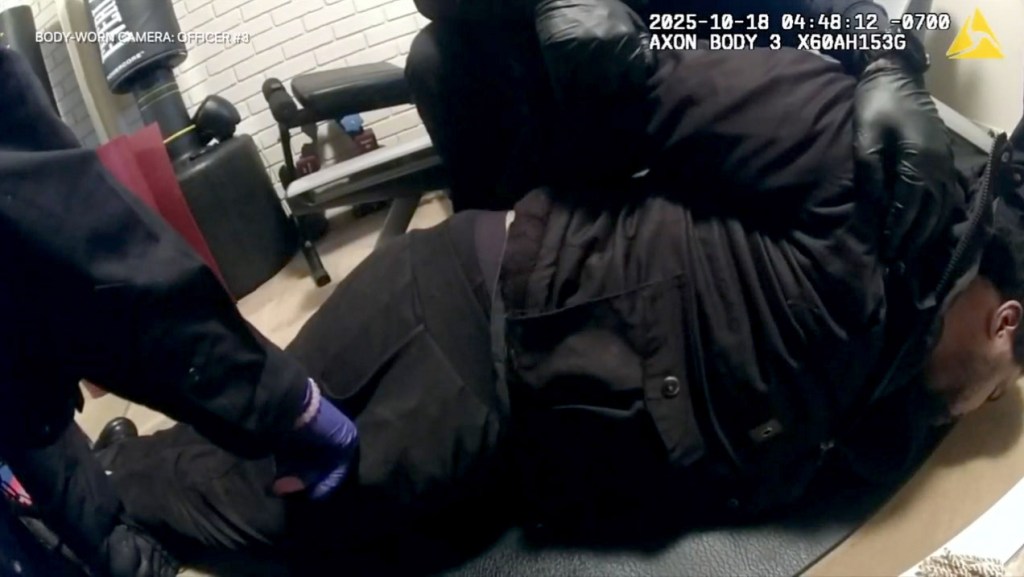
The video compilation, which includes text slides describing the encounter, includes several seconds of 911 audio as police dispatchers are alerted about a man on sleeping pills engaged in an apparent break-in. It also includes select footage of the moment when officers tackled Martin to the floor, after which the former running back stops moving and falls silent, save for a brief snoring sound.
The footage also includes several seconds of video depicting officers asking whether Martin was “playing possum” or even breathing, as he lay face-down on the floor and handcuffed. Later, he is shown being carried out of the house by officers and being placed on a gurney, where a paramedic also questions whether he is breathing.
John Burris, a civil rights attorney who represents the Martin’s family, said he could make no judgements Friday on the officers’ actions, given how little of the footage had been released.
“It’s a production,” Burris said. “They don’t have video from different angles. You don’t know how long that they were holding him down, and how they were holding him down. And certainly one of the issues that’s been raised is about the medical treatment as well — when paramedics got there, what did they do? You couldn’t really tell.”
“I’d like to know more about the first aid that was provided, how timely it was,” Burris added. “Those are legitimate questions.”
The Oakland Police Department declined to comment for this story, citing an active investigation.
Oakland Police Department refused in early December to release any footage of the incident, claiming an exception to a state law that requires its disclosure within 45 days. At the time, the agency said the incident “does not meet the definition of a ‘critical incident,’” under AB 748, the law signed in 2019 to increase public access to such footage.
The Alameda County coroner’s bureau has yet to release Martin’s autopsy or toxicology report. Shortly after Martin’s death, Oakland police said the incident would be investigated by the department’s homicide unit and internal affairs bureau, as well as the Oakland City Police Commission, the Community Police Review Agency and the Alameda County District Attorney’s Office.
A spokesperson for the DA’s office also declined to comment Friday, citing an open investigation.
Martin was one of the NFL’s top running backs a decade ago, in a career that was also marred by injuries and off-field challenges. Most recently, he had been staying in a longtime family home on the 11000 block of Ettrick Street in the Oakland hills.
Police swarmed that block around 4:15 p.m. on Oct. 18, after receiving multiple 911 calls from people living there. Audio released Friday included a seconds-long excerpt of one 911 call, where a woman reports that Martin “takes sleeping pills and he hasn’t slept for three days.”
It also included Ring camera footage from one house, where Martin can be seen approaching and yelling “I see you in there, this is Doug Martin.” He also yells the words “Tampa Bay and Boise State” — potentially referencing places where he played football in college and professionally — before adding “help me.” While continuing to shout, he is seen in the footage released Friday breaking into a window of the house.
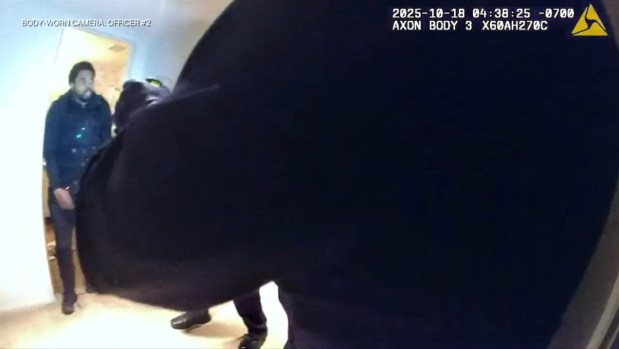 The Oakland Police Department released portions of video and audio captured during the in-custody death on Oct. 18, 2025, of Doug Martin, a former NFL running back. (Oakland Police Department)
Once inside, Martin can be heard yelling from a bathroom while officers try to coax him out. When Martin exits the bathroom, one of the officers says “we’re going to help you,” as at least two officers grab Martin and take him to the floor a few feet away, the footage showed.
There, while laying face-down, several officers gather around, including at least one who appears to be positioned on Martin’s back.
“Keep his legs down,” one officer says, while another can be heard yelling at Martin six times to “stop,” as well as to “calm down.” At first, Martin can be heard moaning or yelling, but he appears to grow nearly completely silent and still as officers handcuffed him.
About eight minutes later — as Martin continues to lay face-down on the floor — an officer inquires about Martin’s status, asking others in the room: “You think he’s playing possum?”
“I don’t know,” an officer says in one video snippet, while others can heard recounting how Martin “was like wild, wild, wild,” and “ran straight through that fence.”
“So he could just be tired,” an officer adds.
At that point, an officer checks Martin’s neck for a pulse, after which a noise resembling snoring can be heard on the video footage.
About 14 minutes after officers handcuffed Martin, officers are seen on the video footage carrying Martin out of the house, because, police said, the paramedics’ gurney could not make it inside the home. Outside, someone notifies a paramedic that Martin may have been using sleeping pills, after which the paramedic responds “OK, well, I guess that’ll make it easier.”
At that moment, someone can be heard on the footage asking whether Martin is breathing. One paramedic can then be seen checking Martin’s pulse.
It remains unclear from the footage released Friday exactly when Martin stopped breathing. Authorities have previously said he was declared dead at a hospital.
Burris said Friday that Martin’s family commissioned a second autopsy, which has yet to be finalized. He said he also has yet to receive the county’s autopsy or toxicology report.
Burris also said he is awaiting the results of tests by a Boston clinic that is examining whether Martin suffered from chronic traumatic encephalopathy. The degenerative brain disease, often known as CTE, can cause erratic behavior, is associated with repeated head trauma and has been found in hundreds of former NFL players in recent years.
On Friday, Martin’s mother, Leslie Martin, said that she had yet to view the footage. She said that “it’s clear he was struggling from these mental health issues, and that he was having a psychotic moment.” She added that the family had been “trying to get him help.”
“He was a very loving person, a very giving man, very earnest,” she said.
Jakob Rodgers is a senior breaking news reporter. Call, text or send him an encrypted message via Signal at 510-390-2351, or email him at jrodgers@bayareanewsgroup.com.