

If it sounds like you are talking to a chatbot when you call the Sheriff’s Office non-emergency line, good catch. It likely is one.
Earlier this month, the department launched a system using artificial intelligence to route non-emergency calls to the appropriate person while allowing 911 dispatchers to focus on true emergencies.
All 911 calls continue to be answered by dispatchers.
There were more than 300,000 911 calls into the Sheriff’s Office last year that dispatchers had to answer, along with the nearly 400,00 calls into the non-emergency line.
Now, instead of having a non-emergency caller wait for a 911 dispatcher, AI answers the phone right away, tries to discern what a caller needs, and then routes the call in that direction if it can. It’s the same thing a 911 dispatcher would do, but without the caller waiting around for a dispatcher to become free, the department says.
“All public safety agencies are trying to figure out how do we utilize technology to provide a better experience and be able to get services to people faster,” said Jeff Hebert, the Sheriff’s Office’s communications coordinator.
People call the department’s non-emergency number for a multitude of reasons, perhaps to ask about concealed weapons permits or report a barking dog or a car break-in, or maybe to find out how to put money in a loved one’s jail account.
Hebert said the AI system interacts with the caller, taking their entire statement into context rather than listening for keywords. It may ask follow-up questions in its quest to get the caller routed to the right spot — likely to a real person, which he said is the goal.
Routing it away from emergency dispatch has a benefit. “That frees up the lines, which means callers who do need to talk to a dispatcher are going to be talking to them much quicker,” Hebert said.
A week in, the Sheriff’s Office said, almost 20% of the non-emergency calls since the launch were diverted from 911 dispatchers. Sheriff’s Capt. Nathan Rowley, who oversees the dispatch center, said diverting those non-emergency calls helps dispatchers be more “rested and available.”
When the AI — which also understands multiple languages — doesn’t know what to do with a call, it puts the caller in a queue to wait for a 911 dispatcher to pick up.
Last Tuesday, callers to the non-emergency line who were routed to the 911 dispatchers were on hold an average of 128 seconds, just over two minutes. That same day a year ago the average hold time was 211 seconds — about 3½ minutes.
The department is also creating a team of 10 people who will work from home to answer non-emergency calls. Once that team is in place later this year, Hebert expects nearly half the calls to the non-emergency line will be diverted from 911 dispatchers.
Hebert initially balked at the idea of having non-emergency dispatchers work from home. Then he spent the day with a policing agency in Colorado that has implemented such a program. “By the time I was done, I’m like ‘We need to do this,’” Hebert said.
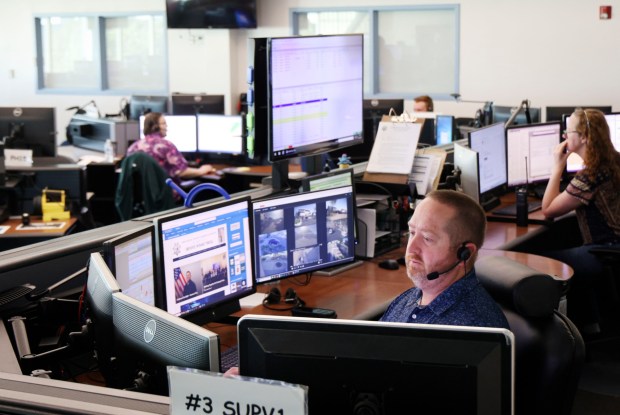 911 operator J.J. Buie works the floor at the Sheriff’s Office Emergency Response Center on Wednesday. (Sandy Huffaker / For The San Diego Union-Tribune)
The newly created work-from-home dispatcher job pays less than a state-certified 911 dispatcher job, but the training is shorter and it doesn’t carry the intensity of taking 911 calls.
Most departments across the country face a shortage of dispatchers. The Sheriff’s Office has spots for 115 dispatchers, with 17 openings — although this new lower classification will account for 10 of those open spots.
Hebert says it cost about $50,000 to get the AI system going, and it will cost $150,000 a year to run it. That money is coming from the department’s technology budget. All calls are recorded (that was true before the AI was launched) and transcribed. The department owns the data.
In prepping the new system, Hebert said, the AI was taught colloquialisms a local caller might use, such IB instead of Imperial Beach, and neighborhoods such as Casa de Oro or Mount Helix. It also knows neighborhoods outside the sheriff’s jurisdiction, because locals tend to say Point Loma or Mission Valley instead of San Diego.
One surprise as they built out the program was just how often people called the Sheriff’s Office when they really needed the San Diego Police Department or some other outside agency. With AI, Hebert said, the caller can be quickly routed to the right outside agency.
Hebert said some people are game to talk to AI and even thank it when it helps them. He acknowledges that a few callers become frustrated when they realize they are talking to a bot. Those who want to talk to a dispatcher can ask to do so, although they do have to wait in that holding queue.
Hebert said he looked into several companies offering AI until he settled on Hyper, a company also works with the Toronto Police Department, which just launched an AI service last month. “It’s very much like a partnership,” Hebert said of working with Hyper.
Hyper co-founder and CEO Ben Sanders said that over the last few years, AI technology “has been getting better and now it’s really ready for prime time.”
He said AI is used in just a tiny percentage of the 911 dispatch centers in the U.S. and Canada, but a shift may be looming. Last year, he said, officials at dispatch centers seemed to see the AI program as “kind of neat” and “intriguing.”
“Now it’s like, ‘Oh, we hear it’s working for all these other agencies. We want it, too,’” Sanders said.
Rowley, who runs the dispatch center, was explaining the new AI system last week when he paused to praise the 911 dispatchers, “the forgotten first responders.”
“Without them,” he said, “none of this works.”
The Sheriff’s Office non-emergency line is 858-868-3200. Call 911 for emergencies.