
Read Mission Local often?
Help grow our newsroom, joining the 3,250 readers who support us by giving below.
On a late February morning, a group of fourth graders from Moscone Elementary School in the Mission District stepped off a yellow school bus and entered a Bayview warehouse filled with books.
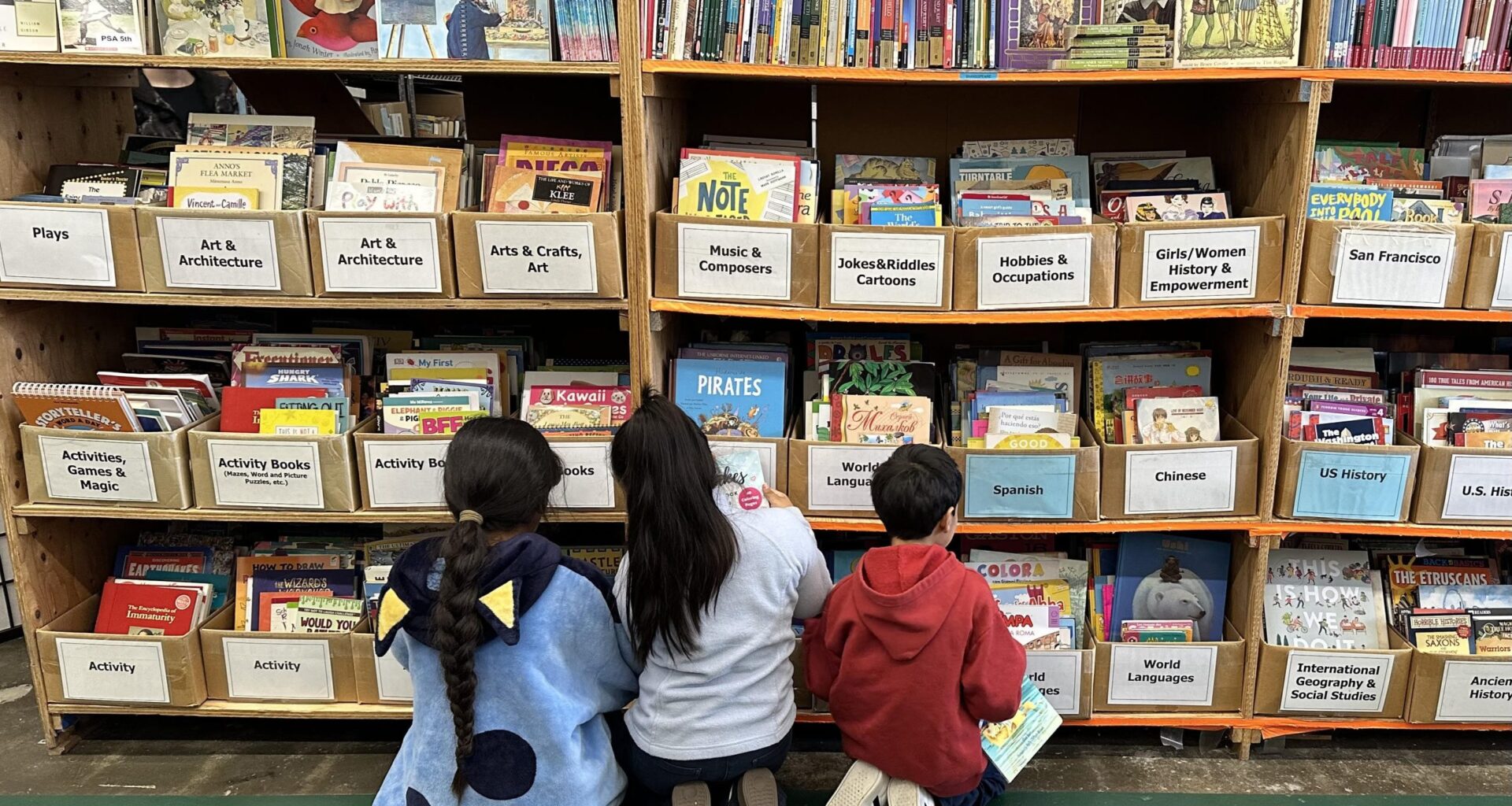
Inside, dozens of shelves loaded towered over the children. Organized into more than 90 categories throughout the warehouse, they held everything from picture books to novels, history books, anime, animal books, and a number of titles focused on social-emotional learning.
“Welcome to the Children’s Book Project,” said Alessandra Argüello-Recinos, as the wide-eyed children took in their surroundings. “Do you guys love reading as well?”

Want the latest on the Mission and San Francisco? Sign up for our free daily newsletter below.
A few children whispered yes.
“If you don’t like it yet, you’re probably going to find today the perfect book that will make you a reader,” she said, explaining that each student will be able to choose five free books to take home and keep.
Argüello-Recinos has been working at the Children’s Book Project since September 2021. This program, called Storytime, was designed for elementary schools with children of low-income backgrounds. On these field trips, students have the chance to listen to an author read their book, receive a signed copy, and then choose five books to take home.
Since the Children’s Book Project was founded by reading specialist Vicki Pollack in 1992, the organization has given away more than 3.4 million books to children from under-resourced communities in San Francisco and 37 other counties in California. Educators visit the book bank to fill classroom libraries or gather books for students who don’t have any.
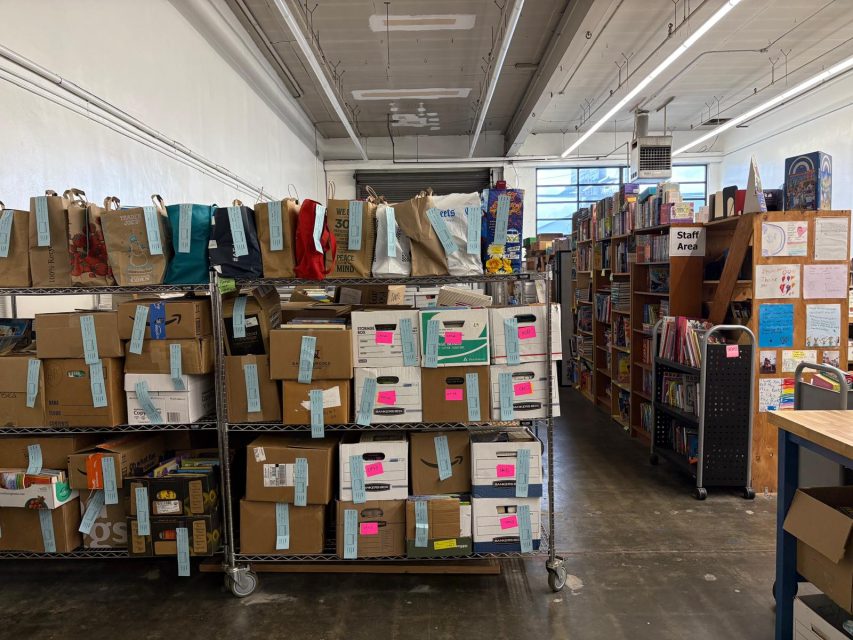 Donated books are stored in the back of the warehouse before being categorized and added to the book bank. Photo by Alice Finno.
The children sat on the carpet at the end of the warehouse to listen to local author, Gennifer Choldenko, read from her new book, “Dogtown,” a story about stray dogs and robot dogs in a shelter waiting to be adopted. The idea grew out of her friendship with her co-author, Katherine Applegate, and their shared love of dogs, Choledenko told the children.
“I actually wrote my first story in third grade,” she said, encouraging the kids to pay attention to what they are interested in, as that might be a sign of what they want to do when they grow up.
The book bank is only open by appointment, about 12 to 15 hours per week, said Risa Schwartz, the Children’s Book Project’s president, but the 3,750-square-foot warehouse isn’t the only place where they have books. The nonprofit also places books in areas they deem “book deserts” where children might not have access to them, including public housing, clinics, community centers and laundromats.
As soon as Choldenko finished her remarks, the students got to spread out across the warehouse, scanning shelves and pulling books down with excitement.
One of the boys asked for scary books, another was searching for books with jokes. “Do you have books about pandas?” a girl asked.
The children who finished their selections slowly went back to the carpet and started reading the books they picked, showing their classmates their finds.
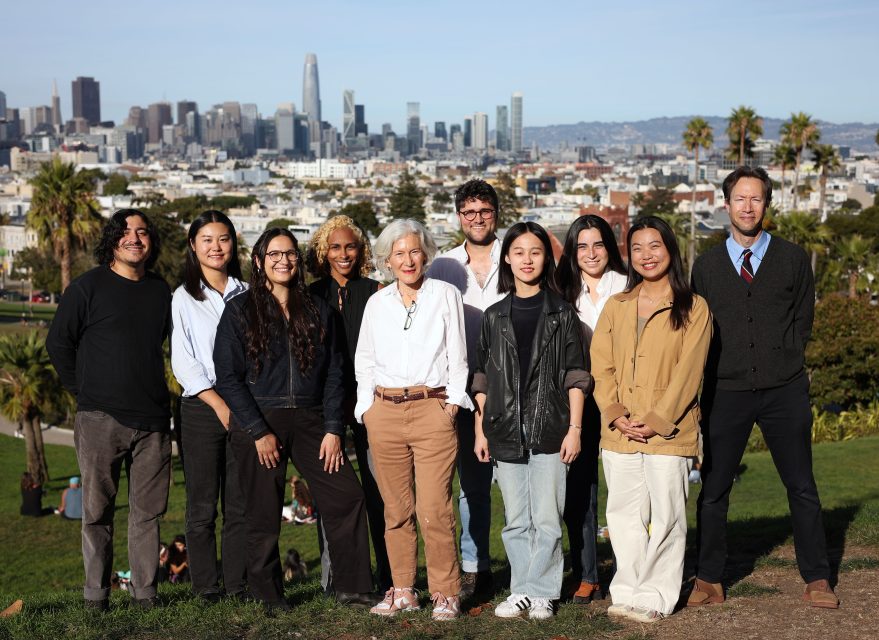
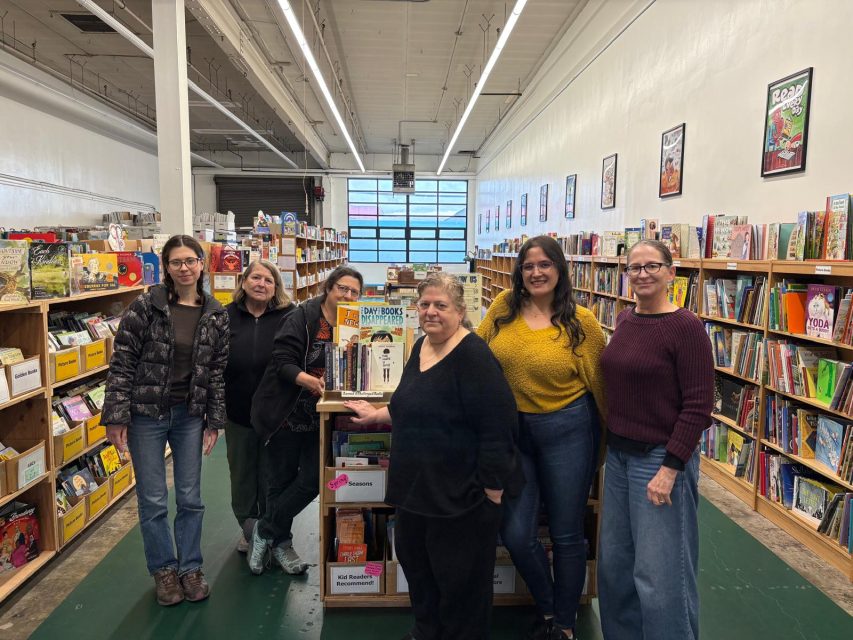 The staff of the Children’s Book Project in the Bayview book bank. Photo by Alice Finno.
Starting small and growing through crisis
The Children’s Book Project has five part-time staff members — including some who speak Spanish and Mandarin to help visitors looking for books in those languages — and more than 100 volunteers. It wasn’t always this big: It started as a one-woman operation back in 1992.
For years, Pollack, the founder, gave away millions of free books. She stacked them in a friend’s garage and ran the project by applying for grants and building a loyal group of donors who continued giving for decades, Schwartz explained. In 2003, Pollack moved the Children’s Book Project from the garage to a leased space on Napoleon Street in Bayview.
She continued running the organization until late 2013 when her husband had a stroke and the landlord tripled the rent at the Bayview location, which led Pollack to consider closing the nonprofit, Schwartz said.
But a small “kitchen table” group formed to save it. Pollack invited a few people to her house to sit down and figure out the project’s future, Schwartz recalled. Among the people who joined were Annelise Goldberg, a public health doctor who had been bringing books from the Children’s Book Project to the clinic where she worked for years, and her friend Risa Schwartz. The two decided to take the lead and became the treasurer and president of the nonprofit to keep the Children’s Book Project alive.
Goldberg and Schwartz said the group was able to find a free space to use — a decommissioned school in the Outer Sunset called the Francis Scott Key Annex — and with the help of teachers and librarians, moved hundreds of thousands of books there.
“For six years, we were out there with no heat and a skunk in the basement,” Schwartz said.
When the annex was repurposed to build teacher housing, the Children’s Book Project had to find a new home again. The organization moved back to the Bayview District, into a commercial warehouse space at 2166 Palou Ave., where it’s currently located.
“It saved the project to have those years of not paying rent,” Goldberg said. “But when we came back to this area, a lot of people who hadn’t had an easy time using us were able once again to use us.”
It’s in this new location that the group started the Storytime program. Now children can come to the warehouse and roam the shelves looking for books they like.
“Studies are showing that kids who do not have books in the home and are not hearing books read to them enter kindergarten so far behind. And we’re talking about low-income kids whose parents can’t afford books,” Schwartz said.
According to a 2019 study, children from literacy-rich homes hear 1.4 million more words during storybook reading in the five years before starting kindergarten than children who are never read to.
“We will do everything we can to not close this. This is a treasure,” Schwartz said, adding that donors and volunteers played a key role in keeping the project open.
Melanie Mickelson, Pollack’s daughter and a public school teacher, highlighted how important the project has been for educators who often feel like they don’t have enough resources. “The book project welcomes people with open arms and gives them what they need,” she said.
Mickelson saw her mother start the Children’s Book Project when she was just eleven years old and has witnessed firsthand the nonprofit’s impact. “People will leave in tears sometimes because they’re so excited and they feel like they can do their jobs.”
As students from Moscone Elementary School were getting ready to leave the book bank, Argüello-Recinos said she wanted to ask them one last question.
“If you have a book that you think you’re going to maybe take home and read right away, raise your hand,” she said, and a wave of hands went up right away.
Join the 3,300 readers who keep Mission Local free for all!
Because of you, Mission Local reached and surpassed our $300,000 year-end fundraising goal. All we can say is thank you.
Thank you for choosing to invest in a local newsroom rooted in San Francisco’s communities — one that listens first and reports deeply.
If you haven’t yet had a chance to give, it’s not too late to be part of this community. Your contribution today helps sustain the reporting our city relies on all year long.
We’re grateful you’re here — and we’d be honored to have you join our donors.