
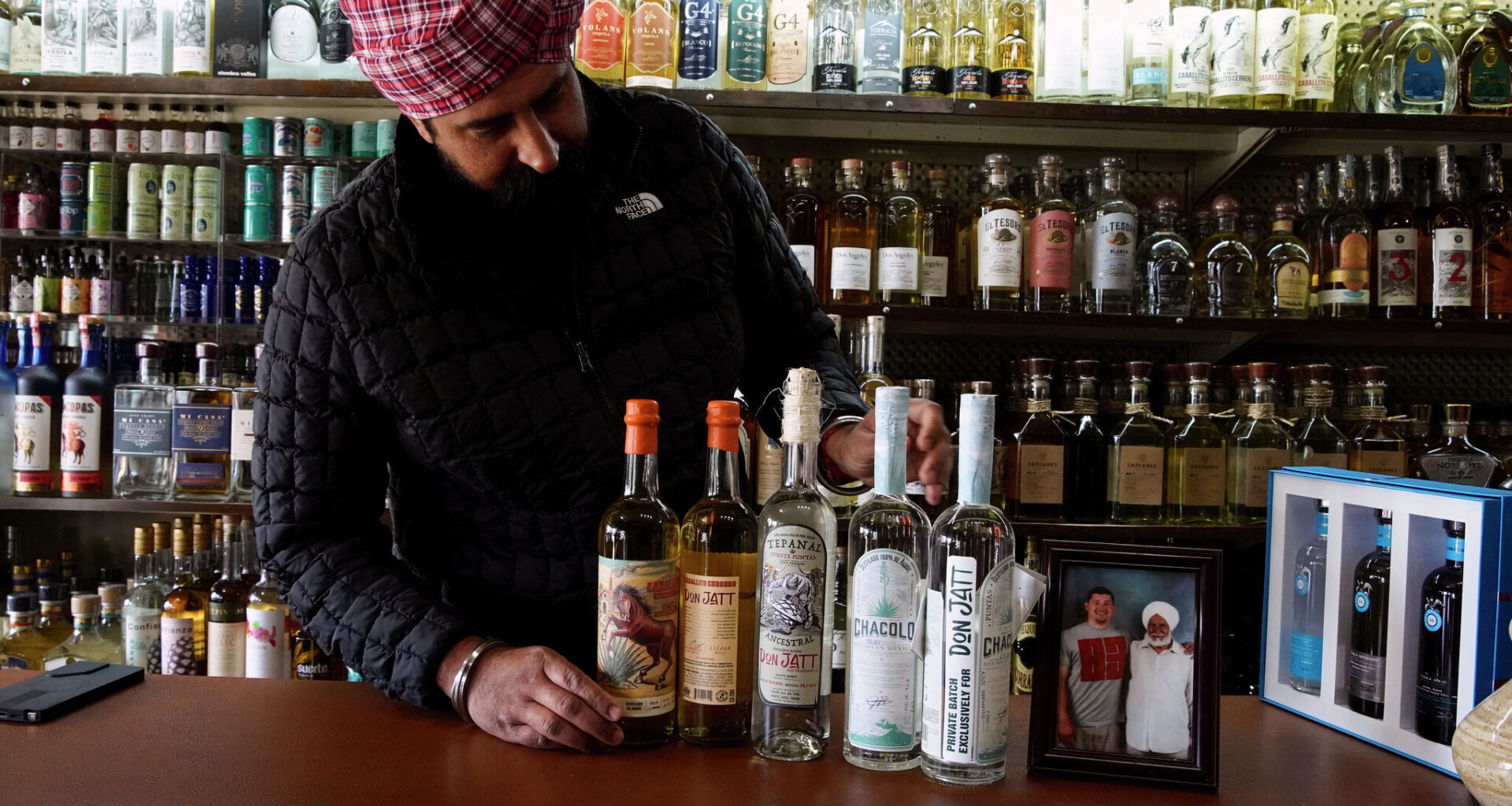
Amandip Singh Malhi, known as Moose, gathers tequila bottles in his store in San Francisco.
Giselle Garza Lerma/S.F. Chronicle
San Francisco Tequila Shop carries more than 2,000 bottles of agave spirits.
Giselle Garza Lerma/S.F. Chronicle
Amandip “Moose” Singh Malhi opened the tequila shop in Bernal Heights in 2023.
Giselle Garza Lerma/S.F. Chronicle
Davinder Singh Malhi with a framed photograph of Ernesto Sanchez (left) and his father, Nirmal Singh Malhi (right).
Giselle Garza Lerma/S.F. Chronicle
Despite the rarity and expense of some of its offerings, San Francisco Tequila Shop still operates like an everyday liquor store in Bernal Heights. “I don’t care if you’re buying a couple Modelos or a $100 mezcal, I am going to treat you exactly the same,” owner Amandip Singh Malhi said.
Giselle Garza Lerma/S.F. Chronicle
In retail, as in life, looks can be deceiving. I’m inside a corner liquor store on Cortland Avenue, at the top of Bernal Heights. At first glance, it is not unlike any of the hundred or so others throughout San Francisco: On the front windows there are signs for Fat Tire Ale and Sierra Nevada Brewing Co., along with a glowing neon Bud Light.
A guy in a Hi Vis vest walks in behind me and pays cash for a couple of Tecate tall boys. I wonder if he knows he’s in one of the best agave bottle shops in America, home to an impressively vast collection of spirits from Mexico, including mezcal, sotol, raicilla, and uncertified “distillado de agave,” as well as a deep bench of rare and sought-after tequilas befitting the establishment’s nom de booze: San Francisco Tequila Shop. Revered bottles that cost as much as $200 or more fill the shelves, including the likes of Cascahuín, Caballito Cerrero and Fuenteseca, with top-flight añejos (tequilas with extended aging) well represented. The store carries more than 2,000 bottles in total, including a couple dozen vintages of Mexican wine.
In some ways, San Francisco Tequila Shop reminds me of a multi-roaster specialty coffee bar like San Francisco’s Coffee Movement, or a curated beer bar like Toronado, shining a light on artisan producers and expanding the context for agave spirits while representing the vastness of the category. Locally, word of mouth has spread thanks to the shop’s packed out events and weekly tastings. But the outstanding online store, with impossibly tiny production bottlings from venerated mezcal labels such as Mezonte, Chacolo, Tepanal and Pasión Ancestral — for agave heads, these names are like Ridge or Arnot Roberts for wine enthusiasts, or Ritual and Hydrangea for coffee geeks — has made it the subject of growing national acclaim through websites like MezcalReviews.com and the dedicated r/mezcal Reddit forum.
Article continues below this ad
San Francisco Tequila Shop is owned and operated by Amandip Singh Malhi, who goes by “Moose.” He opened it in 2023, but its roots stretch back to the 1990s, when his father, Davinder Singh Malhi, co-founded Sharp’s Liquors Premium Tequila in Modesto, one of the first agave-focused liquor stores in the country.
Besides tequila, San Francisco Tequila Shop store is home to a vast collection of agave spirits from Mexico, including mezcal, sotol, raicilla and uncertified “distillado de agave.”
Giselle Garza Lerma/S.F. Chronicle
“My father came here in the mid-’80s,” Moose said, “and like a lot of Sikh immigrants, he moved to a part of America to work in agriculture.” In the Central Valley, Davinder, who went by David, worked on farms. He met other laborers, building relationships with immigrants from around the world. After a few years, the Singh Malhi family, in partnership with another family, led by father-and-son duo Jesus and Ernesto Sanchez, bought farmland. Many of the workers that the Singh Malhis and Sanchezes met in the fields became laborers on the new multi-family plot.
San Francisco Chronicle Logo
Make us a Preferred Source to get more of our news when you search.
Add Preferred Source
“During the harvest season, people would come and camp around our farms,” Moose said, “and bring up plastic jugs of tequila and mezcal. Our working days were from around 5 a.m. until noon, and after that it’s all about socializing, barbecuing, hanging out and comparing spirits.”
Article continues below this ad
The agave expressions shared with the Singh Malhis were as varied as the regional cuisines being cooked out back, and Jesus Sanchez traveled regularly between the Central Valley and Jalisco, bringing back bottles and forging expertise along the way. The exposure couldn’t help but rub off on David, who developed a keen interest in Mexico’s distillation culture.
Amandip “Moose” Singh Malhi and his father, Davinder Singh Malhi, who got the family into the spirits business in the ’90s, inside of San Francisco Tequila Shop.
Giselle Garza Lerma/S.F. Chronicle
Eventually, the Singh Malhis and Sanchezes opened Sharp’s, which was primarily dedicated to tequila and served customers who lived in the Central Valley. “Back then, in the ’90s, these spirits were still looked down upon,” said Moose, who grew up in the store alongside Ernesto Sanchez and an extended family of friends and co-workers. This meant Sharp’s was on an island in terms of the prevailing liquor trends of the day. Or perhaps it was merely early: No alcohol category has grown faster in the 21st century than tequila and mezcal — from $1 billion in annual sales in 2003 to $6.7 billion in 2024 — with sales now outpacing both bourbon and rum, and threatening to overtake vodka.
Modestly priced unit shifters (Jose Cuervo, Don Julio) and celebrity-endorsed brands (Casamigos by George Clooney, Dos Hombres by the stars of “Breaking Bad”) have driven a significant amount of sales. But at the top end of the category, bottlings from master mezcaleros at cult brands are followed with the fervor once reserved for craft beer or single-origin espresso. With growth and expansion comes specialization, and this is where San Francisco Tequila Shop shines. Sharp’s was sold in 2021 and Moose opened it two years later. “I wanted to call it ‘SF Tequila Shop’ because that felt like the big city to me,” he said. “Right off the bat it makes you look like a real shop with a name like that, you know?”
Still, sales were slow at first. “In our first year we did more talking than selling,” Moose said, “and the neighborhood got to know us.” This is why Tequila Shop still functions as a local liquor store, even as it moves $100 bottles of mezcal. “When we took it over, I had these customers who were in here every day,” he said. “These are my neighbors now, and I’ll get them anything they want.”
Article continues below this ad
The connections forged at Sharp’s with the distillado community in Mexico helped Tequila Shop gain access to major figures in the craft spirits scene. When the acclaimed maestro tequilero — a term used for the person who makes tequila, roughly equivalent to brewer or roaster — Felipe Camarena visited the shop to present his brand G4, a name as famous among tequila fanatics as Russian River Brewing Company is for craft beer lovers, the shop was packed shoulder to shoulder. “We had people drive in from as far away as San Jose and Fresno,” Moose said.
Don Jatt, San Francisco Tequila Shop’s house line, features collaborations with acclaimed distillers that might number as few as 40 bottles.
Giselle Garza Lerma/S.F. Chronicle
In-person events have helped forge multi-generational connections; at least one of the visiting tequila brand owners remembers selling to Moose’s dad many years ago in the Central Valley. The consummation of these relationships can be found in Tequila Shop’s unique house line of bottlings, known as “Don Jatt,” tiny reserve collaborations, sometimes as small as 40 bottles, featuring some of the most sought-after mezcaleros and tequileros in all of Mexico. The phrase is a mash-up honorific, using the Mexican “Don” — a highly respected person — alongside the Punjabi Jatt. “My grandfather was Jatt in Punjab,” Moose said, “a kind of farming caste.”
On a trip to Jalisco to meet tequila producers, Moose met a group of jimadores — farmers in Mexico who specialize in the cultivation of agave — and was struck by the many similarities between the two cultures. “The jimadore in Jalisco and the Jatt in Punjab are the same. It’s who we are — people from the earth — and that’s where it all started,” Moose said. The result is something distinctive and emblematic of this family, the Singh Malhis, and their decades-long love affair with the spirits of Mexico.
Article continues below this ad
During my visit, Moose pulled out a bottle of Caballito Cerrero, which is produced at what’s widely regarded to be the oldest agave distillery in the world, founded in the town of Amatitán, Jalisco, in the 1500s. The cap was dipped in ochre wax, the iconic horse on its label branded “Don Jatt” on the flank. It’s a cask strength edition añejo bottling with around a year of barrel aging. If you don’t totally know what that all means, it’s alright — even someone like Moose, who quite literally grew up around it, is still learning. In the glass, there was honeysuckle and mango, a decidedly tropical-floral note from the barrel, which mellowed into something more like mint tea and sweet herbal chai. At the end, a lactic hint peeked through — yogurt maybe, or cotija cheese — and then tumbled sideways into even more flavors. Our group tasted and compared and debated it all along the way, same as it ever was.