
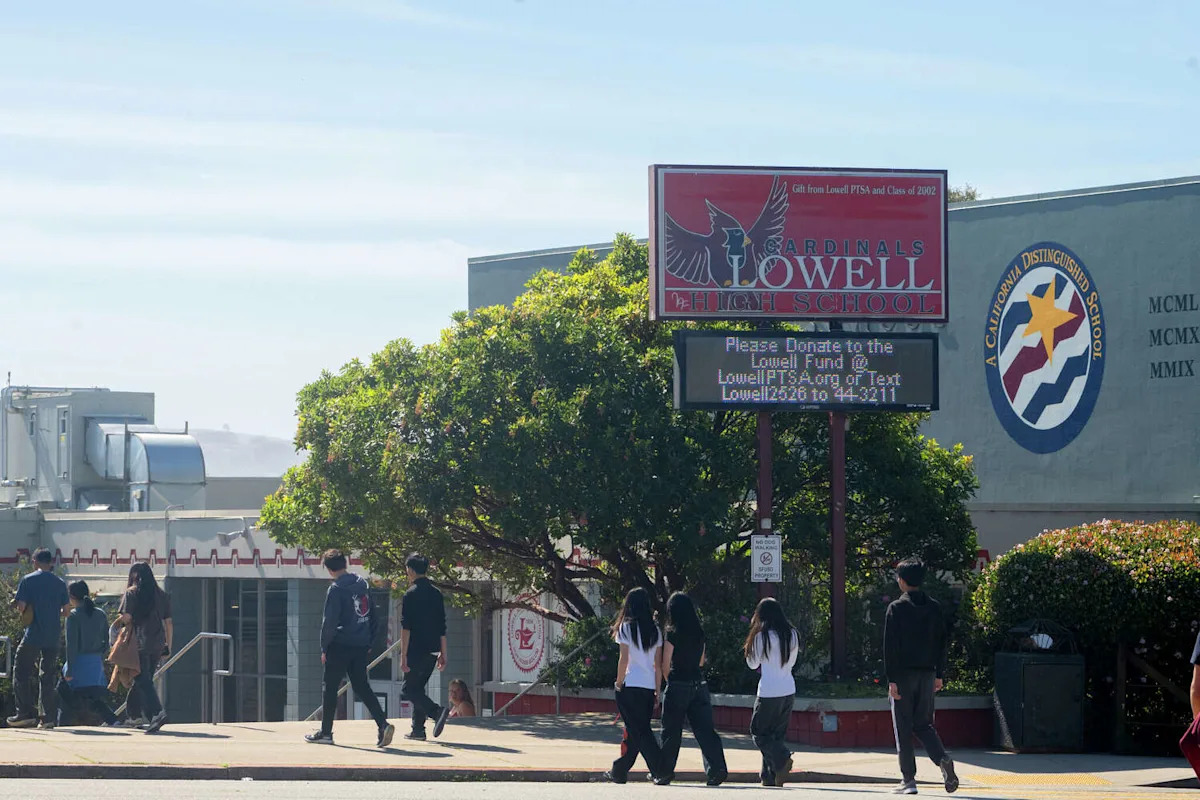
On a recent weekday night in San Francisco, as a big band played in an outdoor courtyard, I waited in a block-long line with hundreds of other excited people. Ride-hailing services jostled with private cars in the street, dropping off more and more ticket holders. But I wasn’t waiting to get into Outside Lands or the latest underground speakeasy. I was at a public high school open house.
It was taking place at one of SF’s most coveted schools, Lowell High School. Throughout its 170-year history, Lowell has frequently been named a top public high school in both the state and the country. The tickets, which I had to acquire via a Google form with a registration deadline, came with a lot of rules: My registration would be vetted against middle school records, and then we’d be sent e-tickets, which admitted just one student and one parent. We’d have to enter through a specific door (there were two) and be able to show our ticket code, or we’d be turned away.

FILE: An aerial view of Lake Merced on the west side of San Francisco, with Lowell High School in the background. (Anadolu/Getty Images)
This sought-after event would be just the first intense step in a monthslong slog to get my child into a public high school in San Francisco. The lengthy to-do list included choosing among 16 schools and signing up for tours; each one had a different Google form to sign up and filled up quicker than the Cake Picnic. School tours aren’t required to apply, but they are the best way to ensure that you know what’s in store for your family at a particular school.
Here’s how it works: Students rank schools in their order of preference on the application (the district suggests ranking five), which is due at the end of January for many kids. But, if your child wants to apply to one of the San Francisco Unified School District’s two high schools with merit-based admissions – Lowell and Ruth Asawa San Francisco School of the Arts – the deadline is earlier. In 2025, it was Dec. 12, which meant cramming tours in a quick two-month window because my son was interested in both.
The tours happen during the school day, of course, meaning my son missed class at a time when, at least for admission to Lowell, his grades really mattered. And my husband and I missed work, which wasn’t easy. Hurtling across the city on rainy mornings and trafficky afternoons to get to these tours, everything felt sort of make-or-break for our child’s future.
My son said he was “excited” and “optimistic” about the high school assignment process, but also “a little anxious.” Most students are matched with their school through a process colloquially known as the lottery, which pits students’ school rankings against the district’s open seats.
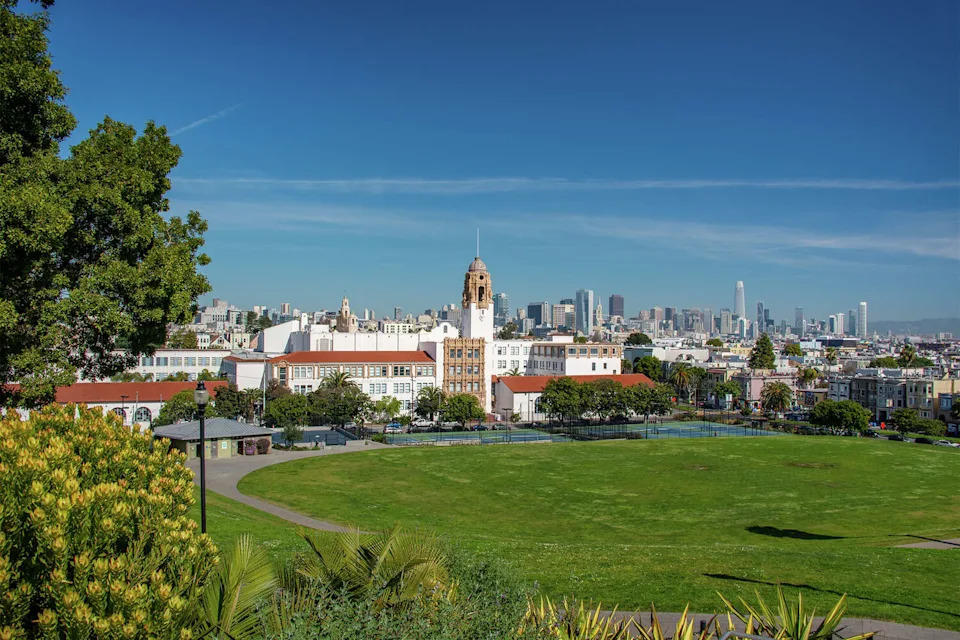
Mission High School, seen from Dolores Park in San Francisco. (Getty Images/iStockphoto)
The district estimates that 90% of kids ultimately get into one of their ranked schools, but it may not happen right away. Prospective high school students end up on waitlists for their top three schools if they’re admitted to a school they ranked lower (or didn’t rank at all). Offers from these rolling waitlists, which hundreds of students are on, start in April. They close in August, when school starts, but some kids may even decide to request a transfer to one of their higher-ranked schools in their freshman year.
When I recounted the byzantine process of getting into San Francisco’s public schools to parents who live in other, albeit much smaller, Bay Area cities like Burlingame and Walnut Creek, I got shocked looks. In those places, where access to the best stuff is as competitive as it is in the city, there may be just one or two high schools, so everyone has little to no doubt about where they’ll end up.
Surprisingly, we’re not the worst in the nation at this. That’s New York City, as an Intelligencer story in December affirmed. My mom chat pinged with updates when the article came out, mostly about the city’s devastating statistics. Students are encouraged to rank at least 12 high schools out of more than 400 (New York City has the biggest school district in the nation), with 900 particular school programs, “each with different pathways to entry.” While San Francisco’s laborious process had been all we could talk about, somehow it was heartening to know some other parents, somewhere else, had it worse.
BEST OF SFGATE
Central Coast | ‘Doomsday fish’: Once-in-a-lifetime sea creature encountered in Monterey Bay
Technology| A Calif. teen trusted ChatGPT for drug advice. He died from an overdose.
Central Coast| He gifted Calif. one of its largest city parks. Then he shot his wife.
Culture | Tragedy cut Sublime’s fame short. Now the singer’s son has the mic.
Get SFGATE’s top stories sent to your inbox by signing up for The Daily newsletter here.
Back at Lowell, crowds of people filled classrooms, trying to enter and exit. Some halls were so close with people, we had to shuffle through as if we were trying to find our seats in a packed arena. A choir sang; the orchestra played. We saw the library, the theater, an English classroom. Teachers sold the school as if we would all have to be convinced to pay $65,000 a year to send our kids here, when, of course, it’s free. (That’s roughly the cost of some private San Francisco high schools, like the one Mayor Daniel Lurie attended.)
To get into Lowell, students have to meet a set of markers that includes scores on standardized tests for math and reading and grades in certain subjects in certain semesters. It’s a point system, and the district determines where it sets the bar – last year a student needed 82.5 points (known as the “cut-off score”) for admission. Kids get points for their scores on the standardized tests, plus 4 points for As, 3 for Bs, and so on down the line. If your kid isn’t in this first group, which represents around 70% of kids who do get into Lowell, and is known as Band 1, the district offers Band 2 admissions. For Band 2, a school committee considers a student’s extracurricular activities and a personal essay in addition to grades and test scores. (Band 3, another 15%, is reserved for students with academic promise from middle schools that are underrepresented at Lowell.)
Yet despite its competitive reputation, admission rates for Lowell are actually pretty good. It’s huge, with nearly 2,700 students, and admits an average of 653 freshmen out of the average of 1,802 eighth graders who apply for general education, according to district documents. That’s around 1 in 3, making Lowell easier to get into, albeit slightly, than the other large high schools on the west side that don’t have the same grade and test score hurdles. Washington High School (2,100 students) has a 29% three-year average admissions rate for its freshman applicants; Lincoln High School’s is 23% (2,130 students).
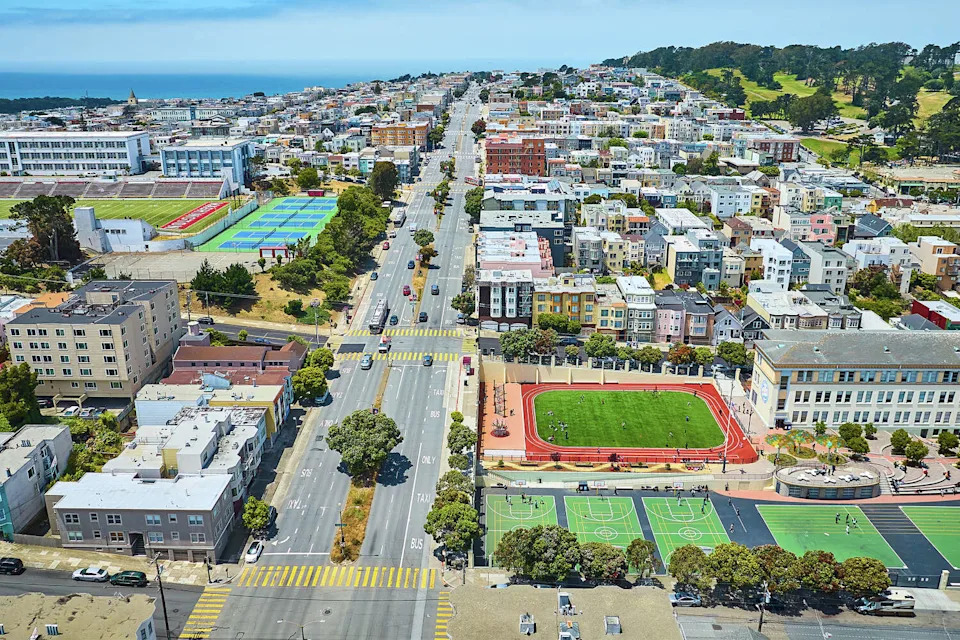
An aerial view of Presidio Middle School track and sports fields with George Washington High School’s football field, in San Francisco. (Nicholas Klein/Getty Images)
Lowell also has a better admission rate than Ruth Asawa School of the Arts, the other merit-based school, where it’s around 20%. There, the audition-based process is equally involved, yet completely different from Lowell’s. There are Wednesday workshops to sign up for in addition to school tours, and students choose from 15 disciplines to apply to – but they must pick only one. (The school doesn’t release admission rates for disciplines, so crafty parents can’t figure out which one is easiest to get into.) There’s an in-person audition no matter the discipline, though they all require significant prep work. Some even call for turning in projects in advance: design drawings, poems, a recorded rap or spoken-word piece.
Thankfully, after all this, there is just one application for all the district’s high schools, and it’s online. Though, to find it in the labyrinth of my online parent account and actually complete it, I had to Google around for a slide presentation with instructions, which I then dutifully cycled to all my friends. For Lowell, we had to add documents to support the kid’s activities, so I found myself screenshotting his online Scouts account to show his rank. He tried to find videos of himself playing baseball that weren’t taken by my mother through a chain-link fence (no dice).
Then came the waiting. Placement takes around six weeks from that January deadline. And now San Francisco’s own Ides of March is upon us – on Monday, March 16, school assignments are to be live in online accounts telling SF eighth graders and their families where they’ll likely spend the next four years.
There’ll be a lot of joy and a lot of disappointment, especially on the west side, all at the same time (making it, honestly, not that unlike Outside Lands). So if you have a friend with an SF eighth grader, mark your calendar to check in. And maybe plan to hear another tirade about this complex system, all over again.
More Local
– Barnes and Noble to close one of last Bay Area stores after over 20 years
– How wild turkeys ended up everywhere in the Bay Area
– Berkeley Bowl dishes up meat banned in red states
– Hundreds of Bay Area properties are heading to auction. Bids start at just $455.
Get SFGATE’s top stories sent to your inbox by signing up for The Daily newsletter here.
This article originally published at Only NY is worse than SF when it comes to getting into high school. I lived it..