
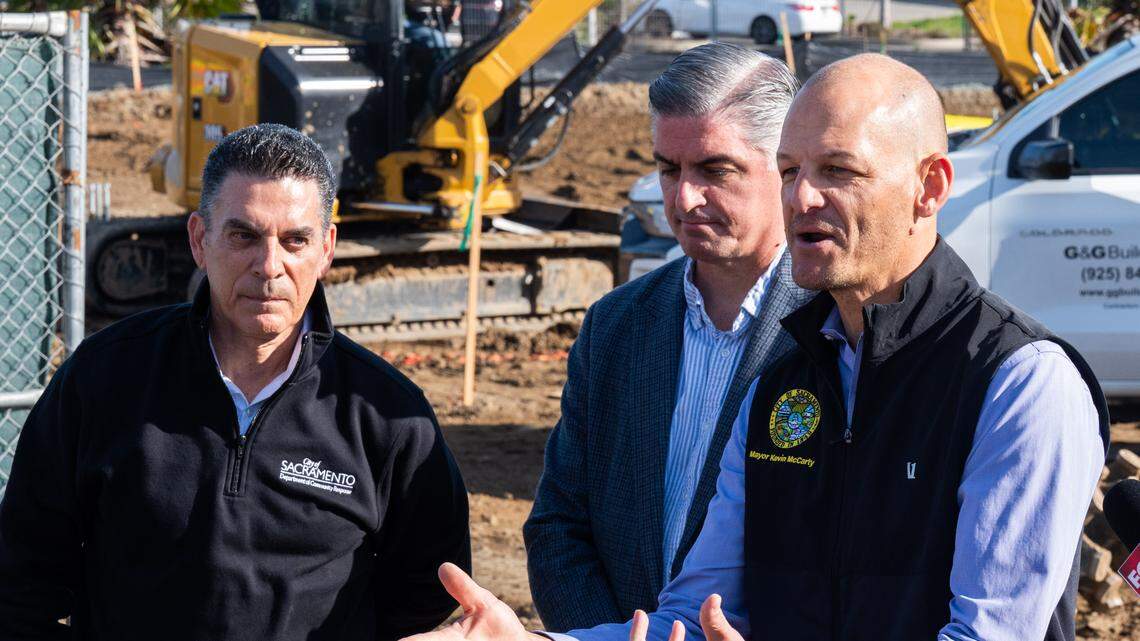
Sacramento Mayor Kevin McCarty, right, speaks as workers build a new safe camping site in the River District on Friday, Feb. 27, 2026. Department of Community Response Director Brian Pedro, left, and Council Member Phil Pluckebaum, center, joined him at the event.
NATHANIEL LEVINE
nlevine@sacbee.com
On homelessness in Sacramento, there is a disconnect—loud and undeniable—between Sacramento’s citizens and our elected leaders.
A little more than a year into his tenure as Sacramento Mayor Kevin McCarty manages public frustration with a smiley face.
“We have made progress… we are making progress, but clearly, we’re not nearly done yet. We’re heading in the right direction,” McCarty told the Sacramento Bee Editorial Board on Tuesday. McCarty touts 500 new beds the city has made for the unhoused.
The problem with citing these numbers is that the public has had homeless bed numbers thrown at them for years, to the point of feeling indifferent and noticing a chasm between the homelessness they see with their eyes and the optimism that McCarty is selling.
The harsh reality is that McCarty is touting a plan that would house homeless senior citizens, a worthwhile goal, but seniors are easy to work with compared to younger people, many of them men, who are resistant to government help, addicted to drugs, suffering mental illness or both. Those people require much more aggressive approaches. That housing homeless seniors can’t be accomplished without a fight in Sacramento shows how far we have to go on this issue.
A tense moment in Midtown
Last Tuesday night, as the sun set and painted the Sacramento sky a brilliant pink, I walked back to my midtown apartment. The pink faded into a deep blue and streetlights flickered on along 28th Street. While crossing G Street, I saw a man gingerly riding his bike against oncoming traffic. He was shouting back and forth with two people on the sidewalk, but they were too far away for me to make out what they were saying. I assumed they knew each other and kept walking.
The man stopped pedaling to let me pass, muttering something unintelligible. As I continued, I heard loud bangs—he was slamming his bike into fences as he passed. A man walking ahead of me noticed the commotion, and we both paused, silently weighing whether to call the police. The unhoused man soon caught up to us. I decided to cross I Street at the corner of James Marshall Park. He followed, though I didn’t realize it at first. When I stopped to tie my shoe, he did too.
My unease grew. I quickly crossed to the other side of the street, but he mirrored my movement. Anxiety spiked as I realized he was keeping pace, and I worried he might follow me home—or worse. I broke into a run toward my house, but he stayed right with me.
“Stop following me,” I shouted as I ran to the door. He responded with more garbled nonsense.
I reached my back door first and started frantically punching in the code.
“Oh yeah, that’s a great idea,” he said sarcastically, closing in. I realized it was a mistake to try to open the door with him so close. Afraid he might try to force his way in, I darted around to the front of the complex and entered the lobby, which locked automatically behind me. My heart pounded and my legs shook as I watched him ride off, still shouting nonsense into the night.
Twenty minutes later, blue and white lights flashed outside my window — two police vehicles had arrived, though I hadn’t called them. Wanting to make sure they had a description of the man, I stepped outside, still in my running gear, and approached an officer’s car. He told me they’d been called by someone else who’d also been followed. Feeling much calmer, I gave them my description and returned to my apartment.
What’s a realistic solution?
I know I’m not alone in experiencing something as disturbing as my latest encounter with an unhoused person on our streets. These encounters take a toll on the people living and working in our community. They call out for more from the city than citing the number of beds created.
What happens when McCarty and the city can place every senior citizen experiencing homelessness in housing? Does that mean the crisis is over?
The fact that on the very day I was reassured by the mayor that homelessness was improving, my faith was quickly shattered after being followed home by an unhoused person in crisis — that’s the real problem at hand.
I appreciate Mayor McCarty’s sincerity and his efforts to create a system that could address homelessness even after his tenure ends.
But what I faced is what people in our city endure — and unlike me, most don’t get to talk to their mayor or council members regularly.
The city will soon reach another critical checkpoint in addressing homelessness: what to do about those who refuse care and continue to terrorize Sacramentans.
Related Stories from Sacramento Bee