
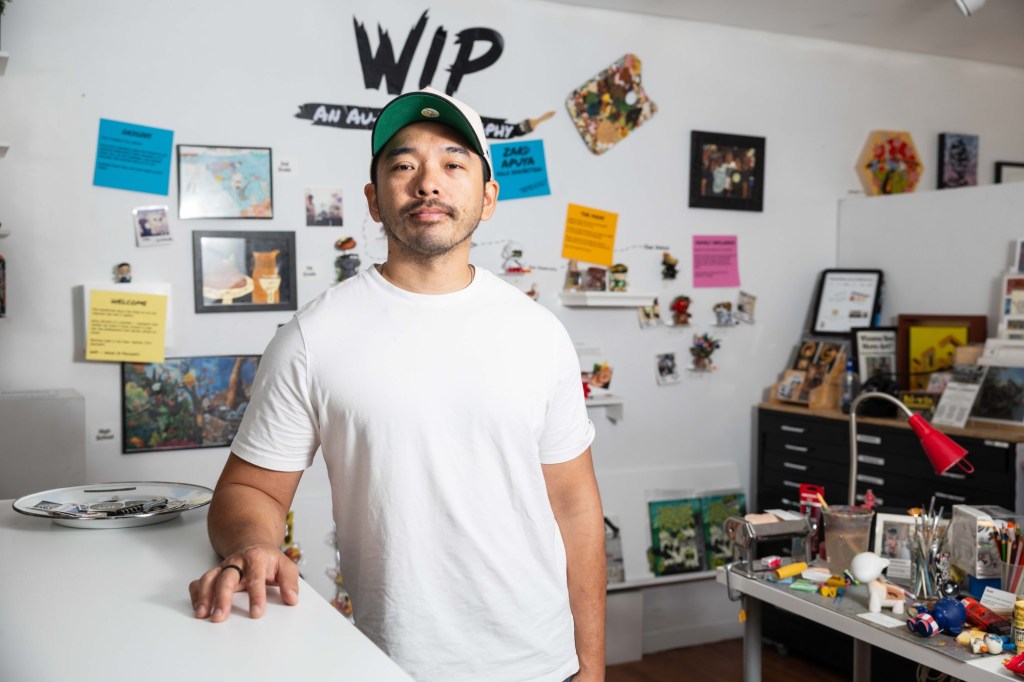
Like a lot of artists, Zard Apuya remembers being the kind of kid who was always doodling or drawing. His favorite classes growing up were the art classes, and while he majored in business in college, he made sure to minor in fine arts.
“Getting into toys probably started more like a hobby after I graduated from college. I kind of started exploring. I’ve always been into anything crafty or artsy. Before toys, I would mess around with painting on shoes, painting on hats, painting on T-shirts; I just like the idea of customizing things, having things be one-of-a-kind,” he says. “I’m all about, ‘Why buy something when you can kind of make it yourself and no one else will have the same thing?’ So, that kind of introduced me to the world of custom toys and, basically, designing toys is what I do right now.”
He creates toys that look like hyper-realistic food sculpted out of vinyl figurines called Munnys, made by the Kidrobot brand. The figurines have movable joints and serve as a blank canvas to be pierced, painted, posed or sculpted into whatever comes to mind for the artist, or comes in the form of an artist commission. While Apuya has created different designs around superheroes or pop culture, he eventually found his way to food—Cheetos, Doritos, gummy worms, Froot Loops, Frosted Flakes, SpaghettiOs or Choco Taco. People seemed to really enjoy seeing food interpreted as a toy and he stuck with it. “I learned that food and art are my happy combinations, the perfect mix,” he says.
When the opportunity came for a solo exhibition of his work this year, the 37-year-old toy artist wanted to go in a different direction that he had for previous exhibitions of his work. He wanted to let people in, give them some background about himself, his family, his culture, as well as his work. So, he put together “WIP: An Au-TOY-biography” currently at Thumbprint Gallery in La Jolla through March 28. The idea of a toy biography allowed him to structure the show into different chapters of his life, from growing up in Guam to parents who’d immigrated from the Philippines, to moving to California for his education, and working full time as a toy artist.
Q: What inspired this exhibition?
A: I’ve done a couple solo shows throughout my art career and, when I look back, most of my shows are always that I’m more recognized as the food artist who is always doing food creations. This show has allowed me to get a little creative and be more vulnerable; I could actually be more open and let people behind the scenes of me as an artist. This is more like a toy biography for me because I want people to learn the story behind who I am as an artist and all of the different factors and events in my life that inspired me to do this, to pursue this path. It’s nice that people can learn more about the artists and see their finished pieces, but I feel like it’s also important, and that you build a better connection with artists, when you know a little bit more about them, like what influenced their work. I feel like this is the perfect opportunity to paint a bigger picture of myself as an artist. For people who’ve known me for years, it allows me to introduce something new, something different. It allows me to kind of start from my beginnings and then lead the audience into the different points of my life, what inspired me to do this, or the different side projects that I got from being a toy artist.
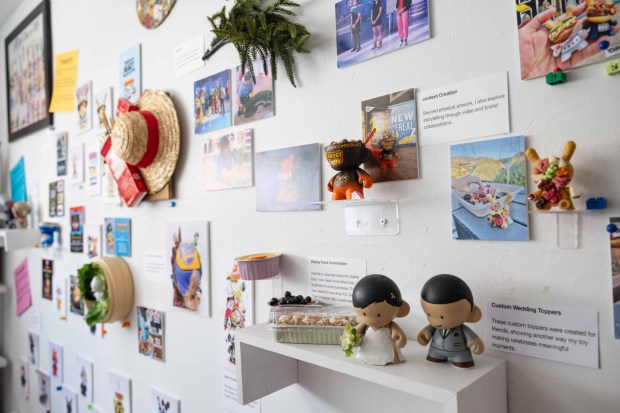 Work of artist Zard Apuya is on view at Thumbprint Gallery, Thursday, March 12, 2026, San Diego, CA. (Zoë Meyers / For The San Diego Union-Tribune)
I designed the show so that it has a flow, a timeline, so you can see my growth. I have some of my old art from when I was in elementary, middle, and high school, and then I kind of paint a picture of me when I move to California. I still incorporate the idea of toys to represent each of those points in my life, especially family influences, like my grandparents and my parents. They were all creative in their own ways and I made toys that kind of represent who they were as creatives. So, I included chapters in my life where I moved from Guam to California, moving from San Francisco to San Diego, and about my family influence. Then, there are the side quests that are all of the projects that I was able to do from being a toy artist: previous solo shows, a TV craft competition on HBO, or my inspiration to do food coming from Japanese restaurants and the fake food displays they have. That was the main driver for me doing hyper realistic food and that comes full circle now because I’m actually creating display food for small businesses.
I also included some pieces, some toys, that I brought with me from my travels to different cities or different countries, so that’s a chapter in my life. I also talk about my identity and what’s important to me as someone who’s from Guam and Guamanian, but I’m full Filipino. I’m also part of the LGBTQ community, so all of that kind of builds who I am as an artist. I also have a little mini-installation in the gallery that represents my chaotic little workspace in my studio.
Q: What was it about this artform of toy making that you connected with, to want to continue pursuing your creativity in this way?
A: I like the idea of customizing and not picking the traditional canvas. That’s why I got into customizing shoes and hats because I was exploring other nontraditional canvases out there. Eventually, I stumbled upon the figurative toys that they sold in one of the stores in Guam and it was like a blank canvas that allowed me to just paint on it. Soon, I started playing with clay, the material I use to sculpt, and it was like, ‘Oh, I can kind of create anything.’ After my first couple of figurines, I got hooked, especially because I saw that people were very interested in it and the audience was there. On Guam, it was very new for people to see because it’s not your typical art. There are a lot of muralists on Guam and I kind of did something very different that people don’t really see; people did some sculptures, but not specifically toys because it’s a very niche kind of art. So, I think that because of the feedback that people loved it, I kept doing it. I kept at it and explored the world of toys that was happening here, on the mainland, and I realized that there’s actually a scene out here in the States.
Q: What are some of the ways that specific toys tell parts of your story? What was your process for selecting certain toys and what they would communicate about you and your life?
A: In the beginning, I talk about my big move from Guam to California, and because my main style is food, I kind of use food to represent the different places I’ve lived in. I also have a Guam flag figurine to represent my origin and another toy that represents Guam’s food, like a fiesta plate of Chamorro food sitting on top of a latte stone, which is a Guam icon. Then, I put a little diagram that shows me moving to California and I have a California flag figurine. To represent me living in San Francisco, I made a mission burrito because it’s one of the iconic dishes there, so the toy looks like the burrito itself. Then, it shows me moving to San Diego, which I interpreted with carne asada fries because I still want to stick to my style, but I wanted to use food to represent the different cities because people love the food. I also have figurines that represent me going to grad school with a figure in the back that says, “Art Was Always the Plan” because I knew the opportunity for art was out here, in California.
Q: What kinds of toys did you play with as a kid? How do we see this reflected in the art you create as an adult?
A: I would say Lego (pieces) was my thing because you get to build things. I feel like that’s the more creative toy out there. Other than that, it’s probably like a mix of your typical action figures.