

The rise in popularity of women’s sports is a recent concept. It was only in 1972 when it became a federal law that schools must give women equal opportunities in sports. Title IX may have given women sports equity but does that mean women and men’s sports all have the same playing field?
Fresno City College’s women’s soccer are ranked top 9 in the nation and are nationally ranked Central Valley Conference Champions, yet the FCC soccer field has no lights, and home games play at 3 p.m. leaving women’s soccer at a disadvantage for home game attendees making it difficult to gain a crowd.
“Certain things have been done the same way for so long that it’s hard to make changes,” Women’s Soccer Head Coach, Oliver Germond said.
Germond’s disappointment over these setbacks is emphasized when looking at the history of women’s soccer and its steady rise in popularity in the past five years. Especially when it comes to the youth and how important it is to see women’s soccer gain as much popularity as other competitive sports.
“In general women’s sports don’t get the same attention as men’s sports unless you’re very successful, but the growth of women’s sports have changed,” Germond said.
The recent renovations made to the softball field weren’t for no reason, they were changed to match the baseball field’s measurements when FCC was sued for not abiding to Title IX laws. They also included lights and improved bleachers to match the baseball field.
“But to me it shouldn’t take Title IX to make those changes, it should be a respect towards women,” Germond said.
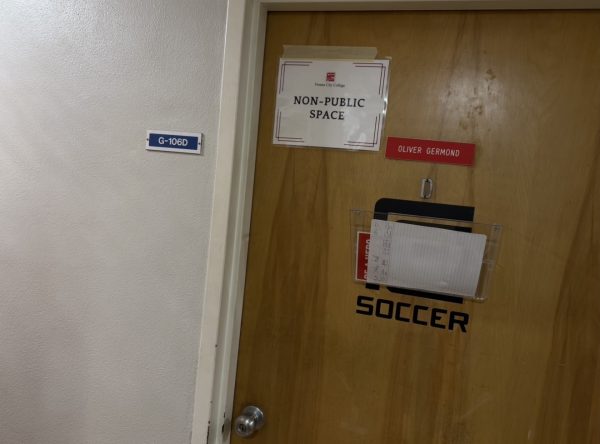 Photo of the outside of Women’s Head Soccer Coach Oliver Germond’s office door on March 10. (Photo by: Reoz Marquez)
Noann Morice, the FCC’s women’s soccer attacking midfielder and reporter for the Rampage, said social media plays a big part in why women soccer players aren’t taken seriously. Men constantly making comments online dismissing women’s accomplishments takes a toll on athletes.
Germond has always felt strongly towards women’s issues in sports and believes it starts in the youth. He urges his athletes to get involved with high school soccer players, volunteering as their coaches, and to read to elementary students at the Reading Across America event.
“I just told them how powerful they are as female athletes to give back to the youth. Girls need more mentors that are female athletes,” Germond said.
Over the years women’s soccer players who have played for FCC have gone on to coach high school soccer and club soccer. As a female athlete being able to coach younger girls is important because they have established that level of relatability, Germond said.
Emma Connolly, defense player, states that players from all over come to this school just to play for FCC and that it’s impressive how much the program has grown.
Morice feels the team has built a strong bond and has always done well at making each other feel included.
“We’re like sisters,” Morice said.
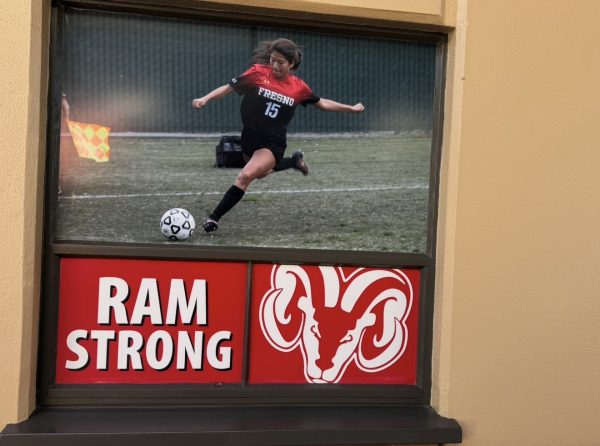 Photo of picture framed inside of the Fresno City College gym with an FCC women’s soccer player hitting a goal and the words “Ram Strong” under it on March 10. (Photo by: Reoz Marquez)
Germond said youth sports have gotten more competitive as he continued to coach. He said it’s more how you can relate to them, create a good environment and give them the enjoyment of playing while focusing on developing skills needed to be able to advance in the sport instead of winning.
The challenges that come with training as a woman athlete go beyond the field, not only physically but also mentally draining with the competition and the constant training.
Skylar Terra who plays forward position for the soccer team said that the intense training and high level of play made it hard to push through the workouts.
Morice added that on top of the rigorous training, there is also an expectation and comparison to the men’s team that drives the women’s soccer team to work hard.
“Because we’re women, we probably need to push ourselves without even thinking about it, I do compare myself to the men’s team,” Morice said. “It’s hard.”
Connolly explained there is already a popularity gap between men and women soccer, and the nature of the sport pressures the players to exceed expectations.
“We’re already seen as not as significant in a way, because we are a women’s program we do have to work harder than the men’s program,” Connolly said.