
Initiatives Have Primarily Helped Tenants
SF also requires by far the lowest amount of signatures for measures to qualify for the ballot. This incentivizes politicians and special interests to overload the ballot with poorly conceived, divisive, and often contradictory measures. The result is a system that forces San Franciscans to fill out lengthy, confusing ballots that often result in unintended consequences.— Press release, MAYOR LURIE FILES CHARTER REFORM MEASURES TO CLEAN UP CITY HALL, March 11, 2026
Does the actual history of San Francisco ballot measures confirm the above account? Not by my research. To the contrary, gathering signatures under the current law has brought enormous benefits to the city’s non-wealthy residents. It’s been the primary strategy keeping the non-wealthy in San Francisco.
Let’s go through some examples.
Ballot Measures Increase Economic Equity
I encourage other media to investigate which San Francisco constituencies have benefited most from initiatives secured by signature gathering. My research says the answer is obvious: tenants have far and away gained the most.
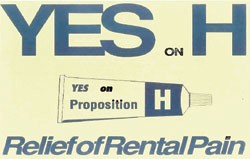
I have authored and coordinated signature gathering for two tenant campaigns. In 1992, Prop H cut annual rent increases by more than half. Its passage has saved tenants billions of dollars and kept working people in the city. People who would have eventually been priced out by the annual guaranteed 4% rent increase previously in effect.
The organization I head, the Tenderloin Housing Clinic, was the chief funder of Prop H. We could not have afforded to pay for enough signatures to qualify under the proposed new rules (even grassroots campaigns rely heavily on paid signature gatherers).
Had the proposed new signature rules been in effect in 1992, landlords would have continued getting annual rent increases well above inflation. But for Prop H this would have continued for the past 33 years.
In 1994, I authored Prop G, a charter amendment to create a Department of Building Inspection. We had to collect 60,000 signatures because charter amendments have a higher requirement. We spent every campaign dollar we had on qualifying for the ballot. Had the proposed new signature requirements been in effect it would have been impossible for us to qualify.
Thanks to Prop G, San Francisco went from having terrible housing code enforcement to becoming a national model. The Housing Inspection Division was fully funded for the first time ever. The City Attorney went from only filing lawsuits against in=law apartments to targeting landlords who flagrantly violate the housing code.
These two measures alone show tenants have gained enormously from the current system. But there’s even more examples of how tenants benefit from the existing signature rules.
Ending Rent Control Exemptions
A 1994 ballot measure to end the rent control exemption for four-unit or less owner-occupied buildings barely qualified with enough signatures. The late Ted Gullicksen of the SF Tenants Union worked day and night to make it happen.
This exemption was a major driving force behind San Francisco’s tenant displacement and neighborhood gentrification. It lasted from 1979 to the end of 1994.
Despite this exemption primarily benefiting real estate speculators, neither the supervisors nor any mayor ended it. If the mayor’s higher signature limit had been in effect, the impact is clear: thousands of San Francisco residents would have been evicted from their homes and likely forced out of the city.
Who benefited from this ballot measure? Tenants. Who lost? Real estate speculators.
Owner Move-In Evictions
Ted Gullicksen and I spent over a decade passing laws to restrict owner move-in evictions. Voters approved all of them. The Board of Supervisors rarely helped. That’s the situation the mayor’s “reform” plan seeks to impose.
San Francisco tenants are the chief beneficiaries of the current system for qualifying ballot measures. Residential landlords and real estate speculators, who are now once again enjoying a rental boom, would gain most from the mayor’s proposal.
The Nation’s First Local Minimum Wage
In 2003, a grassroots coalition of labor and community activists gathered enough signatures to place a local minimum wage measure on the ballot. Prop L sought to raise the minimum from $6.75 to $8.50. Beginning in January 2005 the minimum wage would automatically rise with inflation.
According to SPUR, which took no position on Prop L, 25,000-50,000 workers would see their incomes rise with its passage. The first “Con” argument cited by SPUR was “Prop. L does not need to be on the ballot.” Had Mayor Lurie’s higher signature requirement for initiatives been in effect in 2003, Prop L would not have been on the ballot. I was involved with the campaign and money for signature gathering was tight.
Once again, a ballot measure, not legislative action, helped low-income people and the working-class at the expense of wealthier interests.
Initiative Option Shapes Policy Debates
Ballot initiatives enable tenants and other non-elite, non-insider constituencies to get results that Boards and mayors fail to produce. Progressive groups have long used the ballot option as a bargaining chip; elite groups do not have to do that.
I was involved in a long campaign around the rebuilding of Trinity Plaza at 8th and Market. I drafted an anti-demolition ordinance to protect tenants. Mayor Newsom vetoed it and we fell one vote short of an override. We then circulated a ballot measure. To avoid a ballot fight an agreement with the owner was reached. It protected tenants and resulted in one of the most impressive housing developments in the modern history of San Francisco.
You don’t get these win-win outcomes without the initiative option.
Big Money Not Deterred
What is perhaps most outrageous about the mayor’s plan is that it doesn’t deter wealthy interests from qualifying any initiative they want. They can pay whatever it takes to qualify measures for the ballot. They are not impacted by the proposed signature change.
Isn’t this quite obvious to everyone?
If you think San Francisco has a problem with “poorly conceived and divisive” ballot measures, why not equally prevent the wealthy from promoting such?
Further, who determines what measures are “divisive”? That term is typically used against any challenge to the status quo. The mayor’s proposed charter amendment is itself divisive, as many oppose it. Making policies is itself divisive; outward division is only absent in authoritarian states.
I have an entire chapter in The Activist’s Handbook on the strategies for using ballot initiatives to achieve progressive change. The mayor needs to rethink this part of his charter amendment,
San Francisco should not be a city where a key tactic for social change is off limits to all but the wealthy.

Randy Shaw is the Editor of Beyond Chron and the Director of San Francisco’s Tenderloin Housing Clinic, which publishes Beyond Chron. Shaw’s new book is the revised and updated, The Tenderloin: Sex, Crime and Resistance in the Heart of San Francisco. His prior books include Generation Priced Out: Who Gets to Live in the New Urban America. The Activist’s Handbook: Winning Social Change in the 21st Century, and Beyond the Fields: Cesar Chavez, the UFW and the Struggle for Justice in the 21st Century.