
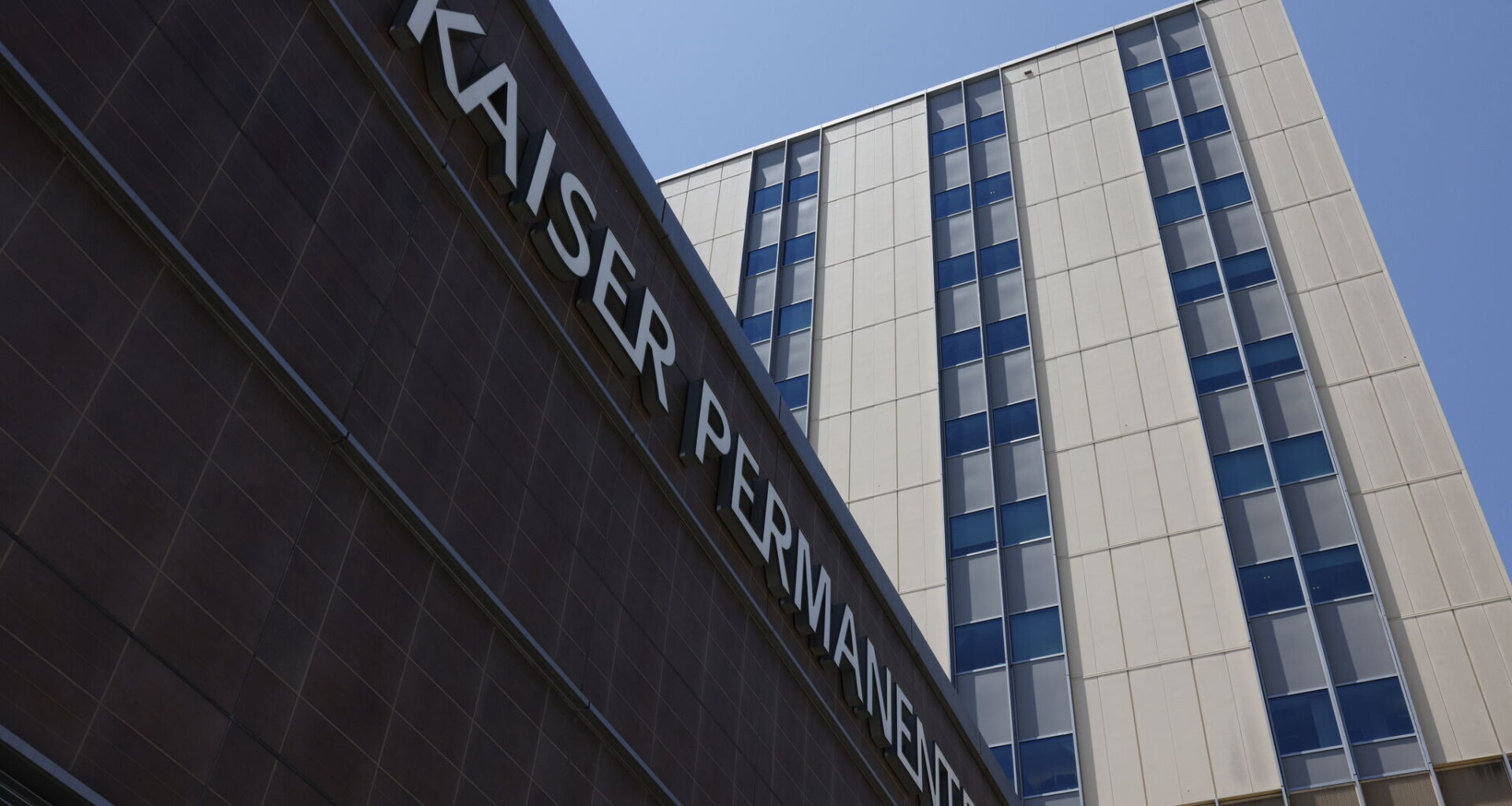
The Bay Area’s hottest job market isn’t tech, it’s health care, like at Kaiser Permanente in Oakland.
Santiago Mejia/S.F. Chronicle
After Sydney Villanueva was laid off from her job as a project manager at a San Jose web design agency in 2023, she spent two years looking for new work, sending out thousands of applications.
“That’s kind of when the job market started to go down,” she said. “It got worse and worse and worse.”
Villanueva wasn’t finding success applying for tech jobs, but noticed plenty of open roles at health care companies. Then she worked a temporary gig as an administrative assistant in a dental office. “I feel like it opened some doors and conversations to me,” she said.
Article continues below this ad
Villanueva, who has a degree in advertising and public relations, is now studying to become a nurse. She’s in the midst of a 12-month accelerated degree program at Oakland’s Samuel Merritt University. The school just opened a new $240 million campus with the goal of doubling its student enrollment in the coming years amid surging demand in health care.
With its aging population and robust science industry, the Bay Area is seeing a strong correlation with a national trend: Health care has been by far the biggest source of new jobs since the pandemic, while other sectors have weakened. In 2025, Santa Clara and San Benito counties added a net 8,300 health care jobs, while Alameda and Contra Costa counties added 9,900 jobs in the sector, according to state data.
Despite hype over artificial intelligence, the information and professional services sectors continued to see job losses last year throughout San Francisco, the East Bay and Silicon Valley.
San Francisco Chronicle Logo
Make us a Preferred Source to get more of our news when you search.
Add Preferred Source
“Health care has really propped up the California economy, as well as the national economy,” said Michael Bernick, special counsel at Duane Morris LLP and former head of the state’s Employment Development Department.
Article continues below this ad
Despite that assessment, there’s still turmoil: Kaiser Permanente nurses went on strike last month over wage disputes and staffing levels before returning to work after a preliminary deal was reached. The U.S. economy lost 92,000 nonfarm jobs in February, including 28,000 health care jobs that were attributed in part to strikes.
Some veteran health care workers also quit the industry after challenges and burnout during COVID, contributing to a jobs shortage.
Then there are the financial barriers for many medical jobs: Villanueva expects to spend over $100,000 on her nursing degree.
After trying to find another job in tech after being laid off, Sydney Villanueva turned to a career in health care. That job sector is the strongest in Bay Area.
Courtesy Meda Abigail Phtoography
But she said she’s gaining valuable hands-on experience, with clinical rotations at Stanford Health Care Tri-Valley, San Ramon Regional Medical Center and Kaiser’s hospital in San Francisco. And Villanueva’s job prospects after graduation feel much better than applying for more tech jobs, she said.
Article continues below this ad
“They do a really good job at making sure you’re prepared for the field,” said Villanueva, who hopes to work in pediatrics at a county hospital. “I think it’s definitely the right choice.”
Villanueva, 28, said her cohort of 48 students is pretty evenly split between recent college graduates and older people who are also switching careers. Samuel Merritt University identified at least two other current accelerated nursing program students who switched from tech, and another student who switched from tech to study social work.
Ryan Kind, another Samuel Merritt accelerated nursing student, previously worked in digital interactive design at several tech startups. “There was this relentless cycle of building and discarding tools, and I kept asking myself whether any of it was actually mattering to people,” Kind said. “At the same time, I watched AI grow in power as some of its major uses became clearly harmful.”
“It became obvious that mental health care was one of the places the world most needed both more human effort and better tools,” which guided Kind to focus on psychology, he said. “I’d rather be in the room being present with a patient than tweaking a product that disappears in six months.”
Dr. Ching-Hua Wang, Samuel Merritt University’s president, said overall enrollment between 2024 and 2025 has grown by 8.5% to 2,800 students across four campuses. Around 80% of graduates are nurses, and she said job placement for all graduates is 100%. California officials have said nursing, physician assistants, physical therapists and health administrator jobs are expected to see double-digit percentage growth through 2032.
Article continues below this ad
U.S. Department of Education data shows Samuel Merritt University is tied for the country’s highest median earnings for graduates, $143,000 per year, which is the same as the Massachusetts Institute of Technology.
Nursing student Sydney Villanueva, second from left, with her cohort at Stanford Health Care Tri-Valley.
Courtesy Sydney Villanueva
Not all health care jobs pay well. The most common job in the San Francisco metro area is home health and personal care aides, who make a median salary of $36,000 per year, around minimum wage. Those jobs generally don’t require a college degree but require a 40-hour certification program in California. Ambulance drivers and attendants make only $37,000 per year, while emergency medical technicians make $50,000 per year.
Bernick, the former head of the state Employment Development Department, said health care is a “bifurcated” market with concentration between high-paying and low-paying jobs. Some roles, like medical technicians and assistants, have salaries in the middle.
“They are within the reach of people who don’t have four-year degrees or two-year degrees,” he said.
Article continues below this ad
Though distinct labor sectors, health care is also entwined with tech. Sutter Health, Northern California’s largest health system, opened a San Francisco innovation center in 2024. UCSF’s massive $4.3 billion Parnassus expansion project includes space for robots.
Samuel Merritt’s new campus includes a virtual reality center and a motion analysis research lab.
While fears abound over AI replacing white-collar workers, particularly coders, Wang sees it as a partner to health care professionals, rather than a threat.
“AI is not going to replace the human-to-human, person-to-person care,” she said. “That requires empathy, compassion, a nuanced people skill to deal with patients.”
“AI certainly cannot do that — at this point,” she said.