
Across the country, diversity, equity and inclusion efforts are being scaled back or eliminated altogether. From federal agencies, to Corporate America, to higher education, DEI programs are disappearing, creating uncertainty about what values and priorities will take their place.
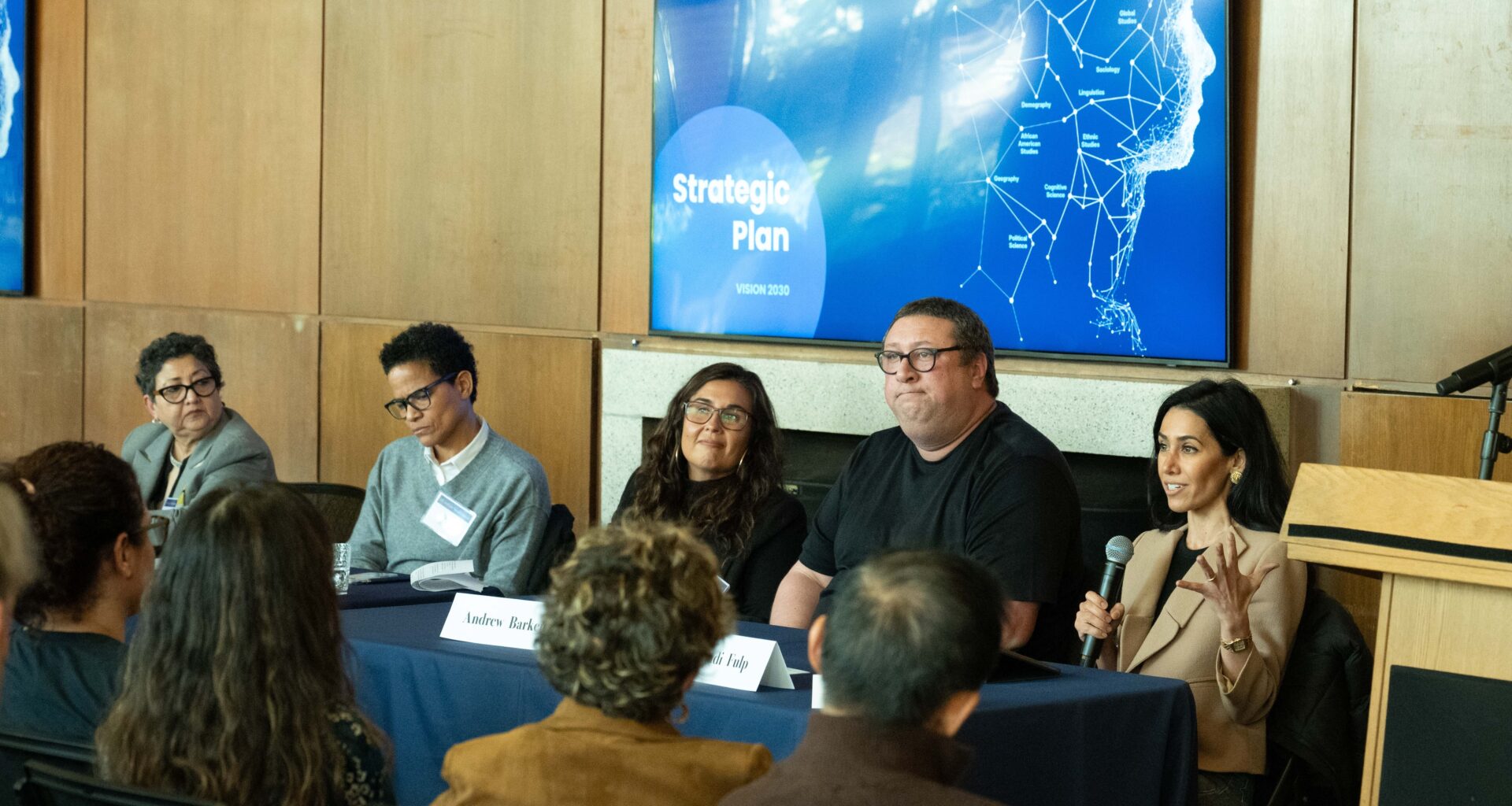
As part of the launch of UC Berkeley Social Sciences’ new 5-year strategic plan, Vision 2030, a panel of Social Sciences faculty and alumni gathered to discuss how this institutional dismantling is reshaping higher education and the corporate world.
The “Building a Post-DEI Future” panel examined how the rollback of DEI efforts, political backlash against “wokeness” and the rise of AI are reshaping higher education and the workplace. Panelists said universities must help students navigate these changes while continuing to confront inequality and expand opportunity.
Berkeley Social Sciences Dean Raka Ray opened the conversation by noting how the discussion reflects the core mission of the social sciences.
“It is the job of the social sciences to not only help create, but also to analyze and critique the elements that make our social world,” she said. “In an atmosphere where it’s getting increasingly hard to talk, debate, reason, disagree, dialogue and learn about tough social issues, we step into it. We see this as our mandate.”
Ray also underscored the importance of discussing a post-DEI future amid widespread efforts to dismantle it. “It’s valuable to still work towards a good life for all, in a world where institutional approval for certain policies no longer exists,” she said.
Panelist Nikki Jones, professor and former chair of the African American Studies Department, emphasized how recent policy shifts are rooted in a deeper ideological struggle.
“The war against ‘woke’ is an ideological battle centered on the principle of white male Christian supremacy, with very significant policy implications,” Jones said.
Sociology Professor and Institute of Governmental Studies Co-Director Cristina Mora argued that while many of these attacks on DEI focus on language — such as objections to pronouns or land acknowledgements — the deeper inequalities that DEI initiatives were meant to address remain unresolved, particularly within university settings.
“The turn to DEI got us to have some honest conversations about what we are doing internally, and that was great. But we never did enough for these students in terms of resources and programs,” Mora said. “I’ve never — even before the attacks — met a DEI officer here on this campus or on any other campus that’s told me, ‘We have too much money. We have too many resources. We have too much manpower.’ They never had enough to do their job. And I think we need to start there. How do we now increase access?”
The panelists also discussed what initially began this “war against woke.”
Panelist Andrew Barkett — a political economy alumnus and current chief technology officer (CTO) of a real estate tech firm, who previously served as CTO of the Republican National Committee and in management roles at Google and Meta — said he agrees with Jones that white nationalism is at the root of the problem, but emphasized that the picture is more complicated.
“DEI became the mascot for a team — the team that said the reign of the white, Anglo-Saxon Protestant needs to end. What’s lost in that disagreement is the middle side,” Barkett said. “I think that this moment is seeing us have a terrible overreaction by a group that is losing its power, that has long had this sort of position of privilege, and is lashing out in totally the wrong way.”
He added: “The argument between the white nationalist side and the ‘woke’ side is the wrong argument. The right argument is about whether the United States as a country — imperfect as it may have been and may still be — can achieve the idea set out in the Constitution. And if there’s a post-DEI concept that helps us perfect our imperfect union.”
Political Science Alumna Shaudi Fulp, a veteran political advisor, emphasized that lawmakers across the political spectrum recognize longstanding disparities in opportunity and the experiences of those affected. She noted that some programs affected by external pressures had real challenges, while others became convenient targets in the political debate.
She acknowledged that the changes were felt deeply by students and communities, and that “this is a moment to elevate the conversation, reassess what works, address gaps and strengthen initiatives to better serve all students.”
Fulp also stressed that universities remain “one of the last places in society where people are still asked to wrestle with complexity.” This moment, she suggested, invites reflection on what diversity, equity and inclusion efforts were originally designed to accomplish: increase representation, remove systemic barriers and ensure all students can participate fully and meaningfully, she noted.
“It’s not about labels,” she said. “It’s about making sure all members of the community can contribute, thrive and access the resources they need, while institutions adapt thoughtfully to changing legal, societal and political realities.”
Beyond higher education, Barkett looked to the corporate world, and the implications of DEI in these environments. He argued that many in the corporate space, especially those in hiring roles, remain unsure about the rules around diversity targets — what’s expected of them, whether they’re doing it correctly or even the purpose behind it. The foundation for understanding why diversity matters, he said, is built at universities.
“Students graduating today have no idea what the job market is or if they’re going to be able to get a job. This question of diversity is super important, but it’s very hard to get a 22-year-old person to have enough space, comfort and knowledge to tackle these complicated interrelated issues,” Barkett said. “It’s going to be a challenge of the university’s ability to solve, and not an easy one.”
Jones agreed that “defending the space of the university and the classroom” is an essential part of a post-DEI world, adding that this work extends to engaging students beyond the social sciences in courses like her own.
“When I have computer science students come through my class and read for the first time [about systematic oppression], it blows their mind because they haven’t been introduced to this kind of work before,” Jones said. “My hope is that then when they go on to these higher positions, it’s in the back of their mind. That once they have power, they think about how they can make decisions so that they are not replicating this thing that we know is bound to happen.”
Mora echoed the point, highlighting the crucial role of social sciences education in addressing these challenges.
“It’s going to take a continued commitment from those in fields like Ethnic Studies, African American Studies and American cultures, to bring students together across disciplines, learn from our diversity, our challenges and our acknowledgements, and then work through solutions as a group,” Mora said. “Berkeley is the best place to do this work. Our classrooms are incredible labs where students from different walks of life — from farmworker communities to middle class suburbs — come together to learn and learn from each other.”
Lastly, the panel looked ahead to a future shaped by artificial intelligence, with Fulp highlighting how AI could perpetuate existing inequities.
“Is AI an equalizer, or does it actually create more inequity? When people come into the workforce, have they leaned too heavily on it? Or have they not been exposed to it?” she asked.
To navigate this post-DEI world, Jones offered a strategy of “refuse, reclaim, relate.” She urged the audience to refuse exclusionary frameworks, reclaim their imaginations for a more creative future and relate to one another through shared values.
“We need to make sure we are building the institutions and systems that produce the world that we want to see — and be real about what world you want to see,” she said. “I want to see a diverse world, an equitable world and an inclusive world. I want my leader to help build that world. And that’s the work that’s ahead of us.”