
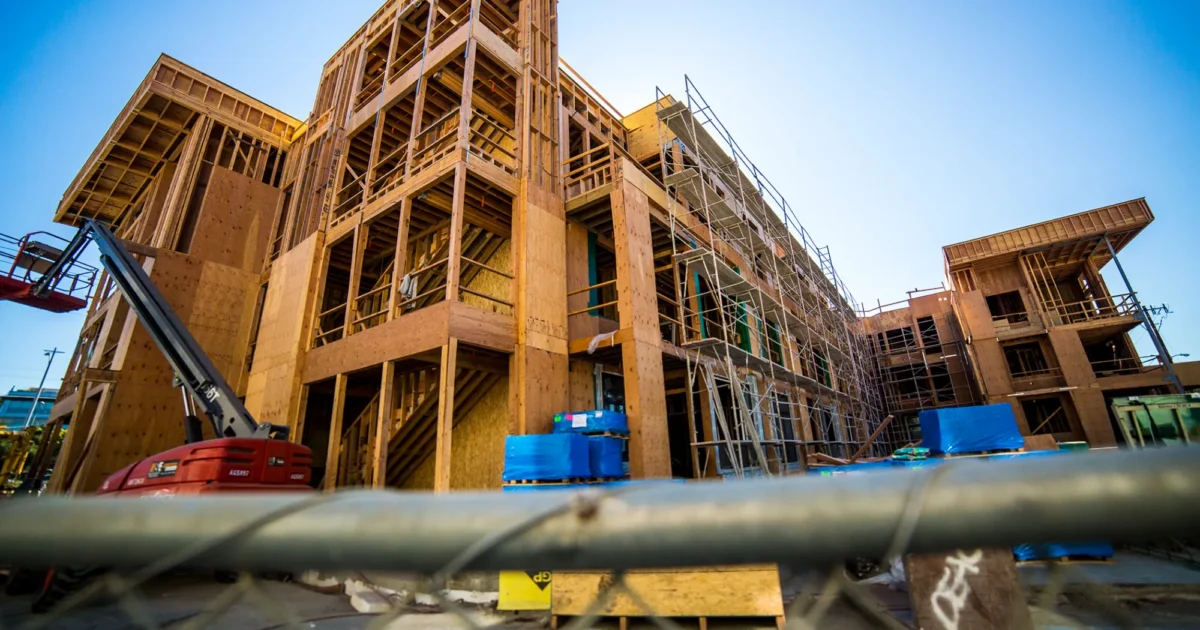
Developers have submitted plans to build more than 10,000 homes in Mountain View, but only a small fraction of those have broken ground, as financial headwinds are making it difficult to start construction.
A recent city report shows a drop in the number of building permits issued over the past two years, posing a challenge for Mountain View as it tries to meet its state mandated housing goal of planning for more than 11,000 new homes by 2031.
“I think the numbers are bearing out that it’s just really difficult to get the financing lined up to transition to the construction phase,” Community Development Director Christian Murdock said.
Three years ago, Mountain View approved a housing element that lays out how it plans to meet the 11,135 target over eight years. Since then, the city has been tracking its progress with annual reports submitted to the state.
In 2025, Mountain View issued building permits for 388 homes, bringing the total number to 1,867 over a three-and-half year period, according to a city staff report presented to the Environmental Planning Commission last month. This represents 16.8% of the city’s total housing commitment of 11,135 new homes.
According to Murdock, developers have reported that persistently high interest rates and construction costs are making it difficult for projects to pencil out.
“We very much wish that we were making more proportionate progress towards our (state target),” Murdock said. “There’s just limited ability for us to do that if the projects aren’t forthcoming.”
Eric Anderson, the city’s advanced planning manager, said it was common to see “spikes” in the number of building permits issued year-to-year. The past two years are not necessarily indicative of a long-term trend.
While construction lags, many projects remain in the pipeline
Last month’s staff report presented a more favorable outlook for the future, noting that the annual report to the state only included projects that had hit certain milestones, like being issued building permits, while many more developments were in the pipeline.
Currently, there are 3,606 homes that have been approved but are not yet under construction and another 4,914 under entitlement review, according to the staff report. If these homes pan out, it could bring the city much closer to its housing goals.
Reaching 11,135 new homes by 2031, however, is not the city’s only obligation. State law also requires that a portion of these homes be affordable for lower-income households. Proportionately, the city is overshooting its goal for above-moderate income homes while coming in lower for all other income categories.
In Mountain View, developers are typically required to set aside 15% of new homes for lower-income households, meaning that the vast majority, 85%, are built as market-rate homes, according to Murdock.
“That’s never going to produce enough units for our (state) obligations at the lower income levels,” he said.
To mitigate this trend, the city has sought to prop up affordable housing projects, like the La Avenida Apartments in North Bayshore and Heartwood Apartments near Sunnyvale, which opened in 2025 and 2024, respectively. Typically built by nonprofit developers, these projects rely on public funding, primarily through tax credits and land donations as well as sometimes direct funding from the city, county and state. However, these resources are scarce, Murdock said.
The city also has been working on local initiatives to reduce barriers to housing, like updating zoning codes to encourage more multifamily homes. At the same time, it has strengthened tenant protections for lower-income residents, especially for those at risk of displacement and invested resources in a homelessness response strategy.
The state has recognized Mountain View’s commitment to housing by awarding it a “prohousing” designation, the first city in Santa Clara County to receive this distinction. Even so, Murdock noted there is still a big gap between housing needs and production in the region, despite a mandate requiring cities to facilitate the construction of more homes.
“I think the state’s being more realistic about what the true needs are, but that’s not necessarily informed by the ability for cities or developers to carry out those projects” Murdock said. “So that’s where we’re at with the progress, unfortunately.”
This story originally appeared in the Mountain View Voice. Emily Margaretten joined the Mountain View Voice in 2023 as a reporter covering City Hall.