
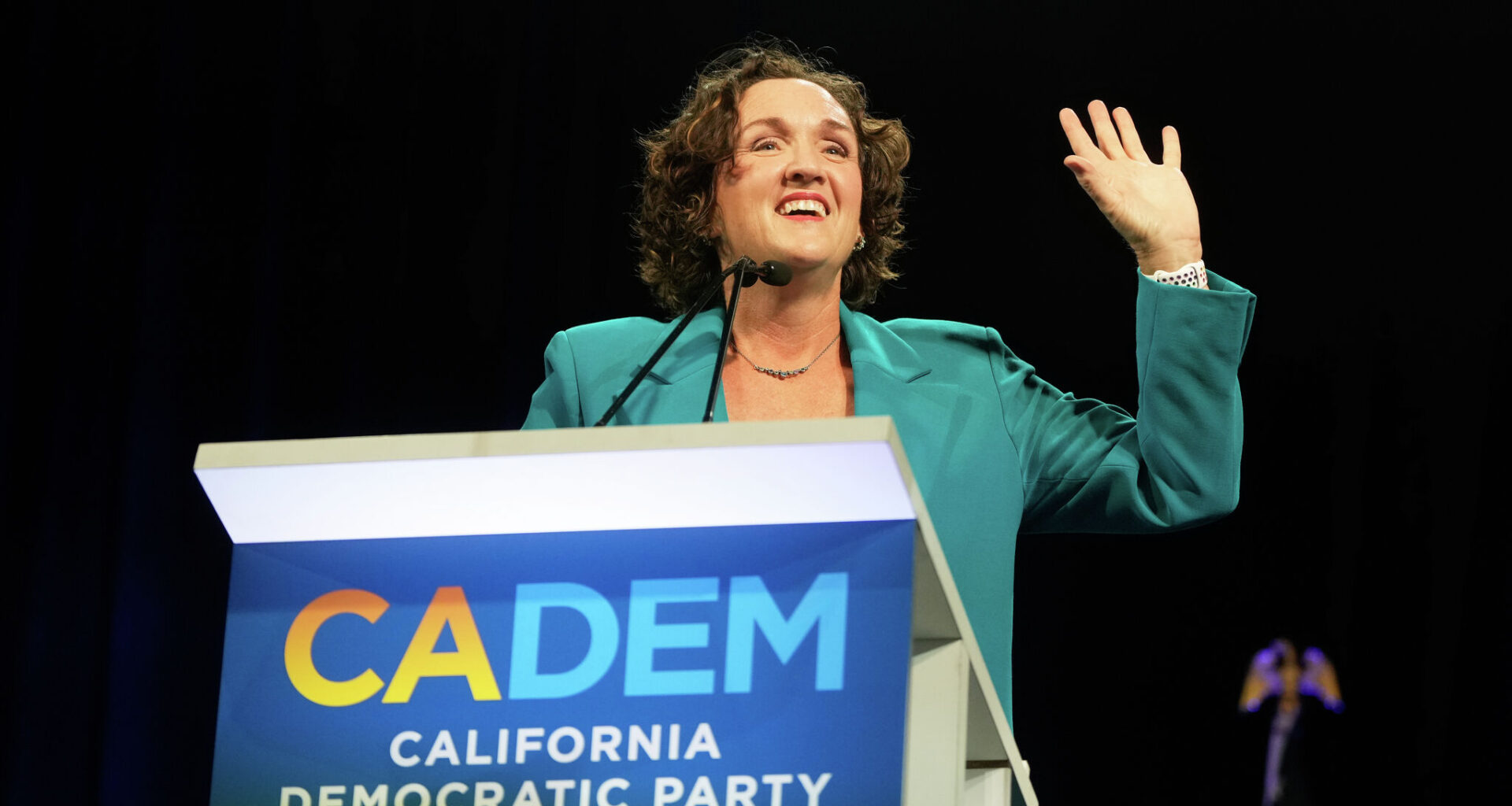
Gubernatorial candidate Katie Porter speaks at the 2026 California Democratic Party State Convention in San Francisco on Feb. 21. She is seeking to connect with voters after PR gaffes raised issues about her temperament.
Jeff Chiu/Associated Press
When former Vice President Kamala Harris announced last summer that she would not run for governor in California, Katie Porter seemed like a shoo-in for the job.
The progressive former U.S. House member who represented Orange County for three terms first gained statewide name recognition from her whiteboard interrogations of corporate witnesses testifying before Congress.
And while her bitter 2024 loss to Adam Schiff in California’s Democratic Senate primary was a setback, the hard-fought campaign helped build her donor base and saw her campaigning across the state.
Article continues below this ad
But just weeks after Harris announced she wouldn’t pursue a glide path to the governor’s mansion, Porter ran into self-inflicted turbulence. During a television interview with CBS Sacramento, she engaged in a testy back-and-forth with a reporter that began with a softball question about whether she needed to court Donald Trump voters to win the gubernatorial race.
“Look, I think it is really important that I continue to demonstrate how I would lead,” Porter told me over coffee last week in the state Capitol. “Sure. I think everyone knows that I am tough and I’m a fighter. I was not going to come up with an answer on how I would pander to Trump voters. And so I couldn’t give the answer that that reporter was seeking.”
San Francisco Chronicle Logo
Make us a Preferred Source to get more of our news when you search.
Add Preferred Source
“Tough” is also a word that might describe the fallout from the resurfaced clip showing her berating a hapless staffer who drifted into her shot during a taped 2021 conversation with former Energy Secretary Jennifer Granholm.
Article continues below this ad
That one-two punch of bad PR was enough to give some California voters pause about Porter’s temperament, and she soon went from leading most primary polls to middle-of-the-pack showings in the crowded field.
When we met, Porter was in no mood to fight. Low-key, warm and cordial, she wore a royal blue dress and looked fit. She speaks with a nasal, Iowa accent that reminded me of my childhood in neighboring Minnesota. When we got to talking about our Midwest roots, I mentioned that I had a job in 1978 as a “body man” for a Minnesota congressional candidate, carrying his Chapstick and breath mints.
Without missing a beat, Porter opened her purse to show me all the things a candidate needs on the trail, including AirPods, keys and various bottles of lotion.
Porter seems to have learned that campaigning is more than attending rallies and giving populist speeches. It’s also about building connections through down-to-earth, off-camera interactions. And Porter has, over the past several months, had her fair share of those in Sacramento.
“Yesterday was my one-year mark in the race,” she said. “So that means not meeting people twice. This is meeting people, in some cases, 20 times.”
Article continues below this ad
Building those relationships is important because — as with her two main Democratic rivals in the race, Rep. Eric Swalwell and billionaire activist Tom Steyer — she has scant governing experience in the state Capitol.
“Some of the best meetings I’ve had have been with former chiefs of staff and former advisers to Newsom, to Schwarzenegger, to Brown,” Porter said of the current and former governors. “And (asking) how a governor can closely partner with a Legislature in a successful way.”
In other words, Porter makes sure that I know she’s a candidate who is putting in the work and who doesn’t see the governor’s mansion as a stepping stone to the White House.
“I will never run for president,” she said, adding that she had to be “the only gubernatorial candidate in the history of gubernatorial candidates to say they didn’t want to be president of the United States.”
Instead, she asserted that her “life’s work is affordability” and is informed by her experience of going through a divorce and struggling to raise two kids as a single parent.
Article continues below this ad
She also sought to distinguish herself from the wealthy candidates in the race and from those supported by Silicon Valley billionaires. She said she is “the only gubernatorial candidate in the history of California gubernatorial candidates who doesn’t take corporate PAC money and corporate corporation money.”
Raised in Lorimor, Iowa, a microscopic farming community, and later Fort Dodge, Porter spent countless hours applying for college financial aid before finally being accepted as an undergraduate to Yale University, and later to Harvard Law School, where she studied with Elizabeth Warren, the woman who became her mentor before she became a senator from Massachusetts and a presidential candidate in 2020.
“From the moment Katie set foot in my consumer law class, I knew that she would be a warrior for working families,” Warren said in a statement in January, when she endorsed Porter for governor.
With just over two months to go before the primary election, Porter is hoping voters will see her again as the whiteboard-toting champion of the middle class, a fighter in all the right ways.
Guest opinions in Open Forum and Insight are produced by writers with expertise, personal experience or original insights on a subject of interest to our readers. Their views do not necessarily reflect the opinion of The Chronicle editorial board, which is committed to providing a diversity of ideas to our readership.
Read more about our transparency and ethics policies
To bolster that image, she deftly finds a way to slip in biographical details that feel sure to resonate with the middle-class voters she’ll need if she hopes to be on the November ballot, like the fact that she drives a Toyota Sienna minivan with 179,000 miles.
Article continues below this ad
“My credibility with voters has always come from those kinds of realness,” she told me.
Jack Ohman is a Pulitzer Prize-winning editorial cartoonist and columnist who also writes at https://substack.com/@jackohman