
Want more ways to catch up on the latest in Bay Area sports? Sign up for the Section 415 email newsletter here and subscribe to the “Section 415″ podcast wherever you listen.
As Jake Langner watched from the stands at Los Gatos High while his daughter Isabella and dozens of other girls ran routes and caught passes, he tried to just cheer and enjoy the Wildcats’ first-ever flag football game.
But the tech consultant, who once managed third-party products at Apple and retail partnerships at Google, couldn’t stop himself from thinking bigger. As the WNBA, NWSL, and fledgling volleyball and hockey leagues generated momentum, Langner realized that football — America’s most popular sport — had no visible place for women
“Do women even play football?” he wondered.


The question sent him down a research rabbit hole. He learned the answer. And three years later, he’s investing his time and capital to make sure everyone else knows the answer too.
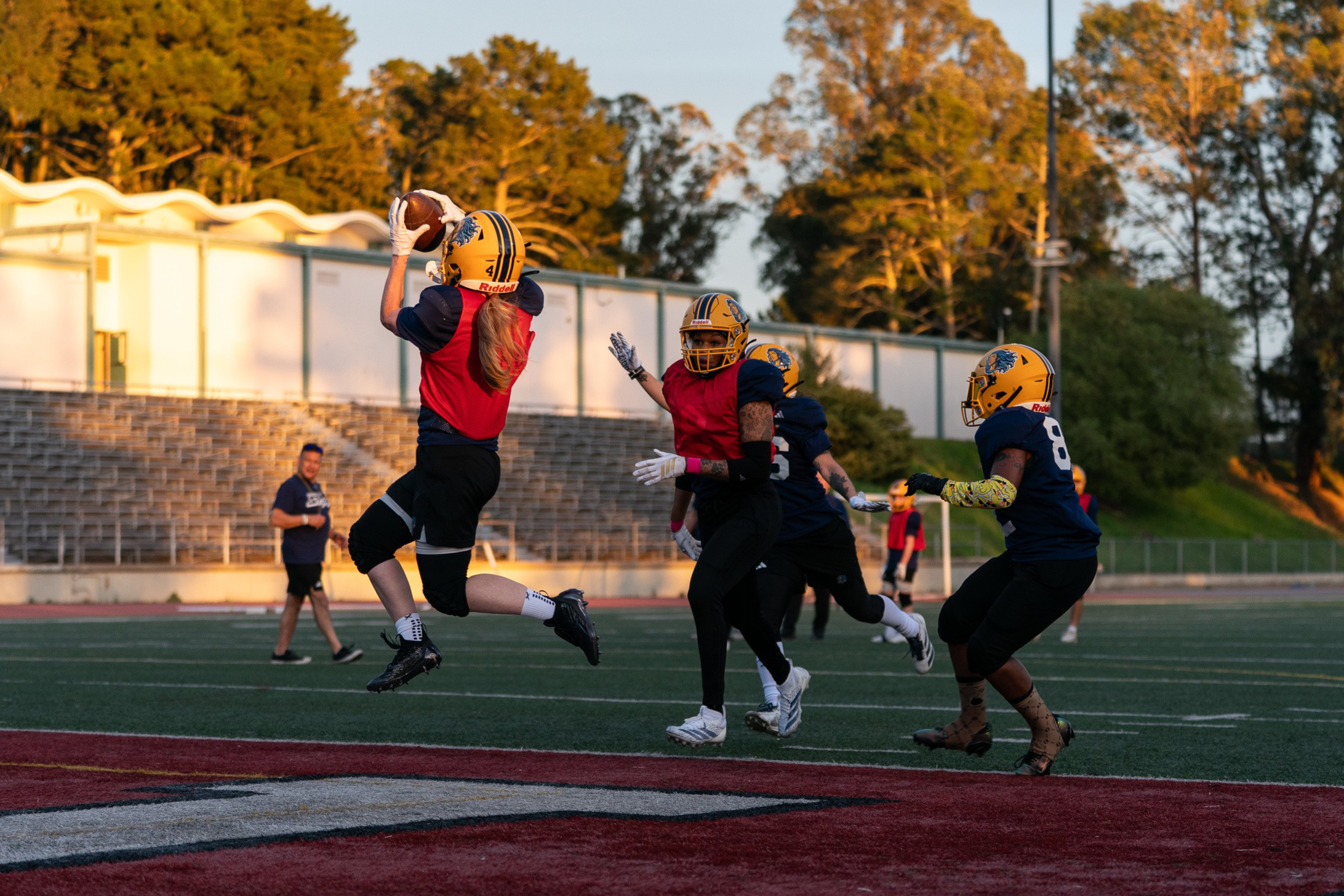
The result is the Golden State Storm, the Bay Area’s newest pro women’s sports team. Owned by Langner and former Google colleague Brad Grovich, who has two daughters, the franchise is set to begin its inaugural season in the Women’s National Football Conference in two weeks.
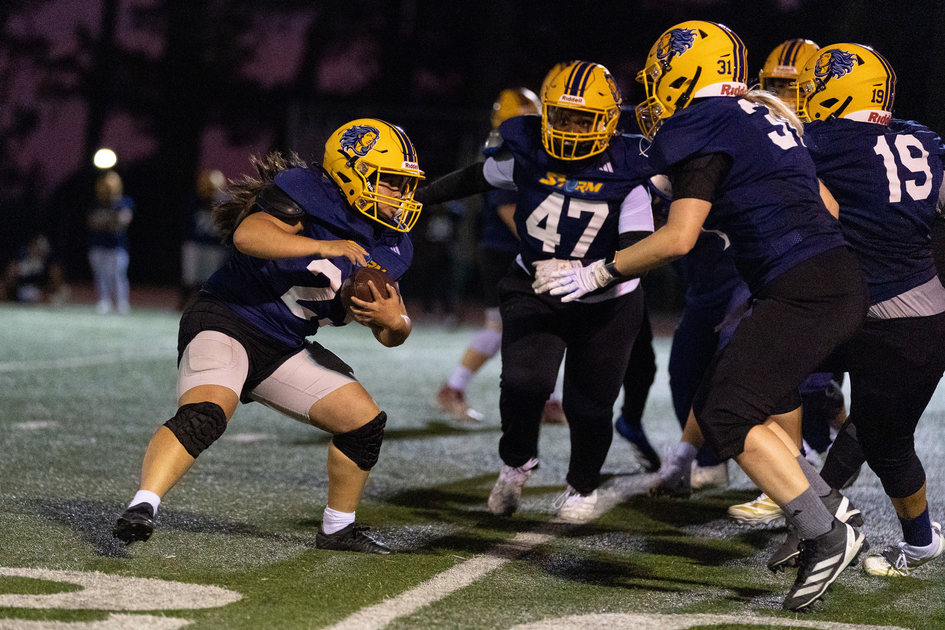
It’s not flag. It’s 11-on-11, fully padded tackle football.
After the team’s launch last summer, interest poured in from prospective athletes. Fifty-five players will be on the roster when the Storm takes the field March 28 at Laney College against the San Diego Rebellion.
“The moment I found out that there was going to be a team, I was honestly probably the first to send out an ‘I’m interested, I want to play right now, right this second’ text,” quarterback Alyssa Dixon told The Standard.
 Quarterback Alyssa Dixon gathers the Storm offense in a huddle. | Source: Jungho Kim for The Standard
Dixon, 29, who has played tackle football since her days at North Monterey County High School, lives in Monterey Bay with her three kids, all under 5 — and makes the two-plus-hour commute north for practices and games.
The inaugural roster includes 40 athletes from California, five international players, and several who have relocated from across the U.S. to join the Storm. Two players hold Ph.D.s, a handful are mothers, many are former college athletes, and one is a local high school senior.
Like their 11-person coaching staff and 33-person front office, Storm players won’t collect a paycheck, but the all-volunteer model has attracted people who want to prove that football is for everyone.
That included the late Laney football head coach and athletic director John Beam, who was an advocate and adviser for the Storm before he was killed in a campus shooting in November. The Storm’s executive team was open to planting roots anywhere in the Bay Area, but after meetings with Beam, Laney’s football legacy — and the legendary coach’s enthusiasm — made the stadium a “natural fit.”
“He didn’t know much about the league or women playing football,” Langner said. “But when he learned about it, he was like, ‘Yes. I want to be involved in this. I want you guys to play here.’”
The WNFC
In its seventh season and considered the premier U.S. women’s tackle league, the WNFC spun out of a women’s league that had operated since the 1970s. The new edition introduced franchise ownership, investment standards, and a more structured model designed to scale like other major sports leagues.
The WNFC’s growth potential appealed to Langner and Grovich, but there was another factor that made the league the right fit: It mandates that each franchise field both tackle and flag football teams. While the initial inspiration came from the flag boom and a crowded field at Los Gatos High, the tech duo realized that limiting women to just one version of football would leave athletes out.
 The Storm will compete in the Women’s National Football Conference, which features four divisions, 16 teams, and more than 1,000 athletes.
“Flag is a really narrow version of the sport,” Langner said, referencing the positions, body-type diversity, and skill sets that are dominant in a flag game that favors mobility, speed, and elusiveness. “By offering tackle and flag, it’s the full platform. We give women the full range of opportunities that are available to men.”
The WNFC’s tackle teams play a six-game season that runs from March to May. The league’s flag football schedule follows a tournament model. The Storm’s flag team has 17 players, approximately one-third of them high school seniors.
A startup model
Langner and Grovich, who have worked in consumer products, sales, and marketing, began their ownership journey by immersing themselves in the WNFC. Through talks with other owners and league leadership, they gathered advice, then set out to recruit.
They created a fractional volunteer system, posting to LinkedIn executive staff and coaching roles — including the head coach job that Dallas Hartwell secured — that required five to 10 hours of unpaid work a week. The response surprised them — there was overwhelming interest and, for some positions, hundreds of applicants.
Acquiring players looked somewhat like a college recruiting process — Langner said he met with families and worked to sell the athletes on a vision that included formidable investment, “meaningfully more” than any other team in the WNFC.
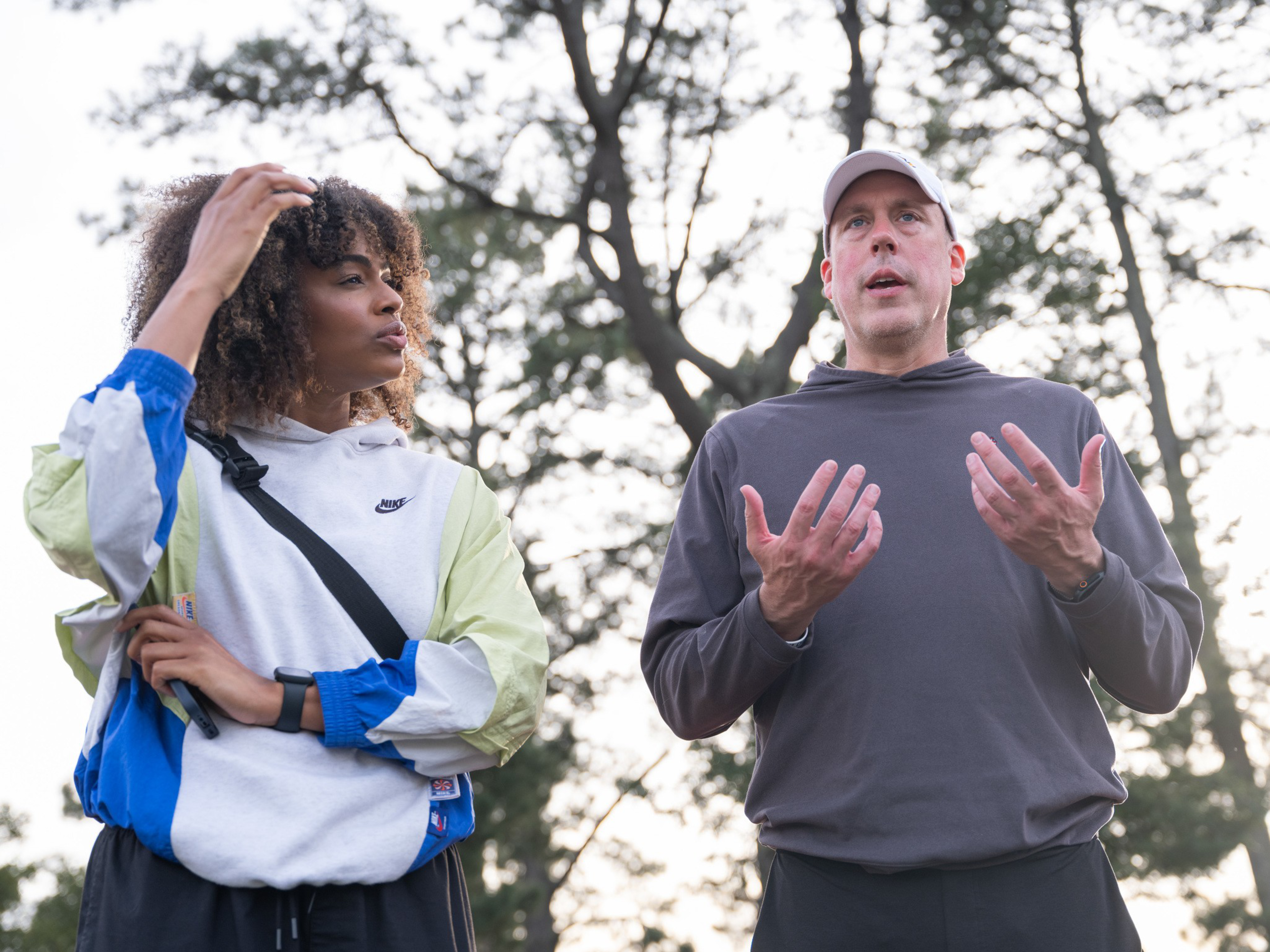 Jake Langner, the Storm’s co-owner, right, speaks alongside Meghin Williams, a member of the team’s board of advisors.
Langner told The Standard that he and Grovich are putting at least $500,000 of their own funds into operating expenses for the inaugural year. That covers uniforms, gear, travel (flights when out of state, charter buses for California matchups), hotel rooms, and the practice facility, among other costs.
The pitch worked.
Outside linebacker Charmaine Bradford, a former college basketball player and Alameda resident, played four seasons in the WFNC for the Seattle Majestics before relocating to join her hometown team. “When I tell you I have never experienced all of this,” she said, “there’s so many different areas where they pour into us as human beings and as athletes.”
The future of women’s football
Coming out of the tech world, with no sports experience, Langner and Grovich are making a big bet that women’s football is nearing its inflection point.
The way Langner sees it, the future of women’s tackle football is tied directly to the explosion of girls flag football. He describes it as a funnel — and right now, the entry point is relatively small.
3 days ago

6 days ago
Friday, Mar. 6
But the youth pipeline is expanding rapidly as states sanction girls flag football programs and the sport spreads through middle and high schools. Colleges are following suit, and the NCAA has recognized flag as an Emerging Sport for Women, committing to institutional support and resources.
The WNFC, eight years into its history, is growing. Three expansion franchises, including the Storm, have entered since 2024, and live games started streaming last season on Victory+. At the league’s start, team ownership was almost entirely former players. Now, angel investors and business people are getting involved.

Langner’s short-term goal has nothing to do with profitability. Any profits made will be invested back into the team, he said, and he’s trying to break even in Year 1. The focus is simple: Chart a course into the mainstream.
“Five years from now, my biggest hope is that it will become harder and harder to find people that have never heard of this,” he said. “My goal is for when I tell people, they are like, ‘Oh, I’ve heard of you guys. I know what you are doing.’” It’s not next year, but it’s also not 20 years from now.”
With growth, the owners will have to consider other ways to invest in their players. Compensation is a long way away, but league-mandated benefits packages could be a next step. As it stands, WNFC teams require athletes to have their own health insurance but do not cover the cost. Langner says that could change in two or three years.
A handful of the Storm’s athletes are already receiving compensation from Name, Image, and Likeness agreements with the organization. But insurance and minimum player compensation is still on the horizon. Even so, Langner isn’t limiting his vision.
“If this thing grows, it could get as close as the WNBA to the NBA — like, this thing is a billion-dollar value, hundreds of millions,” he said. “There is so much potential in this, if this works.”