
A powerful ridge of high pressure dominates the Western U.S. in this model forecast valid for Friday, March 20.
WxBell
It’s not supposed to be like this.
Forecasts are calling for temperatures as high as 114 degrees in parts of California this week. Extreme heat warnings, among the earliest on record, are in effect from Los Angeles to Tucson, Arizona, through Friday. Hundreds of weather stations west of the Rockies are poised to shatter monthly temperature records, in some cases by as much as 10 degrees.
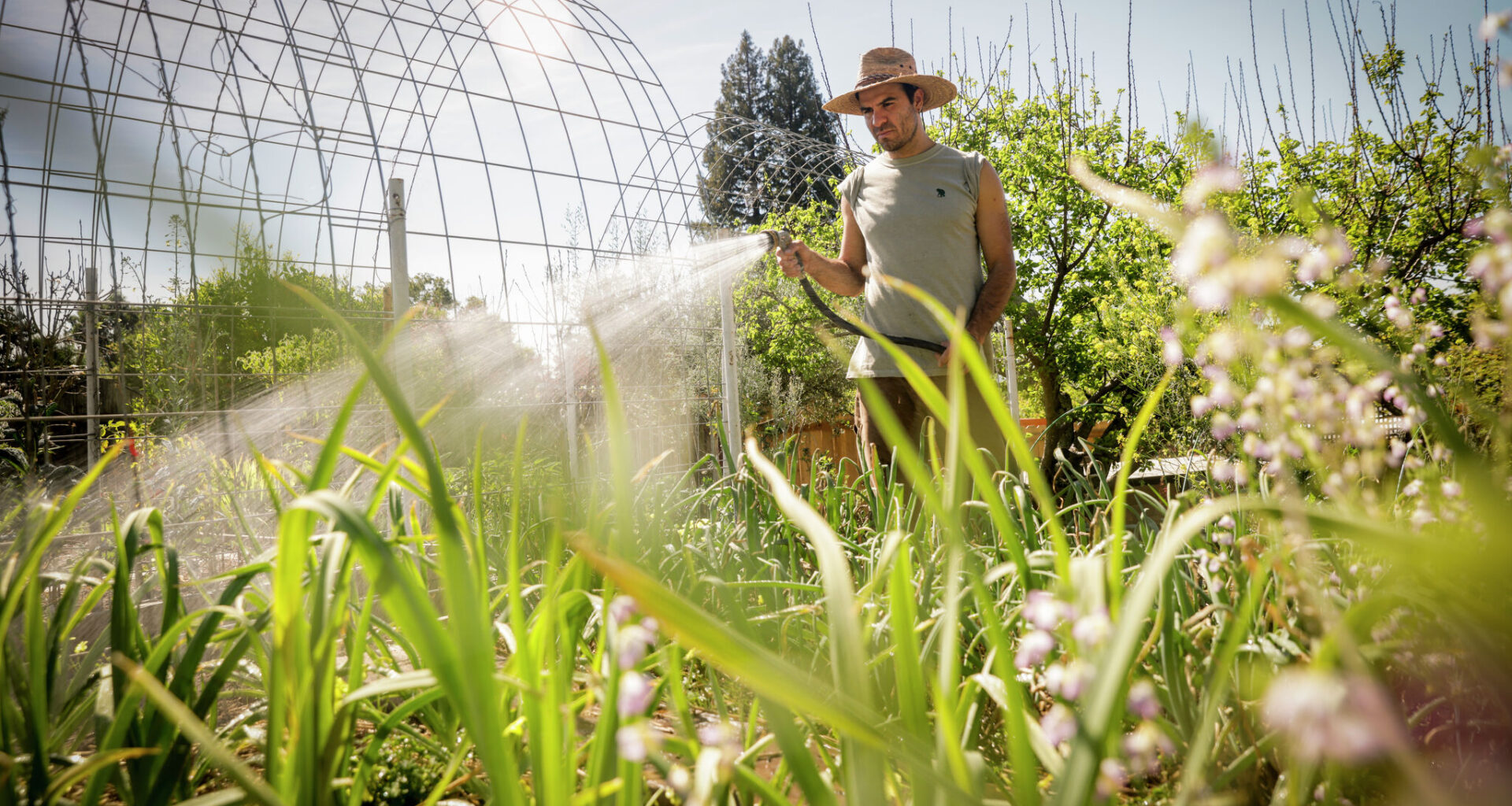
Gardener and beekeeper Manuel “Manny” Garcia waters vegetables at Fig Leaf Gardens in the Laurel District in Oakland on Monday. While most of the 1,400 square-foot garden is prepared for high temperatures, Garcia spends mornings and evenings watering the garden, especially the starter plants, which are more at-risk to the record-breaking temperatures this week.
Brontë Wittpenn/S.F. Chronicle
Those numbers would be eye-popping in the middle of summer. Seeing them in March is something else entirely.
Article continues below this ad
Which raises the obvious question: How does the atmosphere produce a heat wave this extreme while winter technically still has days left on the calendar?
A rare alignment of atmospheric forces
San Francisco Chronicle Logo
Make us a Preferred Source to get more of our news when you search.
Add Preferred Source
Extreme heat waves rarely form from a single trigger. This one developed when several ingredients aligned, allowing a powerful ridge of high pressure to expand and intensify over the western United States.
One of those ingredients sits thousands of miles away.
Article continues below this ad
For the past week, Hawaii has been battered by torrential rain and catastrophic flooding from one of the strongest Kona lows in recent memory. Despite the distance, the storm helped shape the pattern now driving the heat. The powerful system pumped warm, moisture-rich air northward across the Pacific, and as that air rose within storms and released heat into the upper atmosphere, it helped inflate the downstream ridge, a process meteorologists sometimes call a “warm conveyor belt.”
“We’ve always had warm conveyor belts in the North Pacific that help stimulate upper highs in the U.S. West,” said Bob Henson, a meteorologist and journalist with Yale Climate Connections, via a direct message. “The increased Pacific warmth and moisture on our warming planet now seems to be exacerbating the process. We saw this in the Pacific Northwest heat wave of June 2021, and the current pattern has some unnerving similarities. It’s only the lack of June sunshine that will keep this heat from hitting truly frightening levels.”
Water vapor satellite imagery from Monday: The yellow-green arc streaming northeastward from Hawaii traces the moisture plume that has been pumping energy into the upper atmosphere and helping inflate the ridge. The vast orange and red dome over the West is the result, a deep pool of hot, descending air with almost no cloud cover to moderate the heat below.
NOAA
At the same time, the jet stream across the Northern Hemisphere took on an unusually amplified shape, with large north-to-south waves stretching from the Pacific into North America. That configuration is more prone to stalling, which allowed the ridge to grow stronger over days rather than sweeping eastward as it normally would.
The result is a heat dome that is both exceptionally strong and unusually stagnant. Research from Dr. Michael Mann links that kind of stalling behavior to slow-moving planetary waves in the jet stream, a phenomenon known as quasi-resonant amplification. Mann’s team implicated the mechanism in the devastating June 2021 Pacific Northwest heat dome, and his work suggests these configurations are becoming more common as human-caused warming reshapes the jet stream.
Article continues below this ad
The record-setting ridge is also getting help from the ground up.
Across much of the Southwest and Rockies, the soil dryness has been building for more than a year. Multiple seasons of lackluster snowpack, combined with record-hot summers in 2024 and 2025, helped aggressively evaporate whatever soil moisture remained, and left the ground essentially depleted.
Across parts of California, the Desert Southwest and much of the Mountain West, soils are now holding just a fraction of their normal moisture capacity. Dry soil converts incoming solar radiation almost entirely into heat rather than evaporation, aggressively warming the air near the surface. That heat spreads upwards into the atmosphere from below, effectively inflating or strengthening the ridge from the ground up. The soil and the atmosphere are caught in a feedback loop, each making the other worse.
This soil moisture map from Monday shows just how depleted the ground is across the western United States after multiple seasons of below-normal snowpack and record-hot summers. When soils are this dry, incoming solar radiation converts almost entirely to heat rather than evaporation, effectively turbo charging the ridge of high pressure above.
NASA
These ingredients are not random: They are all linked to warming conditions. Kona lows are intensifying as the Pacific warms. A wavy, stalled jet stream is increasingly linked to Arctic amplification, the climate change driven disproportionate warming of the Arctic that is reshaping the hemisphere’s weather patterns. The dry soils blanketing the West are the legacy of a decade of rising temperatures and depleted snowpack.
Article continues below this ad
Spring officially begins at 7:46 a.m. Friday. It’s not supposed to feel like July. But this week, the atmosphere didn’t get the memo, and a growing body of research suggests it may stop getting it altogether.