
Municipal planning and building heights were in the news a century ago in Berkeley. At City Hall on March 17, 1926, the city Planning Commission held a presentation and “general discussion on the regulation of the height of buildings in Berkeley,” according to the Berkeley Daily Gazette.
“A study made of the building conditions in 25 large cities by engineers shows that lower buildings are much more desirable from the standpoint of health, safely, traffic and general improvement of the business district,” the Gazette reported.
“It has been found that high buildings do not allow for ample light and fresh air for those working in them and that a five-story structure is more ideal for these conditions. It has also been found that no fire department has the equipment to work effectively on a building that is more than 85 feet in height, making safety from fire largely dependent on the equipment of the building.”
“It has also been proven … that the average city street will not take care of the traffic that results from buildings of unlimited height … .”
Berkeley zoning in 1926 allowed a maximum height of 150 feet for a new building downtown and limited buildings “to a height of one-and-a-half times the width of the widest street frontage.” The next day, after the meeting, the Gazette reported that participants favored “a six-story-type” of building for the maximum height in Berkeley.
A prominent participant in the meeting was William Wallace Campbell, then the University of California’s president, who told the Commission that — as the Gazette reporter summarized — “the university would hate to see a skyline of ‘skyscrapers’ along Shattuck Avenue even if such structures were no taller than 12 stories. He showed photographs illustrating ‘what effect a row of such buildings would have on the view from the campus.’ ”
Land sale: On March 13, 1926, the Gazette carried advertisements about the sale of the “historic Kellogg property in east Berkeley.”
The real estate brokers, Mason-McDuffie, wrote that “this announcement has a deep significance to those who have watched the remarkable growth of Berkeley since 1905. One by one, the large estates that bordered the campus of the University of California have been subdivided and built upon; one by one the barley fields and hillside pastures that surround the university town have become the sites of homes and gardens.
“The Kellogg property alone, despite its close relation to the university grounds, remained intact.”
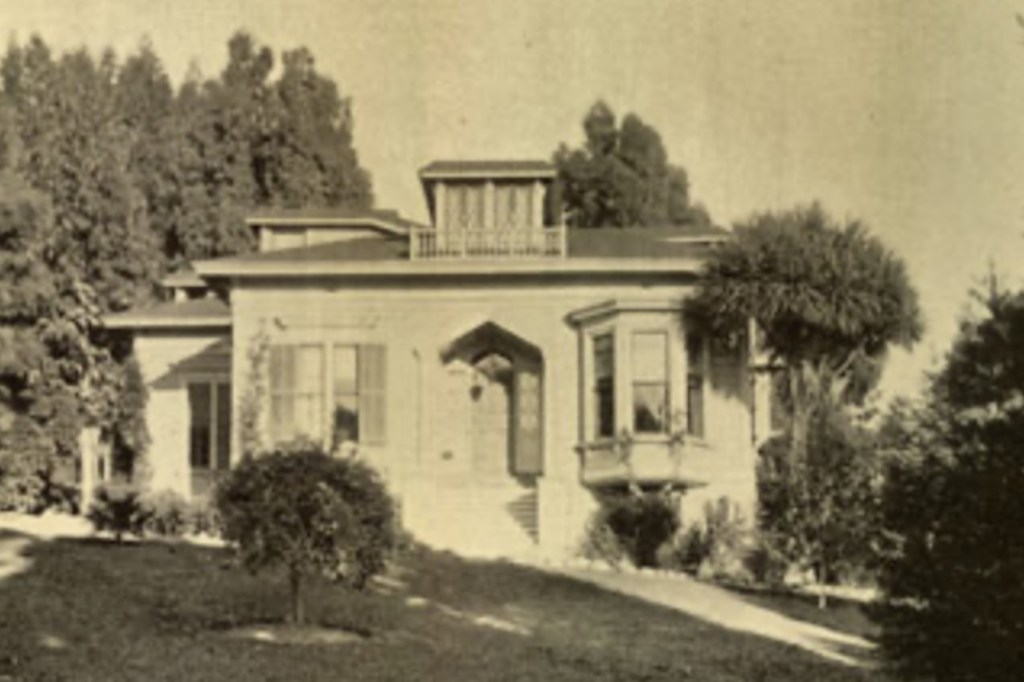
The tract was named for the man who had lived on it and owned it, UC Professor and President Martin Kellogg (he was also the first president of the city of Berkeley’s school board). It seems to have covered what are now the blocks bordered by Hearst Avenue on the south, Oxford Street on the west, Cedar Street on the north and Arch Street on the east.
The advertisements noted that it included the site of the Kellogg home, which had burned in the 1923 fire.
Veterans building: As of March 20, 1926, the city was considering possible sites for the proposed Veterans Memorial Building. At the time, Berkeley had a large number of residents who had served in the Great War (World War I), as well as surviving veterans of the Spanish-American War and even the Civil War.
Two sites were being considered for the new building: one on the corner of Fulton and Dwight Way and the other on Allston Way, opposite the old high school auditorium and about halfway between Milvia and Grove Streets.” Ultimately, a site one block north of the latter location was chosen.
Bay Area native and Berkeley community historian Steven Finacom holds this column’s copyright.