
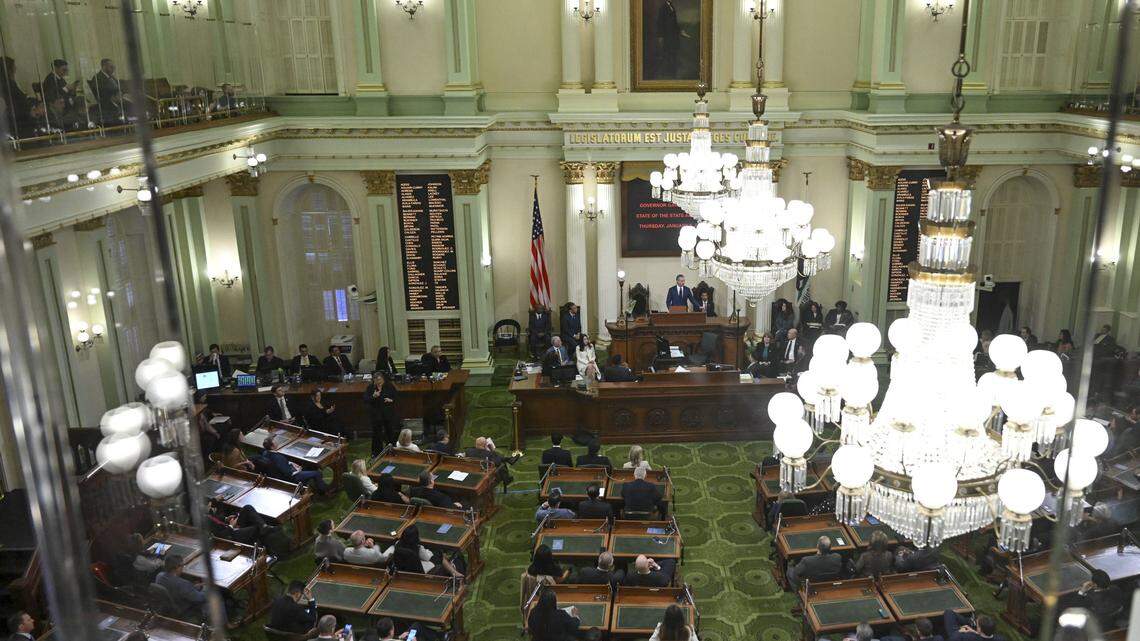
Gov. Gavin Newsom gives his final State of the State address as governor at the California Capitol in Sacramento on Thursday, Jan. 8, 2026. Newsom has generally expressed opposition to new revenue raising proposals as the Leigslature confronts a budget deficit.
Hector Amezcua
hamezcua@sacbee.com
Major labor unions launched an effort this month to push California lawmakers to tax large corporations more, with some of the state’s most powerful unions backing a multi-year campaign they say will make sure businesses don’t rake in huge profits while public services are undermined.
The campaign is called UnRig California.
Since last year, when the Legislature, at Gov. Gavin Newsom’s urging, froze the enrollment of undocumented immigrants in the state’s health-care program amid budget pressures from the Republican-controlled federal government, progressive lawmakers in Sacramento have been pitching revenue-raising proposals to close the state’s budget deficits without deeper cuts. As this year’s legislative session picks up steam, lawmakers have introduced bills to tighten the tax code for offshore corporations and real estate investment groups.
At a state house rally organized by SEIU California last week, labor leaders said they’d be backing those legislative efforts and a proposal to impose a fee on corporations whose workers rely on state benefit programs like Medi-Cal or Cal-Fresh because of low wages and a lack of benefits.
Last month, Assemblymember Mia Bonta, D-Alameda, introduced a bill that could become a vehicle for that policy, cosigned by 16 other assemblymembers, though it does not yet have detailed language. Bonta told The Sacramento Bee last week that proponents of the measure are still weighing if it’s best advanced as separate legislation or through the budget. Proponents estimate the measure targeting offshore corporations could raise as much as $3 billion. The fee imposed on companies who Bonta and other advocates say are taking advantage of Medi-Cal to support their employees could raise far more than that.
Depending on how its structured, the fees could raise as much as $17 billion, Bonta said at a press conference Tuesday.
Rally participants held signs targeting Amazon, Wal-Mart and McDonalds. Corporations and the wealthy have seen large gains from tax cuts pushed by President Donald Trump, while the state struggles to reconcile with the accompanying cuts to federal health and human services programs.
The current tax code represents “socialism for the rich, and capitalism for the workers,” Arnulfo De La Cruz, President of SEIU Local 2015, said at the rally.
SEIU is joined by a who’s who of labor unions, including the California Teachers Association, United Domestic Workers and the California Labor Federation, which represents more than 1,300 unions. It’s a politically potent coalition — labor’s influence on the Legislature ranges from campaign donations to endorsements and a get out the vote apparatus during election season. Leaders of the campaign say the One Big Beautiful Bill Act, which both extended tax cuts from Trump’s first term and slashed deep into federal social service funding, has created momentum in Sacramento for measures that have failed in the past
“California leaders cannot afford to stand by,” SEIU California Executive Director Tia Orr said in a statement. “The time is right for the Legislature to act and make real change to California’s tax code.”
Embracing a tax the rich sentiment isn’t limited to the Statehouse. Gubernatorial candidates are also touting tax proposals on the wealthy and corporations. Then there’s SEIU-UHW’s billionaire tax ballot measure proposal, which has spurred national debate.
Polling suggests Californians support taxing corporations more to maintain the state’s social programs without burdening individual residents, who already face costs of living higher than most of the country. According to the Public Policy Institute of California’s February statewide survey, 61% of adults favor closing the state’s budget deficit by raising state taxes paid by the wealthiest Californians. The same survey found 55% of adults would rather pay less taxes themselves and have less state services as a result.
That sentiment isn’t new for Californians, said Mark Baldassare, the survey’s director.
“Most people feel they’re paying more than their fair share in taxes,” he said. “There’s a distrust of government at both the state and federal level and a feeling that people are getting advantages they don’t have and generally that’s the wealthy and corporations.”
But Californians also support a robust social safety net, he said, and whiplash from Trump’s tax and budget cuts are generating more interest in tax proposals that target the rich.
“There is uncertainty, perhaps unprecedented uncertainty, of what the federal government is going to support,” Baldassare said.
With policy details still being shaped somewhat behind the scenes, the nature of opposition to the legislative campaign has yet to coalesce — except for the offshore corporation measure, sponsored by Assemblymember Damon Connolly, D-San Rafael, which has drawn fire from tax think tanks who say the bill seeks to tax corporations for more than California’s fair share and will disrupt global commerce to the state.
David Kline, vice president of communications for the California Taxpayers Association, said the affordability argument cuts both ways in the tax debate. “California is way too expensive,” he said, “their proposed solutions for the problems just would make it worse.” Corporations will pass tax increases on to customers, cut jobs or leave the state, he said.
Kline attended the rally and said he didn’t hear any convincing arguments that tax increases on corporations would do anything for working class people, but instead just grow government spending to the benefit of labor unions. “Public employee unions vehemently oppose any reductions in spending and economizing and just view the taxpayers as an endless source of new revenue,” he said.
Those arguments have blunted voter enthusiasm for ballot measures to increase corporate taxes before, according to Baldassare. The support for taxing others, “is vulnerable to the argument that there might be unintended consequences,” he said.
Wealthy CEOs are pouring money into campaign committees to fight the billionaire tax, maintaining it will hurt state revenues in the long run by driving people who pay the most in income taxes out of California. It remains to be seen what form the debate over more targeted measures inside the Statehouse will take. Two-thirds of the lawmakers in each chamber must back any tax raising measure for passage.
Also uncertain is how Newsom, who has fiercely opposed the billionaire tax, might consider the legislation.
The governor, who is considering a presidential campaign in 2028 where he would likely face Republican attacks over California’s high taxes, has expressed wariness toward new tax measures at large. Members of his administration have told lawmakers Newsom is not interested in revenue proposals.
This story was originally published March 17, 2026 at 10:55 AM.
Related Stories from Sacramento Bee
The Sacramento Bee
Andrew Graham reports for The Sacramento Bee’s Capitol Bureau, where he covers the Legislature and state politics. He previously reported in Wyoming, for the nonprofit WyoFile, and in Santa Rosa at The Press Democrat. He studied journalism at the University of Montana.