
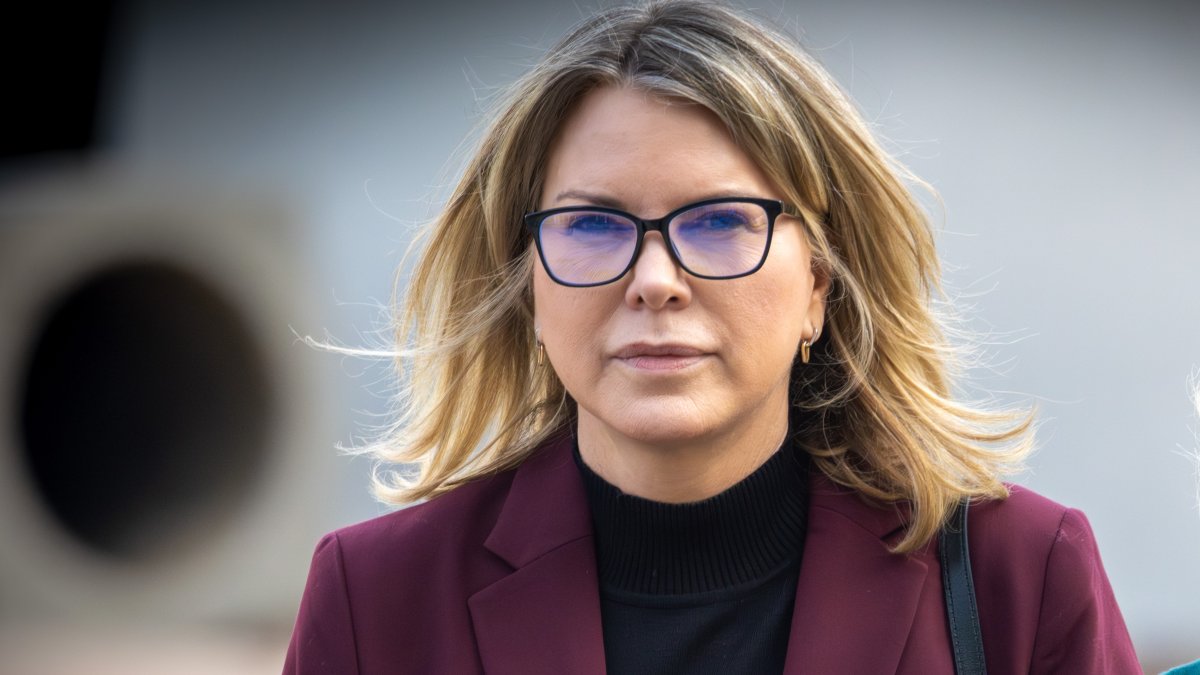
A state appeals court panel has upheld the conviction of Grossman Burn Foundation co-founder Rebecca Grossman, who was sentenced to prison for a 2020 crash that killed two young brothers in Westlake Village.
Grossman was convicted Feb. 23, 2024, of two counts each of second-degree murder and vehicular manslaughter with gross negligence and one count of hit-and-run driving in the Sept. 29, 2020 deaths of Mark and Jacob Iskander, ages 11 and 8. She was sentenced to 15 years to life in prison.
Grossman had been facing a maximum of 34 years in prison.
During the trial, prosecutors argued Grossman and her then-boyfriend — former Dodger Scott Erickson — had been out for drinks earlier that evening and were heading toward her nearby home in separate vehicles when Grossman’s white Mercedes-Benz SUV struck the boys while they were crossing Triunfo Canyon Road with their parents in a marked crosswalk.
Six family members were crossing the three-way intersection — which does not have a stoplight — in the crosswalk when the two young boys were struck. The older boy died at the scene and his 8-year-old sibling died at a hospital.
Prosecutors alleged Grossman was driving at 81 mph in a 45-mph zone seconds before the crash.
Grossman continued driving, eventually stopping about a quarter-mile away from the scene when her car engine stopped running, prosecutors said.
The appeals court panel’s 143-page filing included Grossman’s reasons for appeal:
“On appeal, Grossman contends: the court gave erroneous instructions on implied malice; the evidence was insufficient to establish implied malice and hit and run; the court applied the wrong standard for subjective implied malice in deciding the motion for new trial; the court abused its discretion by admitting character evidence and evidence that was unduly prejudicial; the prosecution improperly argued a theory of guilt in Grossman’s trial that was inconsistent with its theory in the prosecution of former codefendant Scott Erikson; the court erred by refusing to suppress statements Grossman made to officers during a custodial interrogation in violation of her Miranda rights; the court erred in denying Grossman’s request, pursuant to Franks v. Delaware (1978) 438 U.S. 154 (Franks), for an evidentiary hearing on her motion to traverse the warrant used to obtain a blood sample; the court erred in denying Grossman’s motion to suppress blood sample evidence under the Fourth Amendment; the court abused its discretion by excluding evidence that Grossman sought to introduce in her defense; the court erred by finding true the aggravating factor that the victims were particularly vulnerable; and the court abused its discretion by ordering destroyed all identifying information obtained from jurors during voir dire.”
Grossman’s attorneys said during the trial that it was Erickson who struck the boys first with his black SUV. Erickson was never called to testify in the case.
At her sentencing hearing, Grossman said she wanted the boys’ family to know “how sorry I am” and said she did not see the boys in the street.
“God knows that I never saw anybody,” she said. “I never saw anyone. I believe he knows the truth.
“I will carry this with me (until) my dying breath.”