
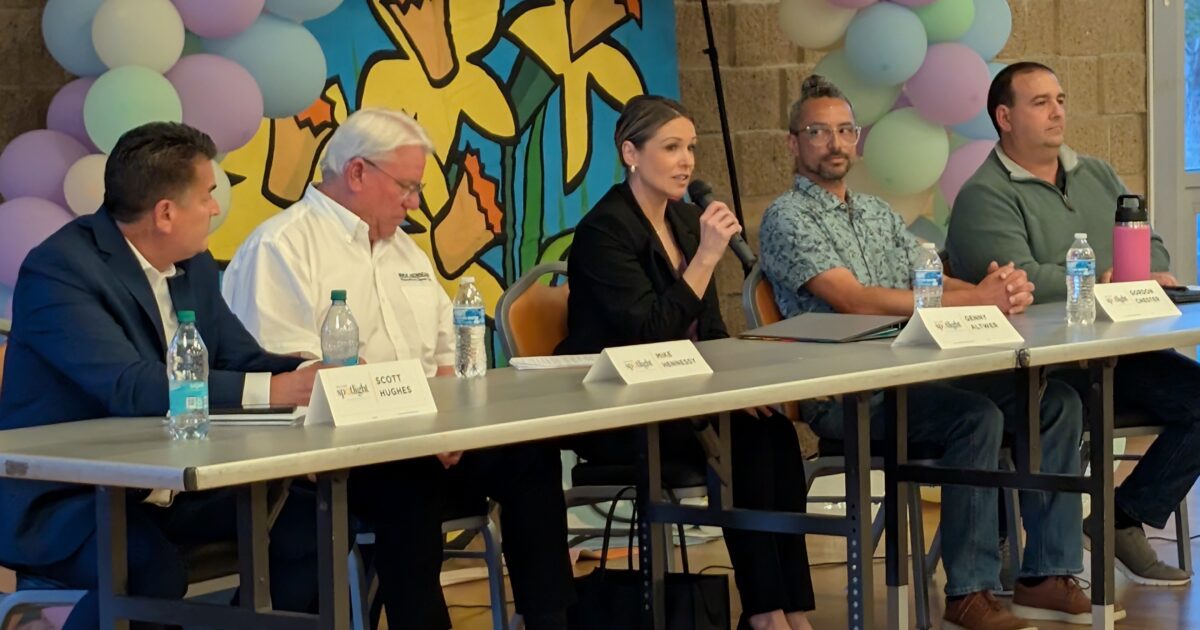
Candidates running to represent District 9 on the San Jose City Council shared competing visions for public safety, housing and the city’s finances during a candidate forum.
The March 9 discussion, hosted by San José Spotlight and the League of Women Voters of San Jose/Santa Clara, brought five candidates to the Camden Community Center to answer questions about how they plan to carry the torch after Vice Mayor Pam Foley terms out at the end of the year. District 9 is the only open council seat in this year’s busy election cycle.
The candidates vying for the District 9 seat include Scott Hughes, who serves as Foley’s chief of staff, Mike Hennessy, a serial entrepreneur, TV host and civic organizer, longtime city employee Gordon Chester, licensed marriage and family therapist Genny Altwer and Rick Ator, a tech worker and entrepreneur.
Each outlined their priorities ranging from homelessness and affordability to increasing police staffing and balancing the city’s budget.
Public safety
Public safety emerged as a central topic throughout the forum, with multiple candidates pointing to police staffing as an ongoing concern.
The San Jose Police Department has one of highest vacancy rates since voters approved Measure B in 2012, which reduced benefits for existing and new city workers and led to years of fallout and controversy — including numerous lawsuits and an exodus of police officers.
Hughes said San Jose needs significantly more officers to meet the needs of a city with more than 1 million residents.
“We are about 400 officers shy of where we were at the high point, and we need to get back to that, but it’s gonna take time,” he said.
Altwer, who previously worked in law enforcement, concurred and emphasized that a safe city is essential for addressing other issues.
“Without having a safe city for us to live in, all the other things don’t fall into place,” she said.
Hennessy also pointed to neighborhood crime concerns, saying residents expect stronger enforcement and accountability.
“If people are committing crimes and they’re not being prosecuted, we’re going to continue having crime,” he said.
Chester tied public safety to broader community planning, including ensuring safe streets for children and older adults.
“We need to make sure people feel safe in their neighborhoods,” Chester said.
Ator said safety and affordability are two most crucial services District 9 must have. Everything from water to taxes are services that need to be affordable to existing residents, he said.
“I plan to fully fund the police force,”Ator said. “We deserve to feel safe in our city.”
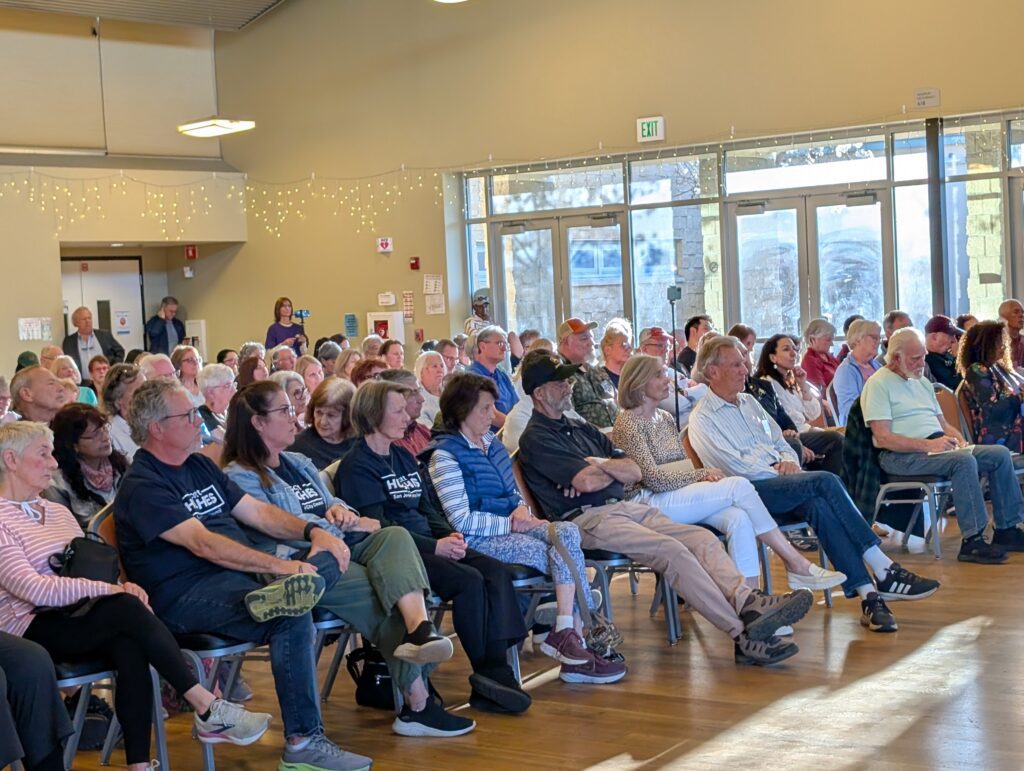 Residents filled the room to hear five candidates in San Jose District 9 pitch their case for becoming the next city councilmember. Photo by Moryt Milo.
Housing and affordability
Candidates also discussed the city’s housing shortage and rising cost of living — an issue several said impacts homelessness and economic stability.
San Jose has been ranked No. 1 for the least affordable city in the world for first-time homebuyers in a new global study, underscoring how far housing costs have outpaced wages in the heart of Silicon Valley.
The findings come as San Jose leaders continue to debate how to address a housing crisis that has increasingly priced out not only low-income residents, but also middle-class workers who keep the city running.
“So without enough available and affordable housing, we just can’t move forward,” Hennessy said. “And I think we really need to focus more on increasing our housing availability.”
Chester said he anticipated that Measure A, the 2016 voter-approved $950 million bond, would help fund emergency and temporary housing to help people transition into permanent home. But homelessness and high housing prices are still an ongoing issue in District 9.
“Measure A insulted me, at least, as a measure that was supposed to be helping us for emergency rent housing and for permanent portable housing,” he said.
Referring to Measure A, Hughes said significant progress has been made to help get residents off the streets and into temporary housing. But affordable, permanent housing is key.
“You know, right now, we actually doubled our shelter system in just one year,” Hughes said. “We have approximately 2,100 beds, along with some hotels that we are leasing out at the moment, but about 30% of those that are in our shelters have jobs, but they just can’t afford to live in your traditional apartment or house.”
Budget challenges
Candidates were also asked how they would approach the city’s projected $56-million budget deficit and if they had supported Measure A, a general sale tax increase passed by county voters last year to help the public health care system’s deficit due to federal and state cuts.
Altwer said essential services such as police, fire and emergency dispatch should not face cuts. She said funding for essential services such as law enforcement, fire response and 911 dispatch must be protected to keep the city running safely.
“Before we start imposing any new taxes on residents, we need to prove that we can use the money we already have wisely,” Altwer said.
Hughes said economic development — particularly attracting businesses downtown — could help increase city revenue.
“We need to look at how we can create a vibrant downtown without a clean and vibrant and safe downtown,” he said. “There is no large city that’s been successful. We need to look at bringing other opportunities downtown.”
Ator said he’d advocate for the growth of small businesses in the city.
“We need to figure out how we’re supporting our small businesses,” he said.
Surveillance technology debate
The candidates also weighed in on the city’s use of automated license plate readers — camera technology police use to help investigate crimes. The privacy issue has been a hot topic of late since a number of neighboring cities have cut ties with Flock, the same vendor San Jose uses.
Hennessy and Altwer agreed the cameras could help law enforcement solve cases, but if the majority of people don’t want this then it should be voted on.
“I think they’re kind of a very good thing. There needs some alterations. I am a fond believer of democracy,” Hennessy said.
Altwer is in full support of the parameters the city council voted on earlier this month for the automated license plate readers, and said they help solve more crimes than they get credit for.
“When it comes to Flock cameras, I am former law enforcement,” she said. “I have viewed in person and seen our real time intelligence center. It is fantastic what our police department does to prevent crime, to solve crimes, things that most of us in this room don’t even know what happened within the city of San Jose.”
Chester and Ator said the technology may have benefits, but must include safeguards to protect privacy, and helping residents understand how it works would be beneficial.
“I believe that it’s possible for the (automated license plate readers) to work effectively,” Chester said. “However, until I find out how it can be done effectively, that’s where I’m gonna get my confidence from — a high quality example to make sure that we keep all of your freedoms safe because that’s what we need to do first.”
Ator asked attendees if they liked and disliked automated license plate readers, and the majority didn’t raise their hands to vote. He proposed that, if feasible, a private database would be best to avoid leaks — but at the end of the day it’s up to the residents to vote.
“I’m here to see what you want and yes, there’s technology out there, and maybe if it’s such great technology, you need to do a better job of showing people how it works, how our deal is safe,” Ator said.
Contact Maryanne Casas-Perez at [email protected].