
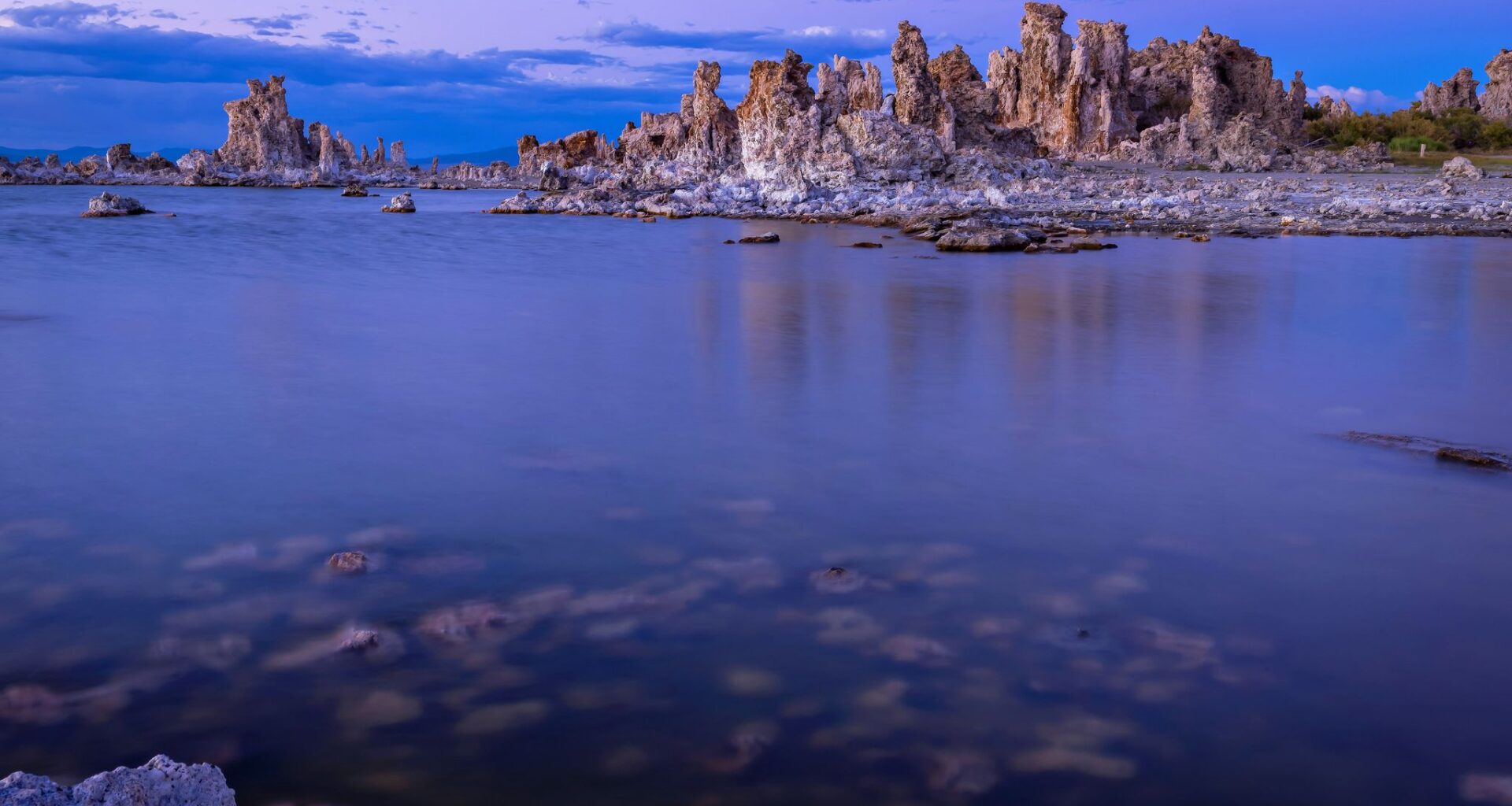
Mono Lake, seen here in July 2022, is a saltwater lake in the Eastern Sierra known for its tufa towers and alkali shores. The lake is large but depleted by inadequate runoff. Water withdrawals for the city of Los Angeles also are taking a toll, a state report says.
Carlos Avila Gonzalez/The ChronicleA new state-commissioned report finds Mono Lake in the eastern Sierra has only a 1 in 3 chance of reaching its target water level by mid-century if current water exports to Los Angeles continue.Halting water exports would significantly increase the likelihood of the lake reaching its target, but climate change could still lower lake levels by up to 6.5 feet by the end of the century.Los Angeles officials dispute the report’s findings, arguing their water draws are a small fraction of the basin’s total supply.
To save California’s celebrated yet very parched Mono Lake, the city of Los Angeles needs to stop taking water from the basin, or at least sharply curtail its draws.
That’s the takeaway from a new, state-commissioned report on how to revive the depleted saltwater body, widely known for its extraordinary tufa towers and curious alkali shores.
Article continues below this ad
But that’s not the only takeaway. Even if Los Angeles is to halt pumping from the remote eastern Sierra watershed — and the city has no intention of doing so — the report says Mono Lake will still struggle to rise to healthy heights, due to the drying effects of climate change.
Evaporation, according to the report, will increasingly siphon water from the basin, exacerbating the low lake levels that have raised water salinity, thrown a wrench into the food web that includes countless migratory birds and caused dust storms to rise furiously from the exposed lakebed.
The rather grim findings complicate matters for California water regulators. The State Water Resources Control Board has expressed interest in revisiting water policy at the lake, acknowledging that landmark guidelines established there three decades ago to curb water exports by Los Angeles aren’t working. The fix, as suggested in the new report, will be much tougher than expected.
A Bishop man and his son check out a measuring gauge once used to measure Mono Lake’s level before it receded, as seen in July 2022.
Carlos Avila Gonzalez/The Chronicle
The report was based on modeling by a research team at UCLA and presented to the state water board Tuesday. Regulators noted the possibility of restricting more water from Los Angeles in the future, but they didn’t say whether or when they would move ahead with such a politically fraught prospect.
Article continues below this ad
San Francisco Chronicle Logo
Make us a Preferred Source to get more of our news when you search.
Add Preferred Source
“There’s a lot to think about here as we go forward,” said Sean Maguire, one of the five members of the state water board’s governing body. “This is the first discussion in decades, frankly, before the board. So this is a very important, significant moment.”
Alex Hall, the lead author of the new report and professor in the Department of Atmospheric and Oceanic Sciences at UCLA, told the water board that short of halting all pumping in the basin, just reducing it would be beneficial for the lake.
“With adjustments to exports, especially carefully chosen adjustments, you can get recovery outcomes that are almost as good as no exports at all,” he said.
The problems at Mono Lake were supposed to be solved with regulation in 1994. Following a nationwide campaign to save the lake, the state water board set limits on how much water the Los Angeles Department of Water and Power could take from the streams feeding the lake, which the agency then pumps 350 miles to the south.
Article continues below this ad
While water levels have since risen above the 40-foot drop that the lake experienced last century, they haven’t hit the level that scientists deem necessary to restore the lake and its ecosystem. The goal is for the lake’s surface, every April, to reach an elevation of 6,391 feet. Water levels have generally remained 8 feet or more shy of the target.
A water level measuring gauge sits on dry land at Mono Lake in July 2022.
Carlos Avila Gonzalez, Staff Photographer / The Chronicle
In 2022, during a severe drought, the lake got so low — more than 12 feet below the target — that coyotes threatened to cross an emerging land bridge, to prey upon newly hatched baby birds on one of the lake’s islands. Researchers at the lake worried about the fate of the population of California gulls, about a quarter of which nest in the basin.
The problems during the recent drought prompted state water regulators to reopen conversations about management of Mono Lake. This included contracting with UCLA’s Center for Climate Science to create a model to better evaluate water policy as well as potential changes to it.
The modeling shows that Mono Lake has just a 1 in 3 chance to reach its target level by mid-century if the current amount of water continues to be pumped from the basin.
Article continues below this ad
Eliminating water exports, however, would roughly double the likelihood of Mono Lake hitting the target, to a roughly 2 in 3 chance, according to the modeling.
Still, climate change, which is expected to increase temperatures and therefore evaporation, threatens to undermine improvements that would come with halting water diversions. By the end of the century, climate change could lower lake levels by as much as 6.5 feet, the modeling shows.
The chance of Mono Lake reaching its target by mid-century, even if water exports cease, is less than 3 in 4 because of intensifying heat and evaporation. The modeling suggests that the most severe climate scenario could lower the chance of hitting the target, with no exports, to 1 in 2 by mid-century.
Officials with the Los Angeles Department of Water and Power, who were also present at Tuesday’s state water board meeting, raised doubts about UCLA’s work.
They shared their own modeling, which showed a “high likelihood” of the lake rising to the target level in 30 to 40 years with Los Angeles continuing to withdraw water. They said the city’s water draws were a small fraction of the total water in the basin — they’ve estimated recent draws at 12% of the water in the creeks — and maintain they’ve had little impact on what was happening there.
Article continues below this ad
“It’s very evident the lake level is driven by hydrology, not exports,” said Eric Tillemans, an aqueduct manager for the agency. “The future of Mono Lake levels are more dependent on precipitation, evaporation and runoff than any other factors.”
Los Angeles gets about 2-3% of its water supply from the basin.
Geoff McQuilkin, executive director of the Mono Lake Committee, which advocates for the lake’s restoration and has also done modeling on the basin’s future, disputed the claims of the Los Angeles Department of Water and Power. He said the clear path forward is to rein in the city’s exports.
“We’ve tried one plan for 30 years and it hasn’t gotten the lake there. Let’s try another plan,” he said. “This (UCLA report) should give the water board some confidence that if they move ahead with decreasing diversions they can be impactful in reaching the 6,391-level required.”