
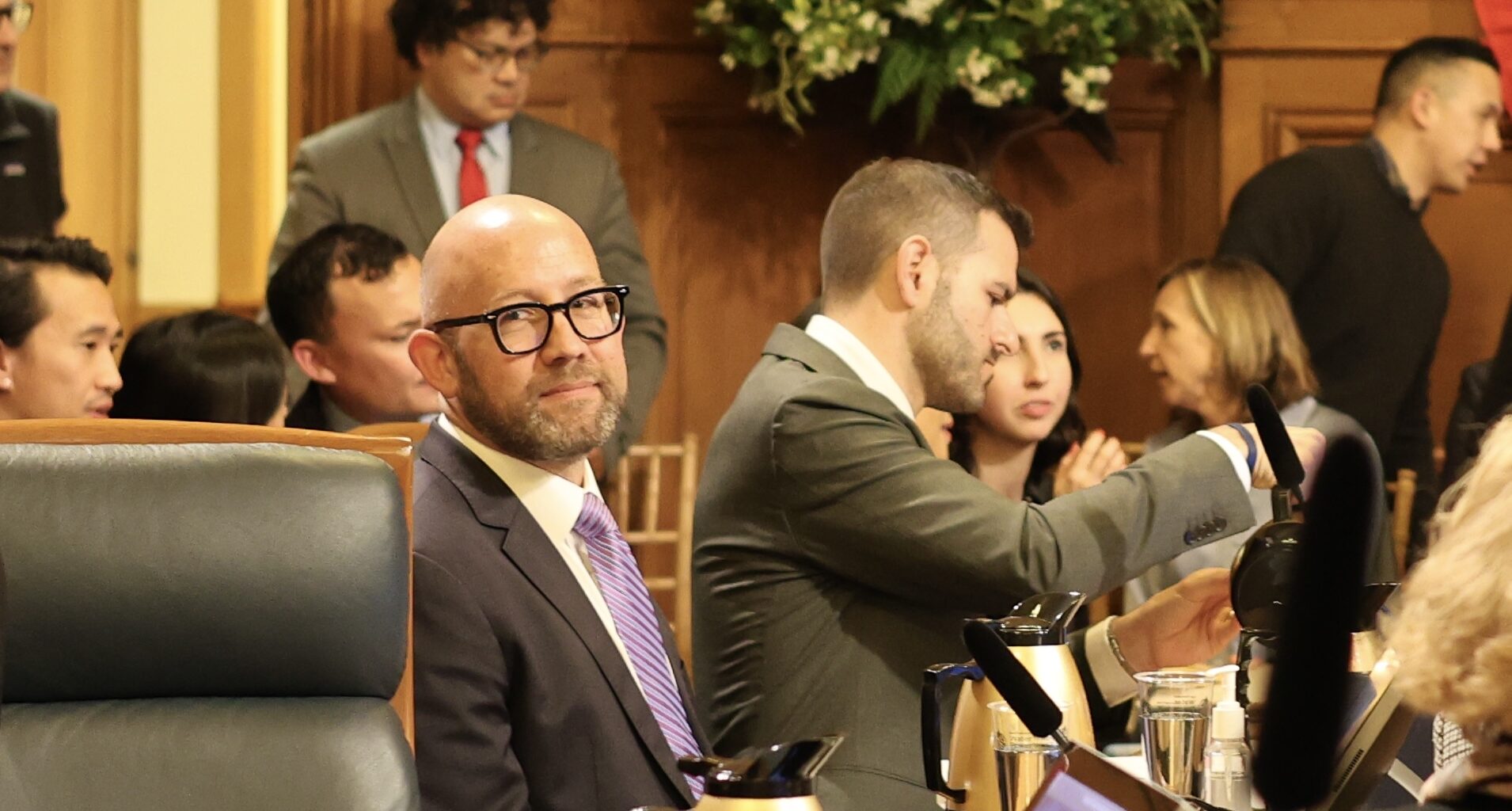
San Francisco supervisors on Tuesday held a hearing on recommendations to cut or weaken the power of dozens of city commissions — and indicated they will not pursue any controversial suggestions.
“I don’t think we’ll touch many of the live wires,” Board President Rafael Mandelman said.
Instead, Mandelman announced that he was planning to draft a charter amendment with only select “non-controversial” recommendations from a report by the Commission Streamlining Task Force, as Mission Local reported Monday.
“There are in that report and in that charter amendment, a host of recommendations that are non-controversial … I think,” Mandelman said to a ripple of laughter from the crowd of about 80 people. Eliminating city commissions has engendered strong opposition, and supervisors have been reticent to expend political capital on the task.
On Tuesday, even suggestions that had previously received little opposition were criticized by public commenters.
That included proposals to loosen strict experience requirements that make it hard to find members for some commissions. One person on the Ballot Simplification Committee must be a reading education specialist, for instance.
But making it easier to fill roles “should not come at the expense of expertise and lived experience,” one person said.
The only suggestion that seemed truly non-controversial was getting rid of defunct bodies.
The board’s consideration of commission reform is the culmination of a years-long public process featuring dueling ballot measures and tens of millions in political spending. With Mandelman’s pledge to move forward on only the most anodyne of recommendations, the movement to cull San Francisco’s many commissions may end not with a bang but a whimper.
And, also: complaints. Some 60 public commenters laid into the board and the Commission Streamlining Task Force for more than two hours.
The city’s contemplation of commission streamlining was sparked by rival ballot measures in the November 2024 election. The since-defunct political pressure group TogetherSF and others sunk some $9.5 million into the campaign for Prop. D, which would’ve arbitrarily capped city commissions at 65. Its proponents argued that commissions made government inefficient.
But, despite a massive warchest, only 43 percent of voters found Prop. D appealing. In the end, 53 percent opted for Prop. E, backed by $117,000. It created the Commission Streamlining Task Force to consider the city’s many commissions one by one.
But the task force was soon accused of going beyond its mandate. Instead of just culling inactive bodies, it also recommended stripping away decision making and oversight authority, moving bodies from the charter to the administrative code where they could be tampered with more easily and merging commissions with similar mandates.
At Tuesday’s meeting, Supervisor Shamann Walton issued a sharp rebuke of the task force.
“Proposing to change bodies that the community voted on that are in the charter, proposing to eliminate independent oversight of law enforcement bodies, all those things are just mind boggling to me,” he said.
He also criticized the pursuit of government efficiency “at the expense of diversity, at the expense of community voice.”
And members of the public agreed. In over two hours of public comment, over 60 commissioners, former commissioners, appointers, and others showed up to defend their current or former posts. It was an ample demonstration of the fierce resistance — and political consequences — the Board of Supervisors would incur by culling active commissions.
“I promise to make it my 2026 magnum opus to make sure everybody knows who votes here,” one commenter said. “Everybody’s going to find out where you stand.”
One woman, who came with her children, said she brought them because “I wanted them to see what side of history you were going to stand on. Were you really going to stand on the value of community first?”
The board seemed prepared to answer yes.
For Mandelman, pursuing uncontroversial changes makes sense. The task force’s charge, he said, was to “think through what was the most reasonable, rational version of our charter.”
“But that’s not what politics is.”