
The Abridged version:
Oak trees and field grasses, both flowering right now, are common causes of springtime allergies.
Allergists recommend trying nasal steroids before considering over-the-counter oral antihistamines.
Oak and grass pollen should calm in the next few weeks, but watch out for pine pollen in early June.
This story was reported by a member of the Abridged by PBS KVIE Community Reporters program. The Community Reporters program empowers local residents to report stories with guidance and support from the Abridged editorial staff.
The first day of spring is around the corner, but for much of the Sacramento region, it’s already sprung. And each year, with warmer weather comes the onslaught of pollen.
If your senses feel clogged, itchy and raw, you aren’t alone. There are a lot of allergens in the breeze and this week is the peak of flowering for many native plants.
Why are allergies so bad right now?
If you walk along the river or through your neighborhood, you’ll see sycamores, maples and elms starting to produce small green buds. However, those aren’t causing the itchy eyes and sore throats of hay fever.
The main culprits? Oak trees and exotic grasses.
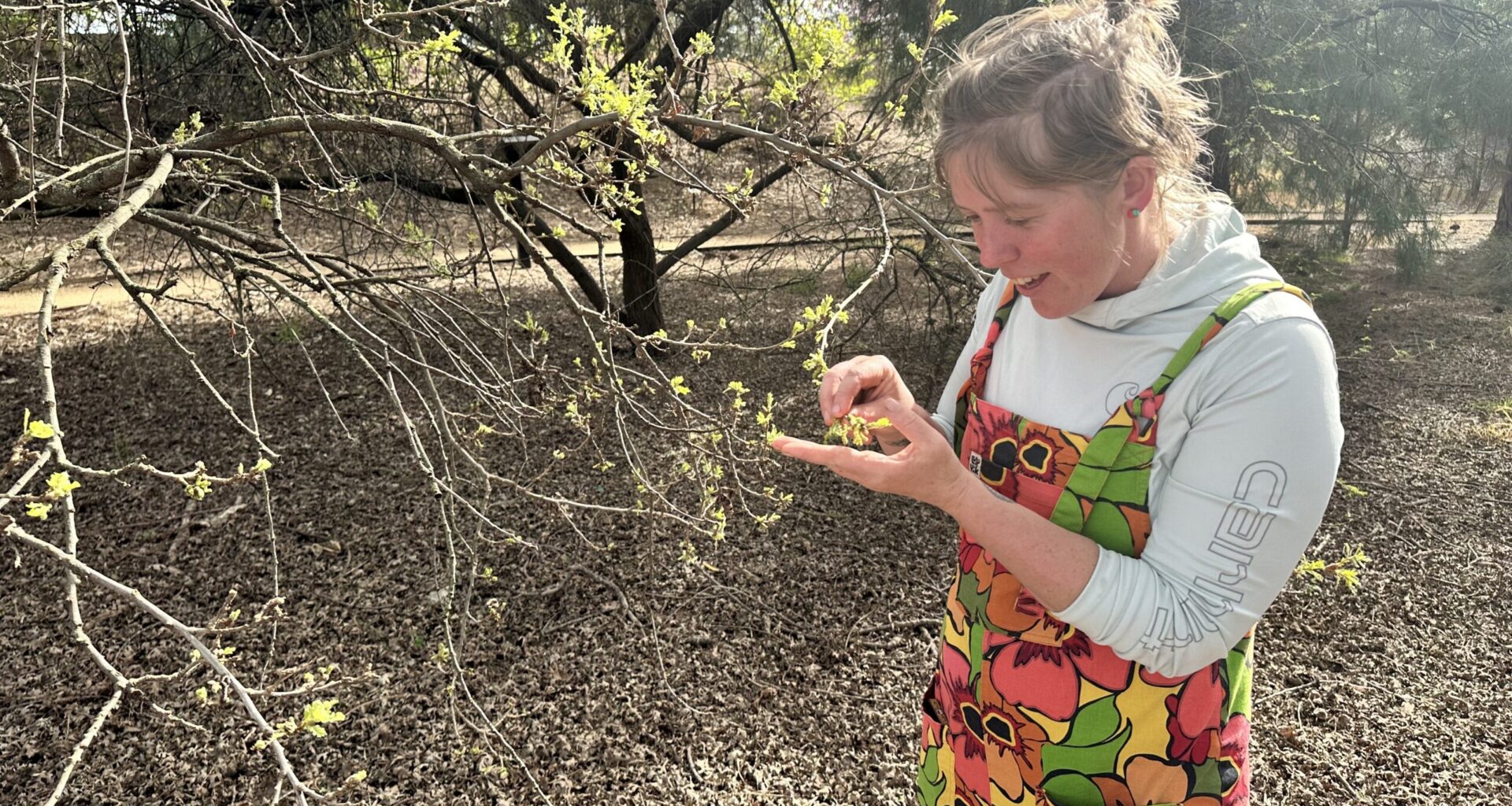
Kitty Bolte is a GATEways horticulturist at the UC Davis Arboretum. The UC Davis GATEways Project is a planning framework that is designed to leverage assets like the arboretum to inform campus visitors about the work of UC Davis scientists and scholars.
Bolte has seen oak and grass pollen swirl around the public gardens since late February.
“Even though you probably don’t think of either of those plants as flowering, they do,” Bolte said. “Not only that… Their pollen has evolved to be easily picked up by the wind and carried in the air.”
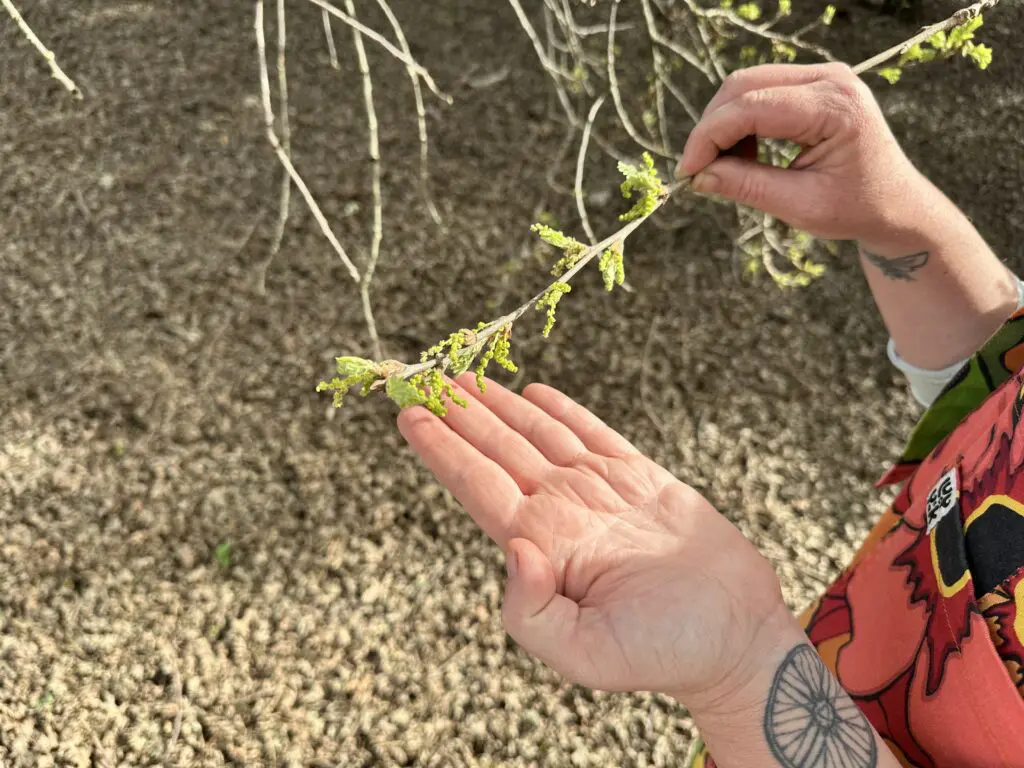 Oak trees reproduce via pollen that spread through the air. Green buds in the spring turn into acorns later in the year. (Emilie DeFazio-Reilly)
Oak trees are all over the region. Most of our area is made up of savannah grasslands and riparian forests where oaks and grasses feel most at home. Oaks have a unique pollinating strategy where trees will have both male and female flowers. The males will produce pollen that relies exclusively on air travel, “hopefully landing on the female flowers of the same tree and producing acorns,” Bolte said.
When it comes to who to blame for the mass of pollen, “The boys are responsible for this” Bolte noted.
If you’re sneezing right now, you could also be reacting to ripgut brome. Those are the weedy exotic grasses that produce pollen each spring — as well as a lot of seeds.
These plants have pollen that’s near impossible to see with the naked eye. There are other flowering plants that seem a lot more dangerous. Acacias — the big, yellow flowering plants that look like they’re made entirely of pollen — are not the problem.
“A lot of people see them and blame them for their allergies,” Bolte said. “It turns out acacias carry pollen that’s too heavy to be easily picked up in the wind.”
How to reduce outdoor allergies in the spring
You can’t get away from oak and grass pollen. It’s in the air, even if you live nowhere near an open field.
Dr. Fatema Mollah, allergist immunologist at UC Davis Health and the Sacramento VA Medical Center, helps patients suffering from allergic rhinitis, or seasonal allergies. She said that instead of focusing only on avoiding the allergens, patients can find relief from mitigating the symptoms. Her advice: Look for a nasal steroid first; don’t go to the pills right away.
“A lot of people reach for oral antihistamines like Zyrtec and Allegra,” Dr. Mollah said. “It’s better to reach for Flonase [spray] because it’s just more effective and actually reduces inflammation in the nose.”
Inflammation of the nose, eyes and throat are the most common symptoms. But if you feel it in the lungs, it could be considered allergy-induced asthma and should be diagnosed and treated by an allergist.
“Skin testing or a blood test to find out what you’re allergic to is also a therapeutic step,” Mollah added. “Then we can give you the specific measures to avoid… and up the medicine as tolerated.”
Mollah said that changing your environment can help as well.
“When people are inside, I recommend they close their windows during their flare season,” Mollah said. “Then if they’re outdoors and they come back indoors, I recommend they change their clothes and shower to get all of their pollen off.”
Mollah insisted that despite how it sometimes feels, Sacramento isn’t special for its allergens. Everywhere in the country gets bombarded with pollen at some point in the spring.
“Even sometimes in the desert,” Mollah said. “People move to Arizona thinking there’s no pollen, but then there’s a ton of golf courses, so then there’s a ton of grass. And then there’s grass allergies. It’s kind of hard to avoid.”
Instead, Mollah asks patients to pay attention to symptoms and reach out when they start impacting their quality of life.
New therapies are coming out of allergy and immunology clinical trials. The latest advance is in allergy tablets — pills that are made entirely of the allergen to help build immunity over time.
“[Tablets] actually replace allergy shots,” Mollah noted. “It’s something they can do at home daily, but the first dose they do in the clinic. It’s pretty effective to do it a couple months before grass season.”
What to plant instead
Colene Rauh is a UC Master Gardener of Sacramento County and a volunteer with the Sacramento Valley chapter of the California Native Plant Society. She grows native plants and vegetables on her one acre of land and helps schools and local programs develop their own biodiverse gardens.
Some of the same solutions to springtime allergies create the most biodiverse gardens. Rauh recommends finding the pretty flowers, because those will be the ones that rely on insects for pollination.
“The pretty flowers, the pretty shrubs, the things that we really enjoy, a good portion of them are insect pollinated, and therefore don’t really affect allergies,” Rauh said.
Bolte recommends fruit trees like apple, plum and pomegranate as a good place to start. As for pomegranates, “not only is it an attractive tree, but it’s a heat- and drought-tolerant tree, so if you want a low-water tree that maybe won’t affect your allergies as much, that could be a good option.”
Rauh lists out some of the plants she gives schools to help start their own biodiverse gardens, starting with California fuschia, manzanita and hummingbird sage.
“Sticky monkey flower, Indian paintbrush, snowberry bush,” Rauh continued. “Don’t ask me [for] my favorite.”
Whatever one’s preference, Rauh recommends always going with native species.
“Plant local natives to support migrating birds, and butterflies, and insects, and other pollinators,” Rauh said. “We’ve isolated our natural areas to the extent that if there is either a natural or a human made disaster in one area, the next area is often too far for a pollinator to reach.”
Why we need some of our worst springtime allergens
Oaks are uniquely allergenic because of their reproductive strategy, but Bolte said they’re extremely important to the natural habitat. Rauh calls them keystone species: “If you take the oak trees out of an ecosystem, that ecosystem will likely fail.”
One thing oak trees do is host butterfly larvae. “Ninety percent of terrestrial songbirds rear their young on insect larvae,” Bolte said. “So if you want the birds, you’ve got to have food for the butterflies, and oaks are a really good food source.”
While peak flowering is happening now, they shouldn’t be a bother for much longer.
“[Oaks] do have a defined bloom period,” Bolte said. “They have one flowering season in the spring. Then they just leaf out and provide beautiful shade for us.”
It’s not over yet
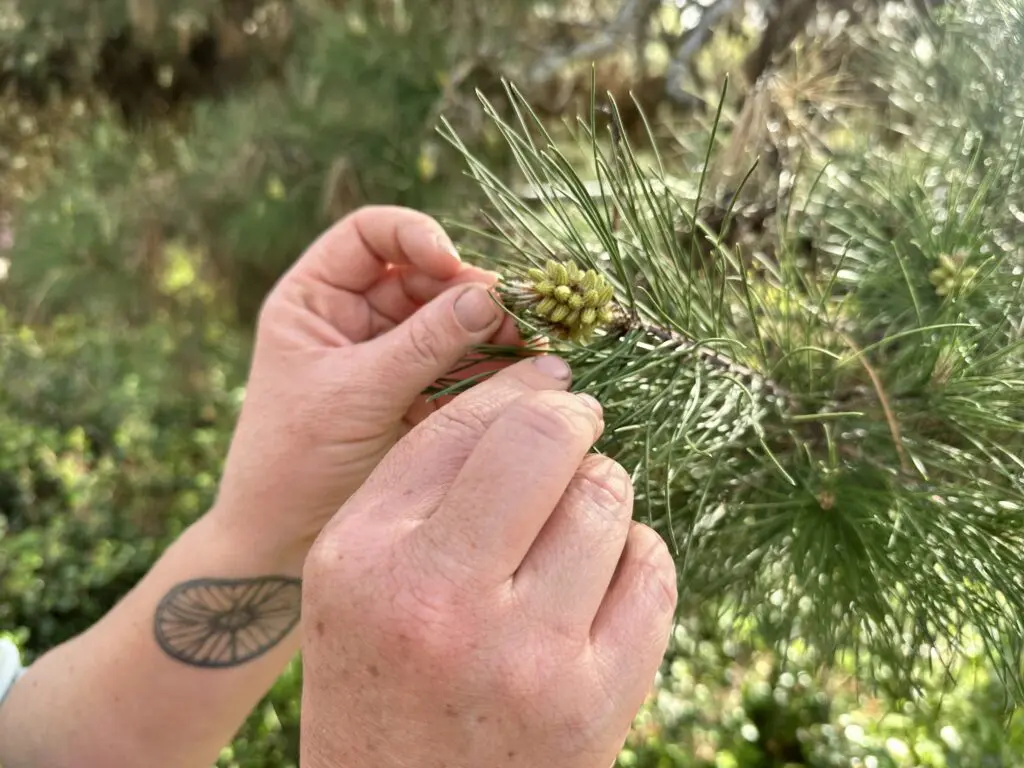 GATEways horticulturist Kitty Bolte shows a young Monterey pinecone. Conifers will start producing pollen in late spring. (Emilie DeFazio-Reilly)
Mollah said her patients will react to grasses into the late spring and early summer, with even more to look forward to in the fall.
“Weeds are more late summer and fall, Mollah said. “Basically, pollen is active in whatever form it may be from spring to the end of fall.”
As for what’s to come, Bolte warned that while oaks and grasses are here now, later in the spring, anyone with a conifer tree allergy could start to feel the burn. Evergreen needles like pines, cedars and firs aren’t as common in our region, but their pollen is still present, especially when they’re planted as industrial landscaping and in local parks.
Like any hardy plant, they have their own unique reproductive strategy that is worth its own story.
“Conifers actually don’t even have flowers,” Bolte says. “They just produce pollen.”
Emilie DeFazio-Reilly is a member of the Abridged Community Reporters program.