
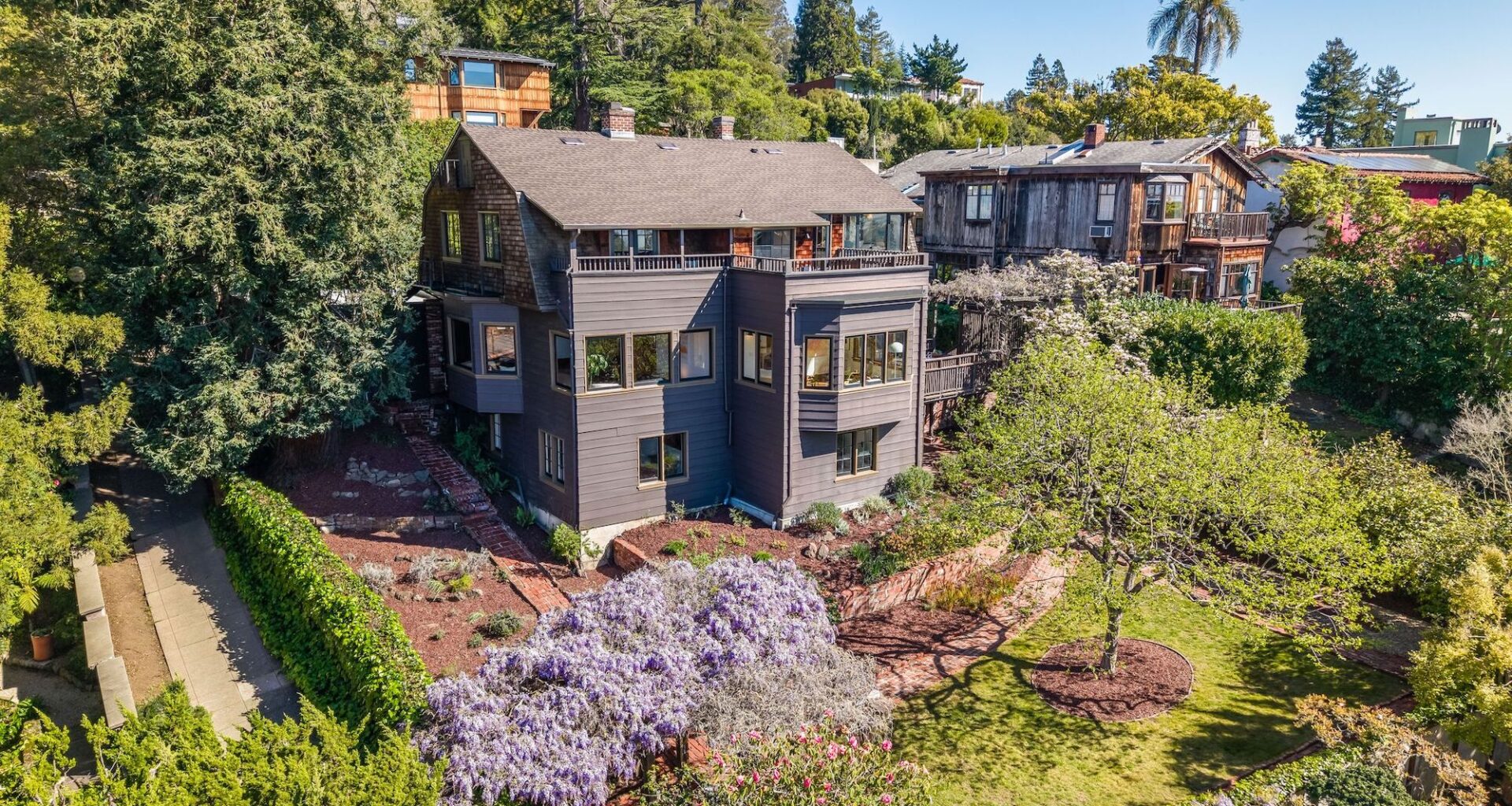
At the top of Rose Walk in the North Berkeley Hills stands a house, soon for sale, that embodies local history: a 1911 Arts & Crafts residence designed by the Bay Area architect Julia Morgan. The house was commissioned by another exceptional woman whose life quietly reflected the social changes of her era. Then, the home was damaged in the 1923 Berkeley Fire — and rebuilt with care.
The house at 1400 Le Roy Ave. is included within Berkeley’s landmark designation of Rose Walk, a small collection of homes clustered around a spacious pedestrian stairway that has connected Euclid and Le Roy avenues for more than a century. Rose Walk was designed in 1913 in the Beaux-Arts tradition by Bernard Maybeck, one of Berkeley’s most influential architects and a mentor to Morgan. That was about 20 years before the Berkeley Rose Garden was constructed a block away. The walk, and the houses surrounding it reflect a period when Berkeley’s hills were becoming a laboratory for new architectural ideas rooted in craftsmanship, landscape and a belief that the built environment could shape daily life for the better.
Visit 1400 LeRoy Ave.: Twilight tour, 4:30-6:30 p.m., Thurs. March 26; open houses Sat. and Sun., March 28 & 29, 2-4 p.m.
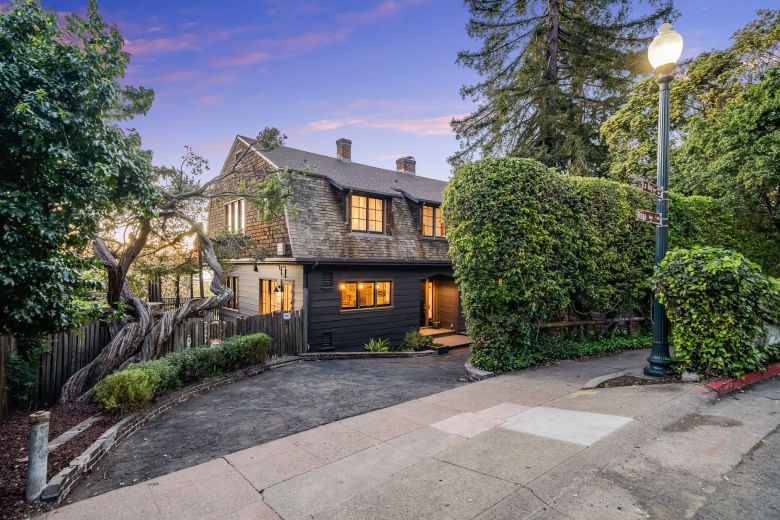 1400 Le Roy Ave. in Berkeley is a 4-bedroom home with 3.5 bathrooms. Courtesy of Megan Micco
An early Julia Morgan house
Designed in 1910 and completed in early 1911, the Le Roy Avenue house dates to the first decade of Morgan’s independent practice. Today Morgan is best known for Hearst Castle, but her early residential work, much of it in Berkeley, is where her architectural philosophy took shape. Influenced by the Arts & Crafts movement and her training at the École des Beaux-Arts in Paris, Morgan favored natural materials, straightforward forms, and plans that prioritized light, circulation and livability over ornament.
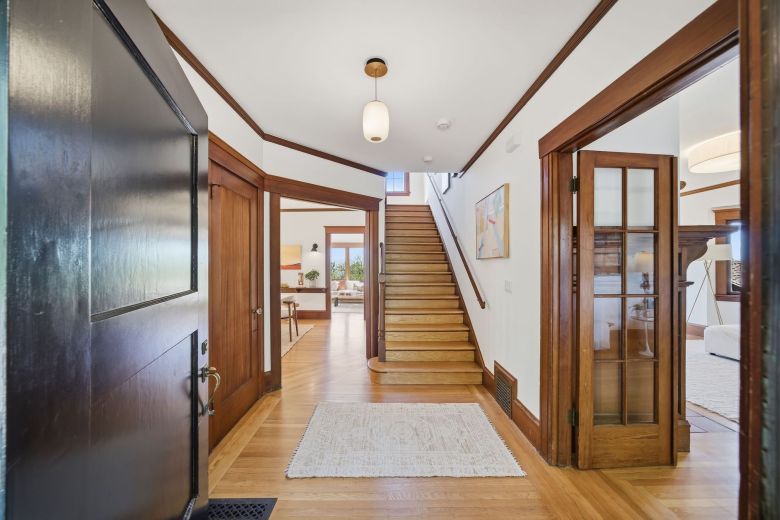 The view from the front door at 1400 Le Roy Ave. in the North Berkeley Hills. Courtesy of Megan Micco
“What strikes you immediately about this house is how intentional every detail feels,” says Megan Micco, the Compass agent representing the property. “The proportions, the light, and the way the rooms flow into each other is all very deliberate. It feels grand, yet relaxed.”
At 1400 Le Roy, those principles are evident in the wood-framed construction, gambrel roof, clapboard siding and carefully proportioned windows that bring light into the living and dining spaces. On the east facade, paired and tripartite dormer windows capture morning sun, while French doors and casement windows on the west open toward porches and garden spaces. Original details including multi-pane wood windows, built-in elements and a living room fireplace, remain intact.
The house feels practical rather than grand which is an intentional choice that reflects both Morgan’s values and those of her client.
Jessie Wallace: Independence and purpose
That client was Jessie D. Wallace, a woman whose biography adds depth to the home’s story. Born in England in 1869 to Scottish parents, Wallace emigrated to the United States as an infant and grew up in the Midwest. She never married and supported herself as a professional stenographer.
Wallace moved to California in the early 1900s, and became affiliated with Berkeley’s intellectual and civic life. She was connected to the Enewah Club, founded to support women students at the University of California. In a remarkable move for the era, she enrolled at UC Berkeley herself at age 42, graduating in 1914. She later worked as a teacher and shared her home with family members.
Wallace’s decision to commission Julia Morgan was not incidental. Many of Morgan’s early clients were women who were educators, professionals and civic leaders seeking homes that reflected new ideas about women’s roles in society. Morgan responded with houses that were less hierarchical, less formal, and more connected to the street and the community beyond. At 1400 Le Roy, large front windows, open porches visible from Rose Walk, and generous shared spaces reflect this ethos.
 1400 Le Roy Ave. in Berkeley features panoramic bay views. Courtesy of Megan Micco
“There’s something really powerful about knowing the story behind the house,” Micco says. “Jessie Wallace wasn’t a society figure or a wealthy patron. She was an independent professional woman who invested in a home that reflected her values. That feels incredibly relevant today.”
Wallace’s life took a dramatic turn after World War I. In 1919 she volunteered with the American Committee for Relief in the Near East, traveling overseas to provide aid to refugees and survivors of the Armenian genocide. Assigned to coordinate relief efforts in what is now southeastern Turkey, she died in Mardin in 1920 following an illness contracted during her relief service.
Fire, reconstruction and continuity
Just three years after Wallace’s death, the Berkeley Hills Fire swept through the neighborhood on Sept. 17, 1923, destroying more than 600 homes. Rose Walk was heavily affected. Many of the original houses were lost entirely and later rebuilt by architects such as Henry Gutterson.
The Le Roy Avenue house was damaged but not destroyed. The reconstruction preserved the home’s original footprint and architectural character. This period of rebuilding is now considered part of the property’s historic narrative, reflecting both the devastation of the fire and the determination of Berkeley residents to rebuild well.
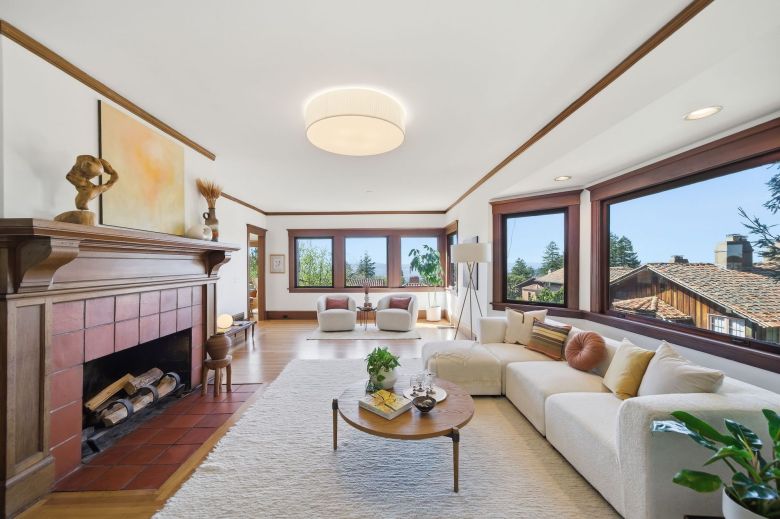 1400 Le Roy Ave. in Berkeley retains many Arts & Crafts features. Courtesy of Megan Micco
A setting like no other
The property’s location at the top of Rose Walk is part of what makes it special. The pedestrian stairway, with its graceful Beaux-Arts design, creates a walking experience that feels transported from another era. The homes that surround it form one of Berkeley’s most distinctive residential enclaves shaped by great architects and occupied by people who valued Berkeley’s progressive ideals.
“Rose Walk is one of those Berkeley secrets that locals treasure,” says Micco. “It’s a public space, but it feels intimate. And being at the top of it, with amazing, unobstructed bay views that provide a sense of elevation and perspective, really sets this house apart.”
A piece of Berkeley history
Homes like this one remind us that historic architecture is something to be lived in, adapted and carried forward. The house has been thoughtfully updated over the years while maintaining its architectural integrity, offering the character and craftsmanship of a Julia Morgan design with the comfort expected in a contemporary home.
“This is a home” Micco says, “at the absolute pinnacle of Berkeley real estate. You have panoramic bay views from the top of Rose Walk, a Julia Morgan design from her formative period, and a Maybeck landmark setting. This represents a once-in-a-generation opportunity.”
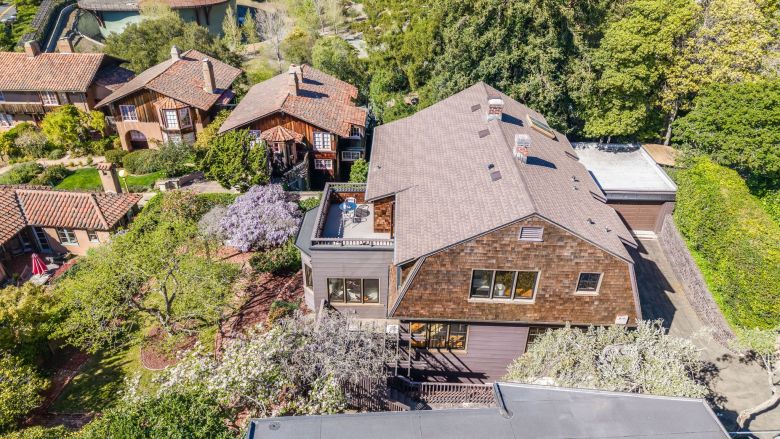 At right, 1400 Le Roy Ave.; at left, several houses along Berkeley’s Rose Walk. Courtesy of Megan Micco
“*” indicates required fields