
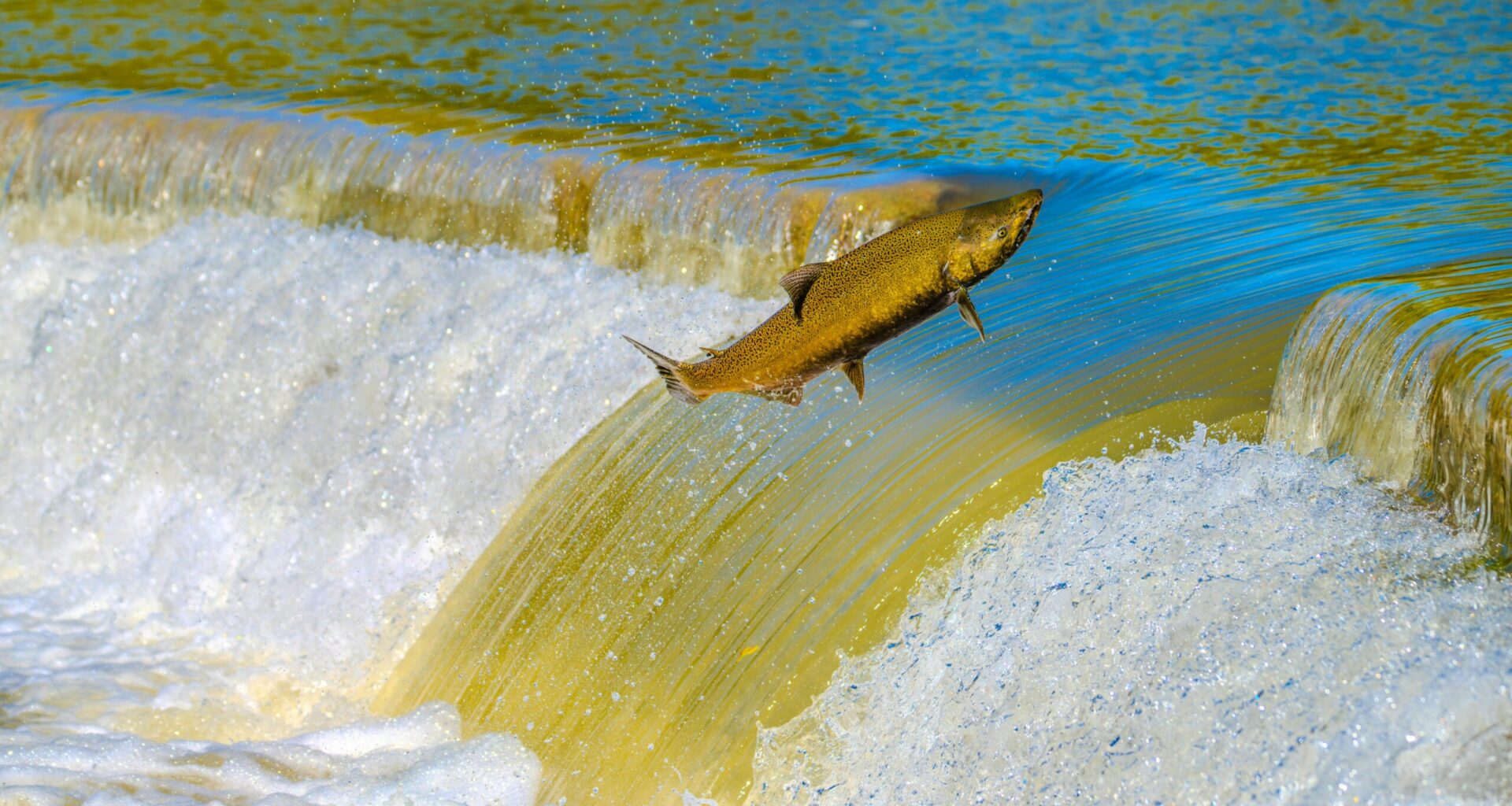
 The salmon decline in the delta has been attributed to the impact of water withdrawals into the California Aqueduct and the Delta Mendota Canal. But something else happened at the same time as the pumps began operating; dredging in most channels in the delta virtually ceased. For the last 50 years, especially in the south delta, silt has been accumulating. This has harmed an aquatic environment that, for the century prior to the 1970s, had a thriving salmon population that was not adversely affected by dredging.
Many delta channels that had been maintained at depths of 12 feet or more up until the 1970s are now less than two feet deep. The introduced non-native species of bass that prefer warm shallow water are now free to prey on salmon and other pelagic fish that prefer cooler and deeper water. Even without bass predation, salmon can’t possibly migrate as effectively in water that is so much warmer, and the water isn’t warmer because of climate change, it’s mostly warmer because the channels are so shallow.
The fact that salmon and other fish species thrived in spite of regular dredging for over 100 years is relevant whether or not water withdrawals to the aqueducts is harmful. Because if dredging won’t cause unreasonable harm, and in fact may help revive fish species, then the other reasons for dredging become more acceptable.
Today when the delta pumps are activated during low tide, portions of channels in the south delta can literally run dry. This obviously damages habitat, but it also prevents farmers on adjacent islands from irrigating their fields. The lower volume of water in the south delta channels also means when the pumps are running they can more quickly create upstream flows, reversing the current of the Sacramento and San Joaquin Rivers. This makes it more likely protected fish species will get trapped in or around the pumps, and causes more saline water to get pulled in from the San Francisco Bay.
Restoring channel depths to 10-12 feet or more through targeted dredging of at least 75 miles of south delta channels dramatically increases both the cross-sectional area and the total water volume. If this were done, it would take much higher pumping rates to produce reverse-flow velocities.
How much more water could be safely pumped from the delta if dredging were resumed and channel depths were restored is difficult to estimate, but there is clearly enough water available. Data on pumping volume and outflow to the ocean over the past six years makes clear that during wet years, there are millions of acre feet that could be diverted for farm and urban use, if it could be done safely.
For example, during the three dry years from 10/01/2019 through 9/30/2022, 17.1 MAF flowed through to the ocean and 7.0 MAF was pumped into the aqueducts (29 percent of the total). During the three wet years from 10/01/2022 through 9/30/2025, an incredible 63.8 MAF flowed into the ocean, and 14.2 MAF was pumped into the aqueducts, only 18 percent of total flow. If, during these wet three years, 29 percent of total flow had been pumped south, that would have totaled 22.6 MAF; meaning an additional 8.4 MAF would have been available for farms and cities. Much of it could have been used for aquifer recharge and storage.
It doesn’t end there. Clearly with that much water flowing through the delta, taking 29 percent of it wouldn’t have been harmful. The bigger question is the absolute number. What running average should be maintained? During the three dry years the average going out to sea was 5.7 MAF per year. That might be on the low side of an acceptable running average. But during the three wet years, the average volume going out to sea was an incredible 21.3 MAF per year. Had 29 percent been withdrawn instead of 18 percent during those three wet years, the yearly average flow to the ocean would still have been 18.5 MAF. Isn’t that still more than enough? How much more than enough? How much more is reasonably accessible?
These questions need to be answered. But it is reasonable to suggest that if we had a way to do it safely, at least 8 million additional acre feet of fresh water could have been saved over the past three years, with all the attendant benefits for farms, cities, Colorado River negotiations, aquifer replenishment, and, depending on what storage assets could be topped off, beneficial ecosystem management.
Dredging to restore deep channels is a prerequisite to nearly every other goal we may have for the delta environment and water infrastructure. Dredging increases habitat volume and cools the water. It increases rates of flow which reduces harmful algal blooms, and flushes out concentrations of saline water. Dredging can rip out invasive weeds that clog channel bottoms. The dredged silt can be used to reinforce levees or in some cases be used for tidal marsh restoration. Dredging will boost flood conveyance capacity allowing greater upstream reservoir storage. It improves navigation and recreational boating. As noted, and crucially, it may allow for more water exports. And it is likely it will help salmon recovery.
It is impossible to turn back the clock. What we can do, however, is review and modify the assumptions that have governed delta management for the last several decades. Dredging, which conjures images of terrific disruption to the marine environment, may in this case may actually be the best thing that could ever happen to it.
Edward Ring is the Director of Water and Energy Policy at the California Policy Center, which he co-founded in 2013. Ring is the author of Fixing California: Abundance, Pragmatism, Optimism (2021) and The Abundance Choice: Our Fight for More Water in California (2022).