
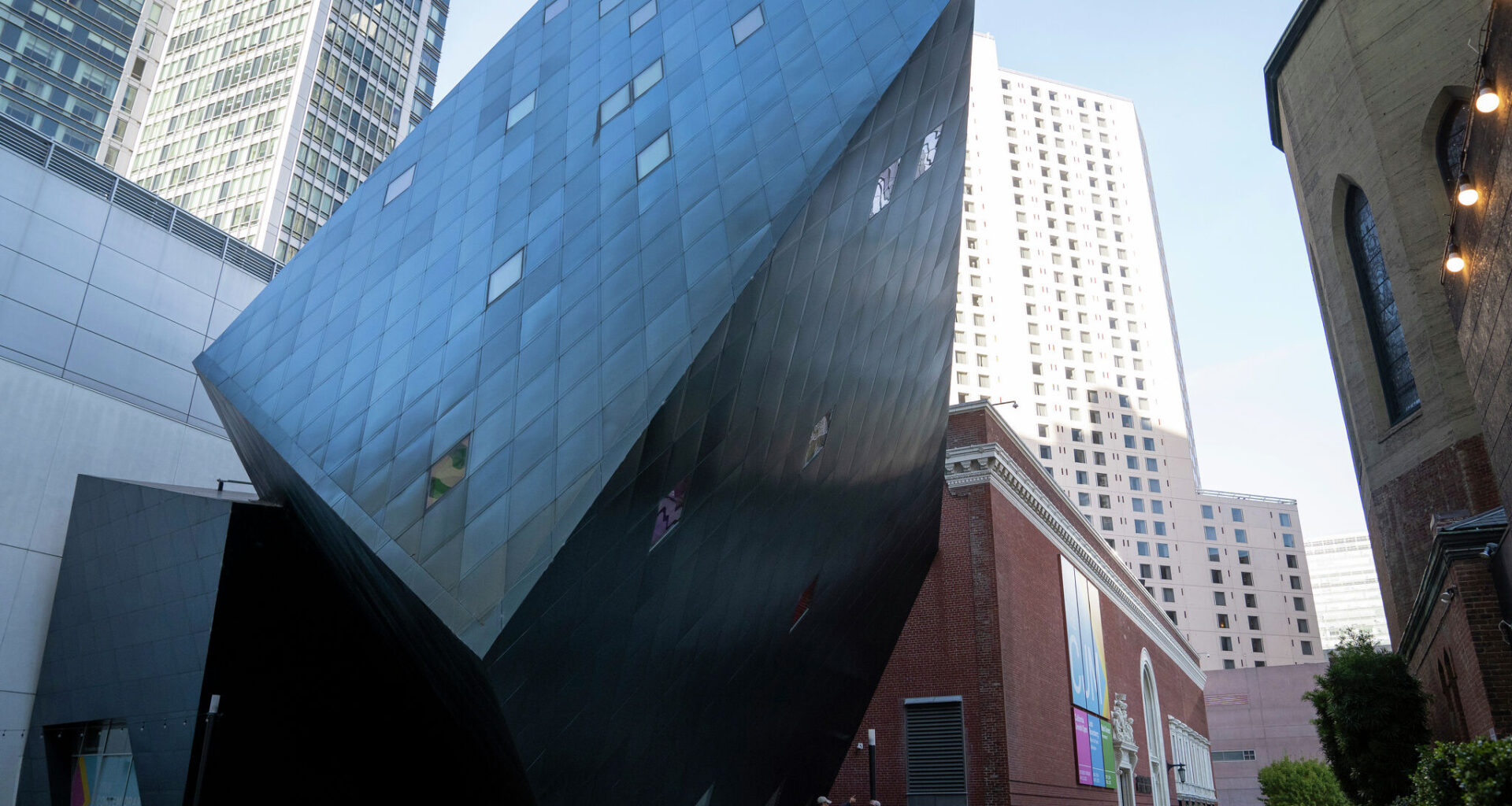
The exterior of the Contemporary Jewish Museum in San Francisco on Tuesday, Nov. 12, 2024. The museum has announced it will be putting its Mission Street building for sale.
Minh Connors/S.F. Chronicle
The Contemporary Jewish Museum plans to sell its building at 736 Mission St. after being closed for more than a year.
The organization’s leadership describes the move as necessary to ensure the museum’s existence as it continues to grapple with its financial challenges since reopening following the COVID-19 pandemic.
Dave Saxe and Melissa Blaustein stand for a photo at the di Rosa in San Francisco on Monday, Nov. 10, 2025. The newly weds held a four day arts festival wedding to benefit the di Rosa, FAMSF, Contemporary Jewish Museum and the CCA.
Brontë Wittpenn/S.F. Chronicle
A woman looks over the Rube Goldberg exhibition at the Contemporary Jewish Museum during a press preview on Wednesday, March 14, 2018 in San Francisco, California. Goldberg was a noted San Francisco cartoonist who became nationally famous.
Amy Osborne/Special To The Chronicle
Museum Director Kerry King told the Chronicle that the CJM will work with San Francisco city officials to find an “appropriate” buyer.
Article continues below this ad
“We looked at a lot of different scenarios,” said King. “We set certain goals around stabilizing and maintaining the future of the endowment and we have done that. We put together a number of different working groups, and what came from that was the need to refocus, to look at ourselves again and say, ‘Why do we exist, who are we?’ and do the mission vision work that is so important for organizations.”
Ultimately, she continued, “We kept coming back around to that we are in a space that is beyond our capacity.”
San Francisco Chronicle Logo
Make us a Preferred Source to get more of our news when you search.
Add Preferred Source
The discussions King described took place during the museum’s public closure, which was announced in November 2024. At the time, the museum said it would cease programming and reduce its staff by 80%, effectively hibernating for at least a year due to declining attendance and the ongoing recovery of the downtown Yerba Buena Arts District.
The CJM has been able to generate some income from renting the space during this period, King said.
Article continues below this ad
Since closing to the public, the CJM has reduced its operating budget by more than half — from $7.5 million to $3 million. That has allowed the institution to pay down a $28 million loan, with the debt now under $14 million, according to King.
The Contemporary Jewish Museum was founded in 1984 as a space within the Jewish Community Federation of San Francisco on Steuart Street near the bay, where it remained for two decades. A noncollecting institution, the museum’s mission has been to showcase the diversity of the Jewish experience and celebrate Jewish culture, while also combating intolerance.
By 1989, the organization determined that more space was needed for exhibitions, performances and community programs, starting a years-long process to find a new home.
The 63,000 square-foot Mission Street building, which the CJM moved into in 2008, is listed as San Francisco Landmark No. 87, one of the distinguished architectural landmarks of the Yerba Buena neighborhood.
The Contemporary Jewish Museum’s modern deconstructivist addition was designed by Polish American architect and artist Daniel Libeskind, and stands in contrast to the historic 1907 Jessie Street Pacific Gas & Electric Power Substation that makes up the shell of the building.
Minh Connors/The Chronicle
The neighborhood, which includes fellow presenters Yerba Buena Center for the Arts, the San Francisco Museum of Modern Art and the Museum of the African Diaspora, has struggled to recover from pandemic closures. Recent years have also seen SFMOMA reduce staff in 2025 to address a $5 million budget deficit, citing low attendance. Meanwhile, the future home of the Mexican Museum on the shared plaza with the CJM remains empty after the organization missed a key fundraising deadline last summer.
Article continues below this ad
The CJM’s modern blue steel structure was designed by Polish American architect and artist Daniel Libeskind, and stands in stark contrast to the historic 1907 Jessie Street Pacific Gas & Electric Power Substation that makes up the shell of the building.
The building’s design is inspired by the Hebrew phrase l’chaim (to life), “with the architecture representing Jewish concepts,” according to the CJM website. The space’s 2,200-square-foot Yud Gallery was named for the Hebrew letter “yud” and was built with 36 diamond-shaped windows that symbolize chai (life.)
Architect Libeskind said in a statement that it has been “both an honor and a profound responsibility to shape a building for this community — one that transforms a historic power station into a new architectural expression of light, form, and public life.”
When the building comes under new ownership, it is Libeskind’s hope that the structure “continues to inspire all who encounter it, serving as a lasting testament to Jewish life in San Francisco and the creativity and cultural exchange it was conceived to foster.”
King described the sale as part of “right-sizing” the organization. But what comes next, and where the museum will operate, remains unclear.
Article continues below this ad
Minnesota Street Project founder Deborah Rappaport, a member of the CJM’s Reimagining Committee, said the group repeatedly returned to a set of questions: “What’s our unique value proposition? What is it that we bring that can’t be found elsewhere, not in the synagogue, not in the Jewish Community Center? And also, importantly, what is sustainable?”
Discussions regarding a new home are still in the early stages, including the possibility of remaining in the Yerba Buena area or even staying in part of its current building through a leaseback agreement with a buyer at an affordable rate, King said.
In the next few years, a key strategy for the CJM will be to partner with other arts and cultural organizations to continue presenting programs. A new curatorial position is being created to oversee that work.
Since 2008, the museum has presented a broad range of exhibitions and programs from pop culture-focused shows like “Stanley Kubrick: The Exhibition” celebrating the filmmaker and “Bill Graham and the Rock & Roll Revolution” exploring the influential Bay Area rock impresario (both in 2016), to fine art shows like “Jewish Folktales Retold: Artist as Maggid” and a survey of contemporary artist Cary “Candy Ass” Leibowitz (both in 2017).
Contemporary Jewish Museum Director Kerry King.
Minh Connors/The Chronicle
The CJM also hosted its inaugural “California Jewish Open,” prior to closing in December 2024. The show was originally intended to feature 54 artists, but seven withdrew, citing disagreements on the framing of political content in their work and objections to museum funders because of their positions on Israel amid the conflict in Gaza.
Article continues below this ad
There’s also the semi-annual Dorothy Saxe Invitational, its longest running exhibition series, that showcases work by contemporary artists who reinterpret a Jewish ritual, tradition or theme.
Saxe’s grandson, David Saxe, has been involved with the museum since its 2008 opening on Mission Street, serving on its young professionals committee and now the CJM board. He designated the museum as one of four beneficiaries of his October 2025 wedding to former Sausalito mayor Melissa Blaustein, asking guests to donate their support in lieu of gifts.
He noted the CJM’s situation is “not different from what so many other local arts organizations are going through.”
“When you can see these trends coming, you have to take a proactive approach,” he said, referring to the museum’s decision to sell its building. “But these decisions are always tough for many reasons.”