
In the aftermath of the World Trade Center attacks on Sept. 11, 2001, conspiracy theories emerged that some of the people who went missing when the towers collapsed had faked their deaths to start a new life.
Ultimately there were no proven cases, but that scenario is the plot of Neil LaBute’s 2002 play “The Mercy Seat.” It’s the story of Ben, a morally corrupt World Trade Center worker who contemplates capitalizing on the tragedy. He plots to escape his marriage and children, assume a new identity and run off with his mistress, Abby. When the towers fell, they were having sex at her nearby apartment.
Twenty-four years later, “The Mercy Seat” has made its San Diego premiere in a production at OnStage Playhouse in Chula Vista.
LaBute was one of the first playwrights in America to tackle the 9/11 subject, and he did so in his typically scorching and cynical style. As a result, “The Mercy Seat” is not a play for the timid. It’s a fast-paced, 90-minute verbal slugfest that’s blistering in its aggressiveness. The dialogue is intense and sexually explicit and the two characters are so unlikeable it’s difficult to root for them. Fortunately, the play has a surprise ending that somewhat redeems the characters and story.
The play’s unusual title is a biblical reference. LaBute said in 2002 that it represents a place where men and priests could speak directly to God and receive judgment. While this play is not religious, it addresses sins and atonement.
Set in Abby’s nicely furnished apartment, the play begins 20 hours after the towers fell. Ben refuses to answer his constantly ringing phone, knowing that if he does pick up, the jig will be up on his “meal ticket” getaway plan.
Abby, who is 12 years older than Ben and also his boss, is emotionally torn. Three years into their affair, Abby is happy that she may finally have the life she wants with Ben, but at what cost? She’d rather Ben make a clean and honest break with his wife, but doesn’t want to risk their future together.
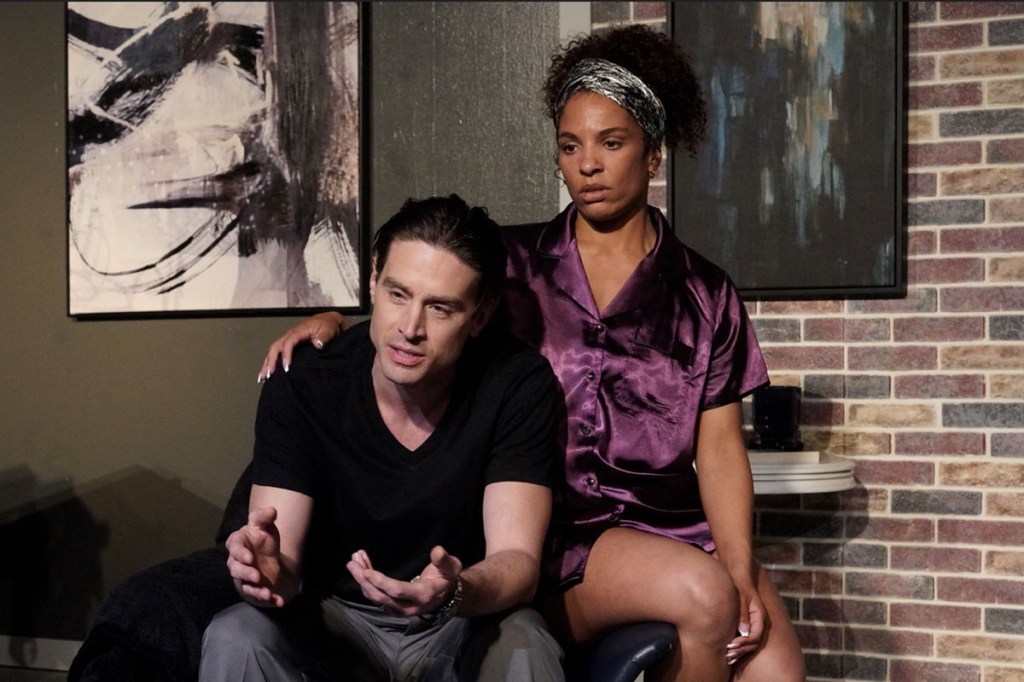
Ray-Anna Ranae gives an edgy, reserved and multilayered performance as the conflicted Abby, whose loneliness and self-loathing have led her to accept both Ben’s dehumanizing treatment of her and his expectation that she’ll quit her high-paying job and follow wherever he leads.
As Ben, Aleksander D’Avignon has the icy-cool, narcissistic demeanor of a serial killer. You can believe his Ben will do whatever is best for Ben, no matter who it hurts. So his final scene, conflicted as it may be, delivers a good acting payoff.
The script unfortunately goes round and round in circles with the characters constantly repeating and contradicting themselves. Luckly, director Jenn Peters kept the stage action interesting, maintained the proper tension and found the much-needed quiet and tender spots in the story.
Patrick Mason designed Abby’s nicely decorated Manhattan apartment, which lighting designer Ginger Chody and sound designer Jaden Guerrero transform with eerie effects to simulate the chaotic aftermath of that time. Brad Dubois designed costumes.
A 9/11-themed New York play may seem an odd choice for 2026 San Diego, but “The Mercy Seat” does have contemporary resonance. Cultural anthropologists and sociologists have warned that we are now living in narcissistic times, where social media, self-promotion and self-esteem movements have led younger Americans to favor individualism over collectivism. History has show that a healthy society balances them equally.
‘The Mercy Seat’
When: 8 p.m. Fridays and Saturdays; 5 p.m. Sundays. Through March 29
Where: OnStage Playhouse, 291 Third Ave, Chula Vista
Tickets: $25 and up
Phone: 619-422-7787
Online: onstageplayhouse.org