
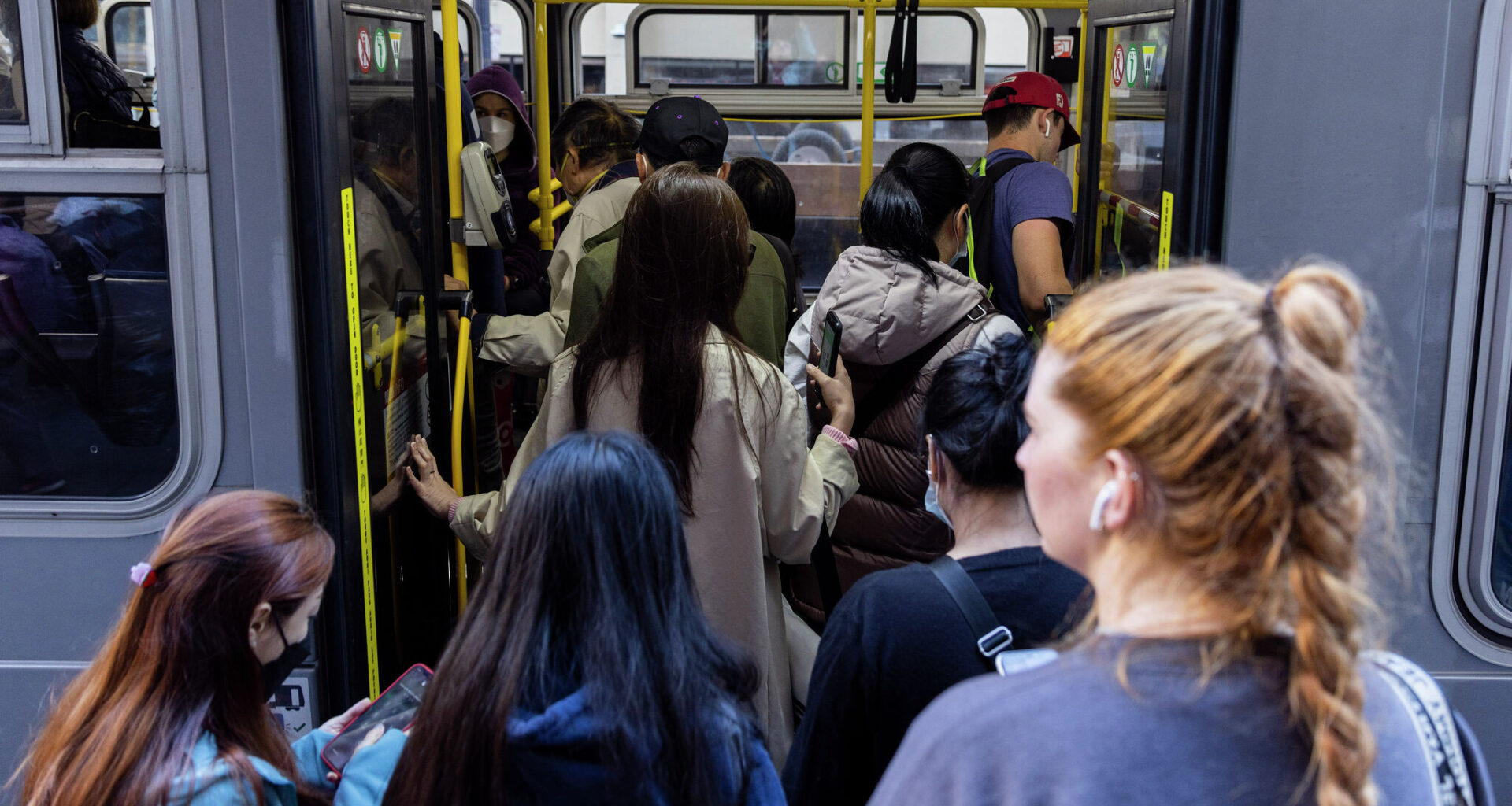
Commuters board the back of a bus at Kearny and Geary streets in San Francisco in a file photo. Demand for seamless, regional rail is high, officials say, anticipating that a Geary subway could see up to 310,000 trips a day and reduce travel times to, from, or within San Francisco by twenty minutes.
Jessica Christian/S.F. Chronicle
Anyone who has slogged through traffic on San Francisco’s Geary Boulevard could probably see the allure of an underground subway. Just imagine burrowing beneath those choked streets, straight from downtown to the west side in less than ten minutes.
Planners have studied the idea since the genesis of BART, drafting maps that ran through Union Square and the Richmond District. Though these routes were shelved in the 1960s, they lived on in the minds of transit enthusiasts.
Now, officials at San Francisco County Transportation Authority are reviving the idea of a $20 billion to $30 billion subway along Geary and down 19th Avenue, deeming it pivotal for a region that’s poised to add jobs and housing. Yet they’re making a pitch to the public at an inflection point for BART and other transit systems. Remote work has caused ridership to plateau leaving agencies in a deepening financial predicament and casting into doubt the need for monumentally expensive new railways. Many agencies are threatening to cut service if voters do not approve tax bailouts this November.
Article continues below this ad
So an air of uncertainty loomed in the background of an otherwise optimistic town hall that SFCTA held on March 7, to detail the agency’s progress on a future west side subway. It’s unclear, at this point, which agency would build and operate it.
“A number of studies and plans have consistently identified the need for a better connection between the west side and downtown San Francisco,” said Andrew Heidel, principal planner at the authority.
San Francisco Chronicle Logo
Make us a Preferred Source to get more of our news when you search.
Add Preferred Source
He envisioned the future Geary line as part of a robust rail network that would include a second Transbay Tube from Embarcadero to Oakland and a southbound link to BART or Caltrain in San Mateo County. This configuration would allow trains to carry people from the East Bay to jobs on the Peninsula, while quickly transporting residents from the Richmond or Sunset neighborhoods into SoMa or the Financial District.
Article continues below this ad
Demand for seamless, regional rail is high, Heidel said, anticipating that the subway could see up to 310,000 trips a day and reduce travel times to, from, or within San Francisco by twenty minutes. (San Francisco Municipal Transportation Agency likely over-estimated ridership for the Central Subway, though city leaders want to extend that line, as well.)
If the logic is clear, the cost is daunting. With BART facing a $400 million deficit, and Muni contending with only a slightly smaller budget hole of $307 million a year, some officials are wary of launching big-swing capital projects. Already, board directors at BART have pushed back against a grassroots campaign to add a new train station in Oakland’s San Antonio neighborhood, which could cost $300 million.
Although spokespeople for BART did not immediately respond to a request for comment on Wednesday, they said last year that the agency is singularly focused on “long-term financial sustainability,” and did not have funds to study the proposed San Antonio station.
But proponents of a Geary subway are playing the long game. During the town hall, Heidel noted that major transportation infrastructure takes many years to conceive and finance. He argued that if agencies wait “until our system is bursting at the seams, we’ll already be decades behind.”
He provided two possible concepts for a subway route. One would bring BART trains through the second Transbay Tube into Mission Bay, where they would travel up Third Street and turn left onto Geary Boulevard The other scenario would bring a new rail line from the Salesforce Transit Center through downtown, past Civic Center and onto Geary.
Article continues below this ad
From there, planners can choose whether to align the train with dense “easterly” hubs like the Fillmore and UC San Francisco’s Parnassus campus, or whether to run it through the Richmond with fast connections to Golden Gate Park and the inner Sunset. Heading south, the subway could terminate at Daly City or Colma BART stations.
Transit buffs who are captivated by the renderings say the price tag hasn’t fazed them.
“We live in a fabulously wealthy region, in a fabulously wealthy state, in a fabulously wealthy country,” said Carter Lavin, co-founder of the advocacy group Transbay Coalition. “It’s just a matter of funding things that directly make people’s lives better.”