
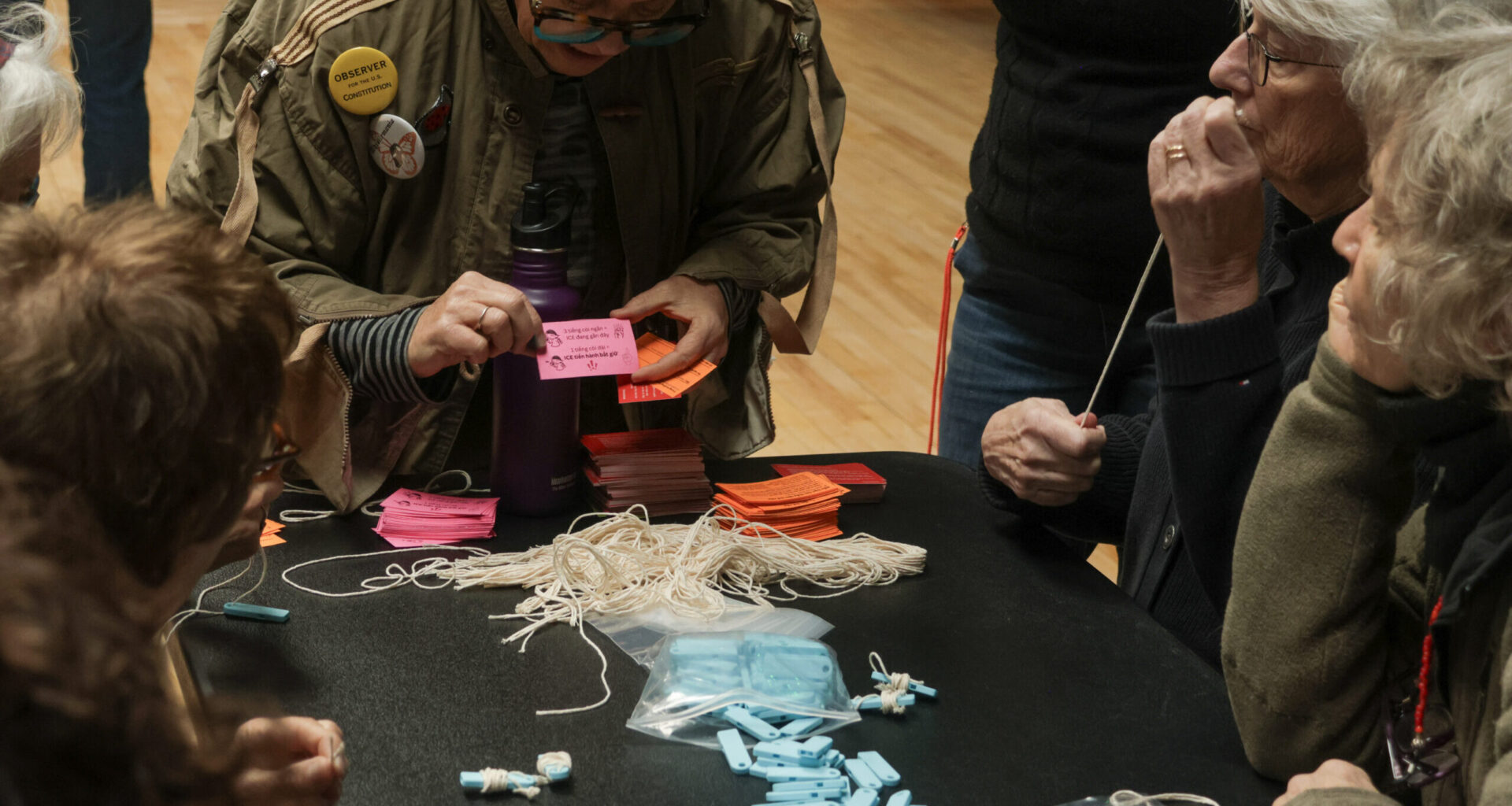
Lisa Rigby stuffed a baggie with focused precision, her third one in minutes. Red card, orange card, pink card, red whistle. When her table of four volunteers finished assembling 100 Safety Alert and Legal Toolkits, or “SALT” packets, the room erupted in applause.
Rigby, an Oakland mom who works full time, carved time out of her busy schedule to volunteer at this Whistlemania event on Valentine’s Day because it was something she could do for immigrants and advocates who encounter Immigration and Customs Enforcement.
“There’s no reason to reinvent the wheel. People have been organizing for social justice for a long time in this country, so this is an opportunity to plug into systems that people have already created, so we don’t have to feel alone,” Rigby said.
The event, the fifth of its kind since November, is just one example of how communities are preparing for possible ICE surges in the Bay Area. Residents also are signing up for foot patrols around vulnerable schools, and municipalities are considering ordinances to limit ICE’s access to public property.
These efforts have taken inspiration from community responses to ICE surges in Minneapolis and Chicago. In December, 3,000 federal immigration agents swarmed Minnesota and, over the course of two and a half months, shot three people, killing two — Renee Good and Alex Pretti — and arrested 4,000 others.
The Bay Area had a close call last October, when President Donald Trump deployed about 100 federal agents to a military base on Coast Guard Island in Alameda but called the operation off a day later. For Goose Brigadier, this prompted a sense of purpose.
 Goose Brigadier’s patch reads, “Observer for the U.S. Constitution.”
In November, he helped jump-start an East Bay section of Whistlemania, a nationwide movement that helps prepare residents for ICE raids. The Easy Bay section works closely with organizations and people such as faith leaders who have inroads to at-risk, local communities for distribution.
Brigadier, who goes by a pseudonym due to safety concerns, said Whistlemania is helping the East Bay prepare for a surge, so residents can be ready if it comes to fruition rather than react to it
“We had two choices,” he said. “We could either say ‘OK, we can relax,’ or we can get to work. We saw Chicago, we saw Minneapolis and said, ‘We have got to get to work.’”
The SALT packets assembled at each event contain a red “Know Your Rights” card outlining protections under the law, an orange “drop” card with emergency contact names, a bright red or blue whistle, and a pink card with directions of how to use the whistle (three quick toots means ICE is near, and one long whistle means ICE is active). The cards come in Spanish or Vietnamese, because two of the largest Alameda County racial groups are Asian and Hispanic, with 2.1% of the total population being Vietnamese.
The orange cards are meant to be dropped on the ground in case of an emergency encounter with federal agents. There are spaces on the front of the card to write down your name, and an emergency contact’s name and phone number. The back of the card has directions for what the person finding it should do, as well as numbers for eight different Bay Area Rapid Response hotlines.
Brigadier said a scenario where the card might be used would be if a Department of Homeland Security officer came up to someone walking down the street and put them in an unmarked vehicle. Brigadier equated the card with a message in a bottle cast into the ocean, because a person would toss it onto the ground in hopes that somebody walking by would pick it up, read it and call the phone numbers to report their detention.
“We know that people are getting lost in the system, we know that people are getting shuffled across multiple states, multiple facilities, and so the drop card is a tool of last resort,” Brigadier said.
Whistlemania assembly events have tripled in volunteers in recent months, Brigadier said. The Valentine’s event drew 60 volunteers who made 3,200 packets. He said 20,000 whistles have been distributed across the Bay Area.
“We had whistles, they had guns,” Brigadier said, quoting Good’s partner. “So, I think the whistles are a key element in documenting and holding accountable a federal government that favors masked, armed men in the pursuit of its goals on U.S. cities, on U.S. streets.”
 At Whistlemania, making buttons that read, “No human is illegal” and “ICE OUT.” (All photos by Caly Plowman)
One of Whistlemania’s biggest distribution groups, specifically when it comes to whistles, are foot patrollers across the East Bay. Susan Bowyer participates in foot patrols at two different schools in East Oakland on Fridays, wearing a bright yellow vest and toting a whistle and an air horn to alert people of possible ICE presence.
She said a recent notification for foot patrollers at a new school site prompted much interest from volunteers willing to sign up. However, Oakland foot patrols shifts are still small in comparison to Minneapolis patrols.
“What I’ve seen in Minneapolis is the school is surrounded by activists,” she said. “So, hopefully, we’re just right now keeping the ground warm, so that when we are able to shift into operations mode, we’ll be able to.”
ICE-free zones
Municipal governments across the Bay Area are trying to protect immigrants from the possibility of an ICE surge. Alameda County, home to over 540,000 immigrants, in January joined dozens of other counties and cities across the nation to establish ICE-free zones, which restrict the use of city or county property for immigration enforcement operations. Oakland, Pinole, Richmond and San Francisco also have established ICE-free zones. However, immigration agents can still enter these properties with a valid judicial warrant.
Eric Casher, city attorney for Pinole, which in December became the first Bay Area city to pass an ICE-free zone policy, said the zones are meant to act as deterrents. If a county and a city both have ICE-free zones in place, there would be few public spaces that wouldn’t be covered.
 An orange “drop” card explains what to do if the card is found.
However, these ordinances are not perfect, and some Alameda County supervisors expressed concerns in January about how the policy would be enforced.
“Questions I have are, can we truly enforce some of the things we are asking to enforce?” Board President David Haubert asked.
Casher said if someone were to violate ICE-free zones, they could be cited, and a violation would create a legal right of action such as suing for damages or seeking a restraining order to stop the activity. If an agent detains someone in an ICE-free zone without a warrant, that could open up a possible case to get the detained individual released, because local law was violated, he said.
However, Casher acknowledged that if a federal agent entered an ICE-free zone without a warrant and quickly detained someone, there probably would not be time to get a cease and desist or a restraining order. He also noted that ICE has not been obtaining warrants, but just going into private places or pulling people out of cars.
“It’s pretty lawless, they’re just, kind of by any means necessary, detaining people — whether there’s probable cause or not — and just taking them into custody,” he said.
At the January meeting, Haubert said he was worried that an ICE-free zone could instill a false sense of security.
“I am concerned that if we send a false perception to people that an ICE-free zone is truly ICE-free, we then put a target on the backs of some people who might rely on that,” he said.
Casher said ICE-free zones should not be treated like physical barriers but rather as legal barriers that allow for prosecution. Using Fernandez Park in Pinole as an example, he said ICE agents could stand on the sidewalk and surround the park, even though they are not allowed to step foot in it.
He noted that if there was a large-scale mobilization and ICE wanted to detain someone in Fernandez Park, agents would probably not care about the ICE-free zone.
“They’re going to violate the law — like, they’re shooting people. They’re not worried about a local ordinance,” Casher said.
At the Whistlemania event, Rigby also found herself wondering how effective the legislation of ICE-free zones would be in Alameda County.
“Nothing about the actions of ICE in this year or last year have made me believe that they are going to follow any laws for policies said to keep them out,” Rigby said.
Candance Goldman, a Berkeley resident at the Whistlemania event, said that this is why community building is important — to act as the second line of defense if the policy fails.
“It all needs to work together to ensure that people are, in fact, protected,” Goldman said.
ICE activity prompts Oakland school lockdowns, turning student fears into reality