
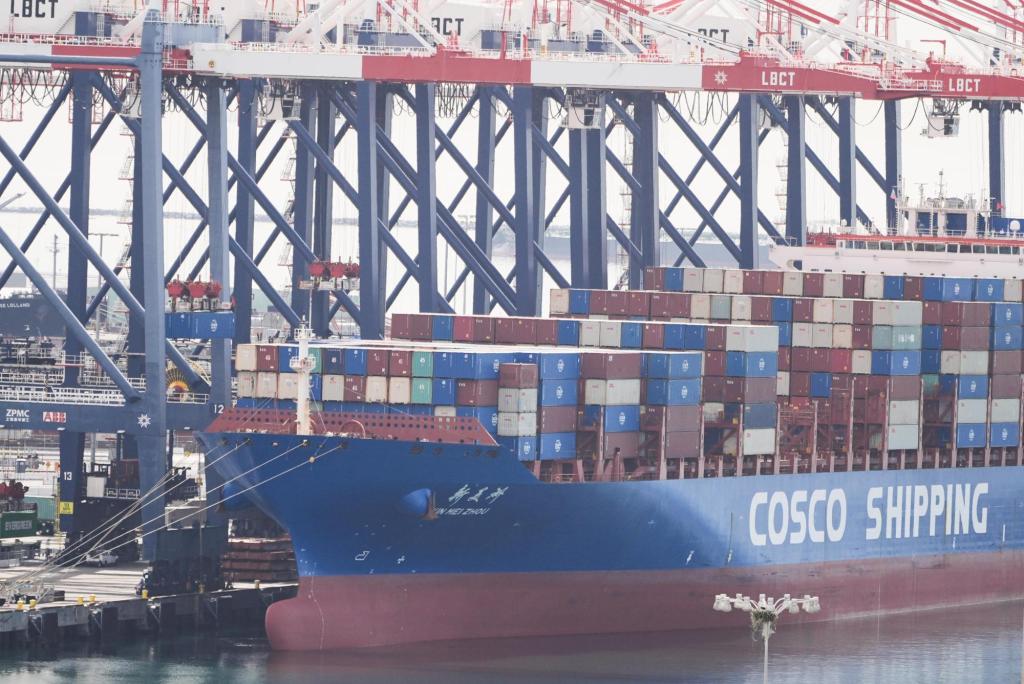
Cargo numbers in the first two months of 2026 at the Port of Long Beach — which moved 1.6 million cargo units in January and February — were down 6% overall from the same period in 2025, a record year for the port.
But the volumes remained “positive” in February, with 767,525 twenty-foot equivalent units, POLB CEO Noel Hacegaba said on Wednesday, March 18 — a .03% increase from the same month in 2025.
“Cargo volumes at the Port of Long Beach remained positive in February,” Hacegaba said during his monthly Supply Chain Insight virtual media briefing. “Despite growing uncertainty fueled by the conflict in the Middle East, cargo continues to move fluidly, planned shipments are on schedule and the Port of Long Beach remains a safe harbor in the sea of trade and geopolitical uncertainty.”
While the port expects to see “a few flat months” early this year — which also reflects the recent Lunar New Year observances in China and elsewhere in Asia — it also anticipates a “bounce back” during the last six months of the year, Hacegaba said.
The outlook is similar to projections by the neighboring Port of Los Angeles.
The early 2026 numbers were reported at Hacegaba’s virtual news briefing this week, which also covered cargo flow impacts amid unrest in the Middle East and the current state of trade.
The briefing focused largely on concerns in the shipping industry lately surrounding the war in Iran and other Mideast countries, and the effective closure of the Strait of Hormuz.
“Twenty percent of the world’s oil supply ships through the Strait of Hormuz,” Hacegaba said, which has been effectively closed to most commercial traffic since mid-March.
But, Hacegaba added, “at present, there are no impacts to operations in the San Pedro Bay.”
All terminals remain open and operating at the Port of Long Beach, he said.
Hacegaba told reporters Wednesday that the Port of Long Beach is closely following developments in the Middle East and the impact of last month’s Supreme Court ruling on the International Emergency Economic Powers Act, or IEEPA, which said about two-thirds of tariffs imposed last year were unconstitutional.
“The conflict in the Middle East has added more uncertainty to global trade,” Hacegaba said, “and triggered broad market conditions and reactions from parties across the supply chain.”
Still, Hacegaba added, the ongoing global turmoil sparked by the outbreak of hostilities in the Middle East “has far reaching impacts around the world” and “is sending tremors through the supply chain.”
He described global trade as akin to a “tightrope” that stretches across “geopolitical fault lines.”
And the longer the war goes on, he said, the more impacts will be felt in prices impacting consumers.
The Port of Long Beach currently sees only 1% of its petroleum coming in from Iran, Hacegaba said, with most oil that arrives on the West Coast coming from Alaska, Canada, Mexico and Colombia. But the costs, regardless, are going up for those products at the consumer level as a result of the unrest and disruptions, he said.
“The disruption at the Strait of Hormuz has already triggered a rapid rise in oil prices,” Hacegaba said. “When the price of oil goes up, the cost of shipping increases and consumers pay more at the gas pump and for many everyday goods.”
And as the price of gas for consumers goes up, Hacegaba added, it leaves less money to spend on other areas, thus affecting the overall U.S. economic outlook as well.
“Supply chains are feeling the shock waves,” he said. “It’s not just fuel that is affected.
Despite the higher gas prices, Hacegaba said, the port has not seen any impact to cargo movement since POLN mainly moves goods via the trans-Pacific trade route with Asia.
But global supply chains are interconnected, he said.
“If this conflict persists and continues to escalate,” Hacegaba said, “supply chains everywhere will have to navigate higher fuel and vessel operating costs and seek alternative shipping routes.”
In January, the Port of Long Beach began the new year as the nation’s busiest seaport, marking its second-busiest January on record, moving 847,765 twenty-foot equivalent units of cargo; that was down 11% from its January 2025 numbers — the port’s best in its 115-year history.
The Port of Los Angeles, meanwhile, processed 824,323 TEUs last month, marking the second-busiest February in that port’s history and an increase of 3% compared to last year.
“With so many developments affecting supply chains — from the conflict unfolding in the Middle East to the Supreme Court tariff ruling and broader trade policy shifts — there’s real uncertainty across the industry right now,” Seroka said in a written comment earlier this month. “Even so, manufacturing flows serving the United States continue to move, and we’re not seeing disruption to U.S.-bound cargo today.”