
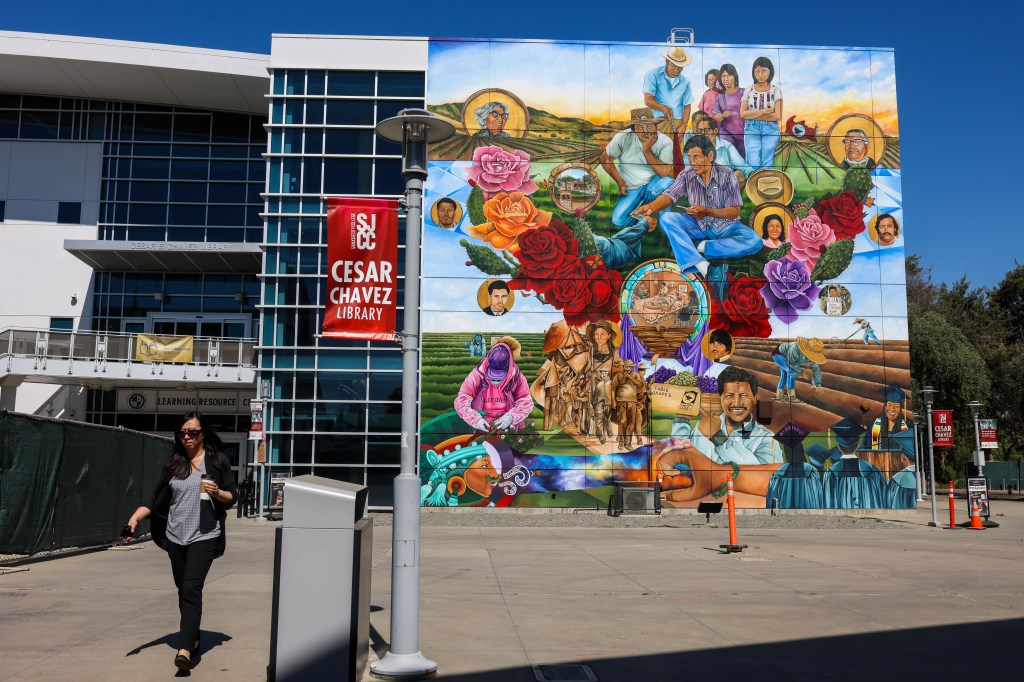
Allegations of sexual abuse toward young women and girls by labor organizer Cesar Chavez sent a shockwave through the Bay Area on Wednesday, forcing public officials to move quickly in a region that has dozens of monuments, streets and schools named after the activist who led a farmworker movement that reshaped California’s agricultural landscape.
The revelations come less than two weeks before Cesar Chavez Day, a state and federally-recognized holiday that is usually marked with parades and other celebrations of Chavez’s life. The future of events and monuments honoring Chavez are uncertain as leaders consider the path forward — including whether to rename the holiday.
The investigation by the New York Times alleged that Chavez sexually abused two women for years when they were children. Dolores Huerta, who co-founded the United Farm Workers with Chavez, also shared for the first time that Chavez raped her in 1966, and that he pressured her into having sex on another occasion. Both instances resulted in Huerta becoming pregnant, she said.
Huerta, now 95, said in a statement that she chose to come forward about her experience because the New York Times found that Chavez had also sexually abused other young women.
“The knowledge that he hurt young girls sickens me,” Huerta said. “My heart aches for everyone who suffered alone and in silence for years. There are no words strong enough to condemn those deplorable actions that he did. Cesar’s actions do not reflect the values of our community and our movement.”
Chavez, who died in 1993 at age 66, moved to California with his Mexican-American family during the Great Depression, where they traveled around the state picking seasonal crops. Later in life, he would go on to found UFW and lead farmworker movements across the state, including the Delano grape strike in the 1960s. He lived in east San Jose for a time in the 1950s, where his family home has since been purchased for preservation by a local nonprofit.
Many of the responses and statements shared Wednesday addressed the allegations against Chavez, but few leaders took questions about the future of these monuments and namesakes.
California Gov. Gavin Newsom said at a press conference Wednesday that he is “absorbing” the new information, noting that he and his wife are friends with Huerta.
“We are all processing this. The farm workers movement and a labor movement are much bigger than one man — and we celebrate that and that will be our focus as we process what the next steps are,” Newsom said. “We’re for justice. We’re for the truth. We’re for transparency. We will have the backs of these victims.”
In San Jose, where a downtown plaza is named in honor of Chavez, elected officials canceled events planned for the state holiday and announced that a process will be formed to identify monuments bearing Chavez’s name or likeness and launch a “community-driven initiative that appropriately honors the broader farmworker justice movement without causing further harm to survivors,” according to a press release from the office of Mayor Matt Mahan. The process is also helmed by several city council members.
“I am deeply troubled by the serious and disturbing allegations that have come to light regarding Cesar Chavez, and my thoughts are with the survivors who have carried this pain for decades,” Mahan said. “As the full scope of these allegations is investigated, we recognize that Chavez’s ties to San José come with a responsibility to ensure we are not further traumatizing survivors.”
UFW and other organizations honoring Chavez’s legacy announced Tuesday that they would pull out of all Cesar Chavez Day events due to the “deeply troubling” allegations.
This is a developing report. Check back for updates.