
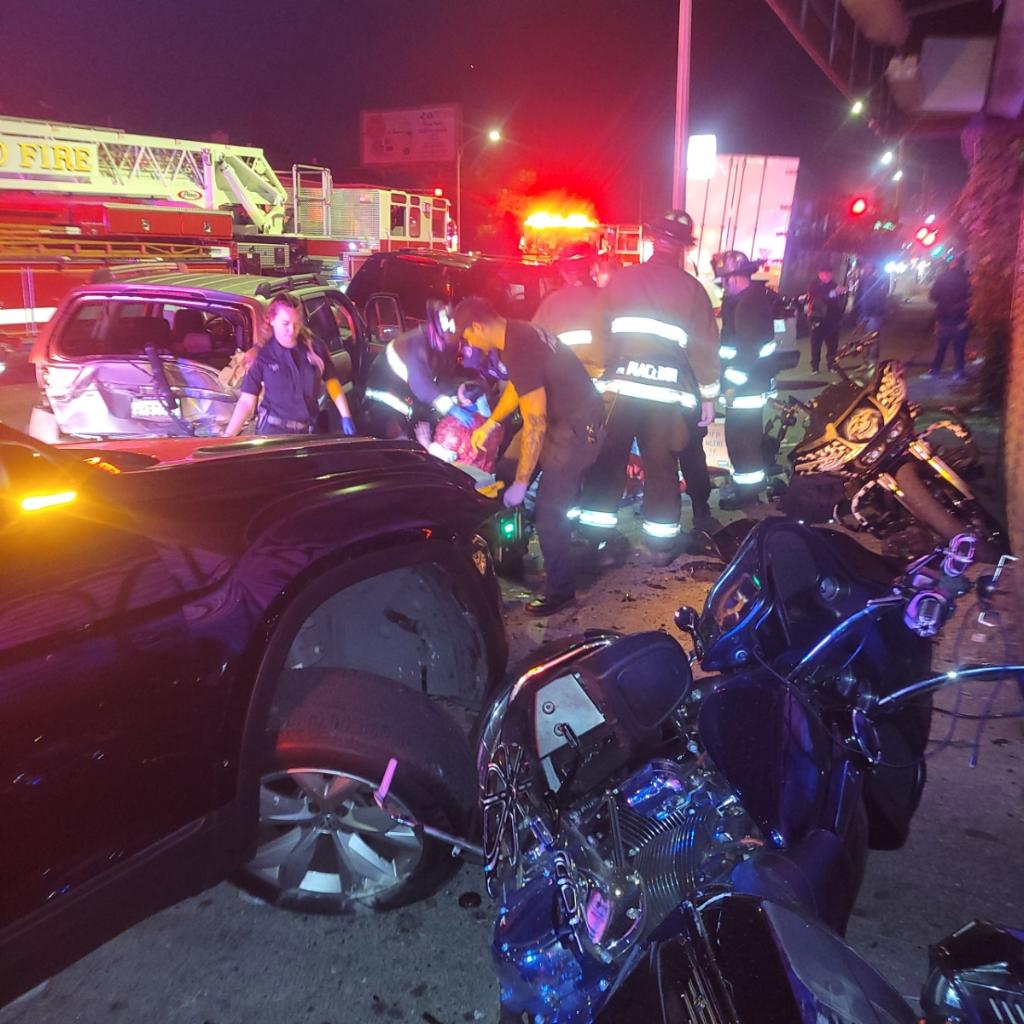
Lawyers for the family of Lolomanai Soakai, the young airport worker who died on an Oakland sidewalk in 2022 in the aftermath of a ghost chase — an unauthorized, undocumented police chase — have released video of the collision for the first time.
The 25-minute video, shocking and violent in nature, is a time-synchronized compilation of surveillance camera and body-worn camera footage that shows the chase that preceded the fatal collision, the collision itself, and the aftermath.
The footage shows Arnold Linaldi, a then-19-year-old driver, engaging in a sideshow at 42nd Avenue on June 25, 2022, then speeding away on International Boulevard with Oakland police officers Walid Abdelaziz and Jimmy Marin-Coronel in hot pursuit. The video tracks the two speeding vehicles, the crash and its aftermath, including images of Soakai as he lies motionless on the ground, blood pooling around his head, as his injured mother calls his name, asking for help.
The video shows the two officers inexplicably leaving the scene of the collision and not providing assistance. The video also appears to show, according to the Soakai family’s attorneys, that the officers sought to obstruct accountability, including by turning off — or attempting to turn off — their body cameras.
On Monday, the video was submitted in the U.S. District Court in Northern California as part of the discovery process, alongside hundreds of pages of transcripts of depositions with the cops and their supervising officers, in Estate of Soakai v. City of Oakland, et al.. The documents were submitted as part of an argument by the Soakai family that their case should go to a jury trial.
KTVU first reported on the video and the depositions.
The Soakai attorneys, Adante Pointer, Patrick Buelna, and Treva Stewart of Lawyers for the People, said in their filing, which opposes a defendants’ motion for summary judgment, that the case came down to the officers hoping “to not only abuse their police powers but also the law to protect their misconduct.”
The Oakland Police Department and Lawyers for the People did not immediately respond to requests for comment
A judge rejects qualified immunity
Sokai’s family and friends gathered for a protest at the collision site two days after his death, with many of them expressing anger toward the police.
“It’s just crazy how y’all people can’t even do their job,” one of Soakai’s cousins yelled at an officer. “And you don’t give a fuck.”
Seven months later, Soakai’s family filed suit against the two officers, the Oakland Police Department, and the city of Oakland in federal court. The attorneys argued that since stricter police chase policies were adopted by the city of Oakland in 2014, cops had engaged in off-the-books ghost chases instead, leading to dangerous conditions on the road.
“The decision to give chase, despite policy and without permission, caused this tragedy,” Pointer said at the time.
Last May, Abdelaziz and Marin-Coronel lost their bid for a qualified immunity defense. Judges Susan P. Graber and Michelle T. Friedland of the 9th U.S. Circuit Court of Appeals in San Francisco affirmed the plaintiff’s argument that the defendants could be sued for liability. The California Vehicle Code’s immunity statutes have, in the past, allowed cops to go free in similar cases.
The state code in question, §17004, says that a public employee is “not liable for civil damages on account of personal injury to or death of any person or damage to property resulting from the operation, in the line of duty, of an authorized emergency vehicle while responding to an emergency call or when in the immediate pursuit of an actual or suspected violator of the law.”
Lawyers for the family argue in their submission this week that the two officers were not doing their job by seeking to arrest Linaldi, but instead were “trying to harm the suspect.” The attorneys, in legal filings this week, pointed out that the officers audibly laughed as they left the scene, saying in recorded audio that they hoped Linaldi was killed in the crash.
The Oaklandside and other news outlets have previously reported that the cop duo, who were beat partners for five months before that night’s chase and had attended a police academy together, may have committed several violations during the incident. Among these were the failure to obtain permission from their superiors to initiate the pursuit, as required under OPD policy; illegally turning off their lights during the high-speed pursuit; attempting to turn off their body-worn cameras to conceal their actions; and then lying about much of it.
The newly public documents go into greater detail on the timeline of what happened that night and how it all went wrong.
New details come to light
According to the defendants’ depositions and the video footage obtained in discovery, the two officers were inside their police Ford Explorer a little after 1:30 a.m. when they saw and heard the familiar sound of a car burning rubber as it made high-speed turns. They had just responded to a Shotspotter alert in the vicinity and were looking for possible suspects who may have fired a weapon, ultimately finding some people who had set off fireworks.
As they made their way south on International toward 42nd Street, where Linaldi was spinning in the intersection in a dark-colored Nissan Z, the officers briefly turned on their vehicle’s emergency lights. That action, the plaintiffs’ motion claims, also automatically activated the body-worn video cameras of both officers. Marin-Coronel said in his deposition that he then deactivated his camera. In the video, Abdelaziz appears to try to deactivate his camera, but failed to do so, leaving his recording as evidence.
According to the plaintiffs’ motion, Abdelaziz “immediately turned off his Code 3 lights when he reached the intersection.” Then the Nissan Z drove past the officers, which they appear to have read as an attempt to flee. With Abdelaziz driving and Marin-Coronel in the passenger seat, the latter said, “Go for it,” suggesting a pursuit. Over the next few seconds, and for the rest of the event, according to the Soakais’ lawyers, the officers did not call superiors to seek approval or to report a chase.
When the officers reached International and 42nd Avenue around 1:38 a.m., Linaldi, the driver of the Nissan, briefly drove northbound on International, passing the officers. Linaldi then turned left and drove into a Smart & Final parking lot, then turned right onto East 12th Street, heading northbound, and right onto 41st Avenue before returning to International, leading the cops in a circle.
The officers followed “close behind the entire time without lights, sirens, or alerting dispatch to their chase,” according to the plaintiff’s motion opposing the defendants’ motion for summary judgment in the case.
Once Linaldi turns onto International, going southbound, he takes off. Abdelaziz, the officer behind the wheel, swerved around a random pedestrian, “narrowly missing him,” according to the same filing. He can be heard saying, “I’ll run your stupid ass over,” around the second minute of the compilation video filed with the court.
For the next few seconds, Linaldi and Abdelaziz drove at high speeds, running red lights and speeding through green lights. Then Linaldi lost control around 54th Street and crashed into a car in front of a grocery store along International Boulevard.
As seen in the video, at the moment of the collision, the cops were about a block and a half behind and wondered aloud whether the suspect had crashed. Abdelaziz can be heard around the 2:45 mark of the video first saying he can’t tell whether there was a crash, then saying, “He smacked the fuck out of that truck.”
“Man, listen,” Marin-Coronel replies. “I wouldn’t mind going over there. Hopefully he’s fucking dead.” They both laugh.
Abdelaziz can be heard in the video seeming to mock the situation by making what sounds like a happy, nonchalant sound that the plaintiffs’ lawyer later described as “Dee-dee-dee.”
As chaos ensues at 54th Street, with people gathering around the collision, the video shows the cops turning their car around and heading away from the scene. According to the same plaintiff’s opposition filing, a car behind them then honks at the cops.
“But Defendant Abdelaziz simply stated, ‘Bitch, I know you’re behind me. Shut the fucking hell up,’” the document states.
According to the plaintiffs’ motion, the police officers drove back to the High Street police substation. They then answered a dispatch call and drove back to International and 54th Street, this time with lights on — again apparently triggering their body cameras — as if they had not just left the scene of the crime, according to the deposition of Sergeant Domertrius Fowler of OPD’s internal affairs unit.
As seen in the video, Abdelaziz and Marin-Coronel end up arresting Linaldi, who they found looking dazed but alive in the driver’s seat, in his destroyed car, which had ricocheted after the collision.
According to the plaintiffs’ motion, around 2:06 a.m., someone approached the officers and told them they had seen a cop car chase the suspect’s car without its lights or alarms on. Abdelaziz and Marin-Coronel, according to the plaintiffs’ motion, “defendants looked at each other, told the witness to leave, then walked next to one another and turned off their cameras.”
The motion claims the pair of officers turned their body cameras back on once the witness had left and they had talked.
“They never reported their involvement or the witness’s report to anyone, including their sergeant, which was required,” according to the plaintiffs’ motion.
The cops’ immediate supervisor at the time was Sergeant Gabriel Urquiza, who also helped manage traffic during the protest and vigil organized by the advocacy group Traffic Violence Rapid Response with the help of the Soakai family two days after his death.
Marin-Coronel and Abdelaziz followed Linaldi to a hospital, where “they accessed and watched their body camera footage of their chase”, according to the plaintiffs’ motion. According to the same filing, the pair then “categorized” the footage as accidental “so that it would automatically delete.”
Buelna, one of the attorneys for the Soakai family, told us that body-cam footage usually has a buffer of at least 24 hours before it is actually deleted, in case cops make a mistake.
“Let’s say you accidentally were trying to scroll down menu of the camera and imagine you clicked the wrong one and then you deleted some murder footage on accident? It doesn’t instantaneously delete,” he said.
Later that night, at the end of the shift, when patrol sergeant Anthony Martinelli held a report and review meeting, another officer, Long Tran, approached Martinelli and told him he’d seen a police vehicle chasing Linaldi. That spurred the department to open a Level 1 Investigation, a high-level inquiry that could lead to termination and requires all involved officers to turn in their phones and cameras and avoid talking to each other.
But Marin-Coronel, in his deposition, claims that Abdelaziz subsequently reached out to him to try to persuade him not to provide a statement to police investigators. Marin-Coronel also said that earlier, in the hours after the chase, his partner had tried to convince him to agree on an invented reason for why they began the chase in the first place — that Linaldl’s car had matched the appearance of a car they were on the lookout for.
“At this point, Defendant Marin was scared for himself, for his family, his children, and decided to confess what they had done was unauthorized and wrong,” the plaintiffs’ motion reads.
In the plaintiffs’ deposition of Marin-Coronel, the officer says that he was in shock.
“Cause I’d never had been in this type of situation,” he said to Buelna, of Lawyers for the People. “I’ve never been in trouble or anything in my two careers that I had. And at that time, it was like I was there but I wasn’t there. I was thinking about my family. I was thinking about my kids. I was thinking about what was going to happen. It seems like Abdelaziz’s words were coming from one ear and getting out of the other. All I remember — all I remember doing is just nodding my head and just keep walking upstairs. And then once I went to the officers, where all the officers were gathered, all I did is just sit by myself and put my head down.”
In all, footage from eight different cameras on the street from businesses or public utilities on International Boulevard was accessed by the plaintiffs, including some from AC Transit’s bus rapid-transit stops, as well as body-worn cameras by the police officers. That’s according to Nick Barreiro, a forensic analyst contracted by the Soakai family’s lawyers to compile all the videos into one, matching their time stamps.
The next important dates
Arguments on both sides about the defendants’ request for summary judgment will be made on April 6, in San Francisco’s Northern District federal courthouse. The presiding judge is U.S. Magistrate Judge Sallie Kim.
“*” indicates required fields