
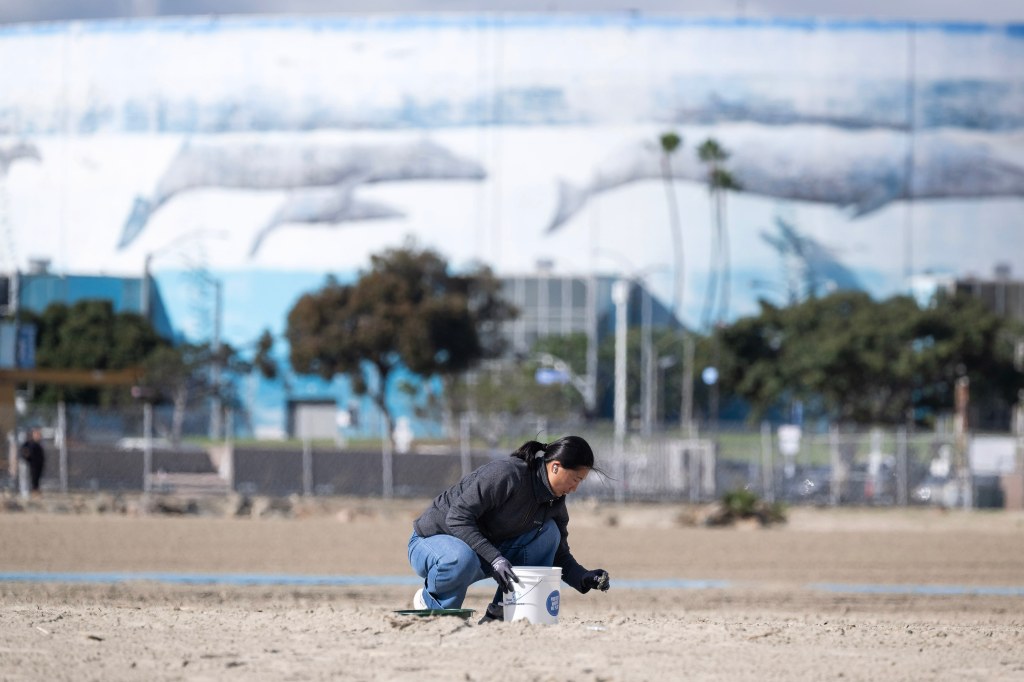
Long Beach is continuing its efforts to reduce trash and debris that comes from the Los Angeles River into the city’s waterways and beaches.
The City Council this week unanimously approved continuing Long Beach’s partnerships with Los Angeles County and The Ocean Cleanup – a Dutch nonprofit developing and scaling technologies to rid the oceans of plastic – through an agreement that supports those cleanup efforts.
“We want to find ways to better protect and clean our beaches, a way that is sustainable financially,” Mayor Rex Richardson said during the Tuesday, March 17, council meeting, “and that the region should step up and help, because it’s the burden and the waste that’s upriver that impacts our communities.”
Long Beach is located at the end of the Los Angeles River watershed and receives an influx of trash pollution and debris after rainstorms in the region.
Despite Long Beach, cities upstream in the LA River watershed and regulatory agencies implementing considerable trash-reduction strategies and policies, significant amounts of trash and debris continue to reach downstream marinas, beaches and the ocean, according to a staff report.
“There’s been a lot of effort throughout the city to put different processes and practices into place, to collect the debris and trash before they end up in our storm drain system, before they end up in our bodies of water,” said Public Works Director Josh Hickman. “But nonetheless, it still does.”
Some of these existing city practices include storm drain screens, street sweeping, trash collection and city maintenance, and clean team crews routinely removing trash from city areas, Hickman said.
Long Beach expends substantial resources to remove, haul and dispose of approximately 2,000 tons of accumulated trash and debris from marinas and beaches on an annual basis, according to the staff report.
Since 2023, city staffers have engaged with city officials, LA County, stakeholders, consultants and organizations, including The Ocean Cleanup, in outreach regarding potential solutions to address trash pollution from the river. LA County currently operates and maintains a trash and debris boom at the mouth of the river that intercepts about 2,000 tons of trash and debris on an annual basis, the staff report said.
City staff have continued discussing the issue with LA County, with support from Supervisor Janice Hahn’s office and The Ocean Cleanup team, with the focus on solutions to intercept additional trash and debris from the LA River and mitigate downstream impacts to waterways and beaches, Hickman said.
The memorandum of understanding with the county and nonprofit will serve as a framework to facilitate ongoing communication, exchange data and information, and further develop potential solutions, with the intent of progressing Long Beach’s Marine Debris and Trash Capture Project.
The project’s goal is to capture trash and debris within the LA River, improve water quality, and enhance aquatic environments and coastal recreational access for residents and visitors, according to the staff report.
Long Beach has been working on a feasibility study, Hickman said, to evaluate technologies and best practices and chart a pathway for engineering, permitting, environmental considerations, operation and maintenance needs, and stakeholder engagement.
The feasibility study findings show that between Ocean Boulevard and Queens Way, the city can consider using a kicker boom, which shifts trash and debris to a bank; a receiving boom, which captures trash and debris; have a trash removal area, such as a city-owned parking lot; and have a crane or mechanical bar screen. These findings will inform the city’s pilot project, according to the staff presentation.
“There were a few different options that have been explored,” Hickman said, “and will continue to be explored throughout the remainder of the feasibility and the design process.”
The anticipated costs for the pilot project include $1.5 million for engineering and permitting, and $4.4 million to $7.7 million in capital costs — for a total of $5.9 million to $9.2 million. The annual costs for operations and maintenance would be $1.9 million to $3.1 million, according to the staff presentation.
Right now, the city has about $4.3 million for the project’s budget, and will work with LA County and The Ocean Cleanup to find additional funding, said City Manager Tom Modica.
The preliminary design, studies, permit and regulatory work are anticipated to happen through 2027, and implementation of solutions will begin in early 2028, Hickman said.
The MOU is a broad statement of intent to explore the proposed project and outline responsibilities of the city, LA County and The Ocean Cleanup to achieve project goals in the LA River. Any future agreement to design, construct, implement, operate or maintain any trash interception system would require separate City Council authorization and identifying funding, according to the staff report.
“This MOU represents the next steps in the partnership with LA County and The Ocean Cleanup to take a more proactive and coordinated approach, including bringing in additional technologies that will improve how we track trash entering our waterways and strengthening our ability to respond,” said Third District Councilmember Kristina Duggan. “The city is also actively transitioning how we view our coastline. It’s not only a world-class port and a place where we produce oil for the benefit of the state of California, but also an asset that benefits our residents and drives visitors to our city.”
With the council’s approval of the MOU, the city will advance its partnership with LA County and The Ocean Cleanup to support design, installation, and operation and maintenance of the pilot project; continue permitting and regulatory tasks; collaborate with upstream jurisdictions on trash capture initiatives; and secure additional funding for the project, Hickman said.