
What’s at stake?
Councilmember Miguel Arias — one of the three co-sponsors of the Cesar Chavez renaming — released a Wednesday statement on Facebook announcing that he plans to introduce an ordinance to remove the Cesar Chavez Boulevard name and restore the street’s previous names.
A Fresno city councilmember who pushed to name a major local street after labor movement leader Cesar Chavez just two years ago, now says the city should remove the civil rights leader’s name in the wake of revelations that Chavez raped and sexually assaulted multiple women, including underage girls and labor icon Dolores Huerta.
The City of Fresno officially renamed a 10-mile stretch of California Avenue, Ventura Street, and Kings Canyon Road to Cesar Chavez Boulevard in 2024. The effort drew fierce pushback from community members, including Black residents in south Fresno who said they weren’t consulted about the name change.
Councilmember Miguel Arias — one of the three co-sponsors of the Cesar Chavez renaming — released a Wednesday statement on Facebook announcing that he plans to introduce an ordinance to remove the Cesar Chavez Boulevard name and restore the street’s previous names.
“Public streets and building names are meant to honor individuals who uplifted our community and represented its highest values,” Arias said on social media. “Given what we now know, Cesar Chavez’s actions do not meet that standard, and we have a responsibility to act accordingly.”
Councilmembers Nelson Esparza, Annalisa Perea and Mike Karbassi issued a statement later on Wednesday calling for the name-change to come during a special meeting at City Hall on Thursday.
Never miss the top stories in Fresno — sign up for our free, daily newsletter.
The Fresno County Board of Supervisors will also hold a special meeting on Monday to change change the name of Cesar Chavez Day to “Fresno County Agriculture Appreciation Day.”
Fresno State President Saúl Jiménez-Sandoval said in a statement to the Fresno State community that the statue of Chavez in their Peace Garden, erected in 1996, will remain covered until they determine appropriate next steps for its removal.
“These profoundly troubling claims about the rape of women and minors call for our full attention and moral reckoning by removing his statue from our campus,” Jiménez-Sandoval said in the statement posted online.
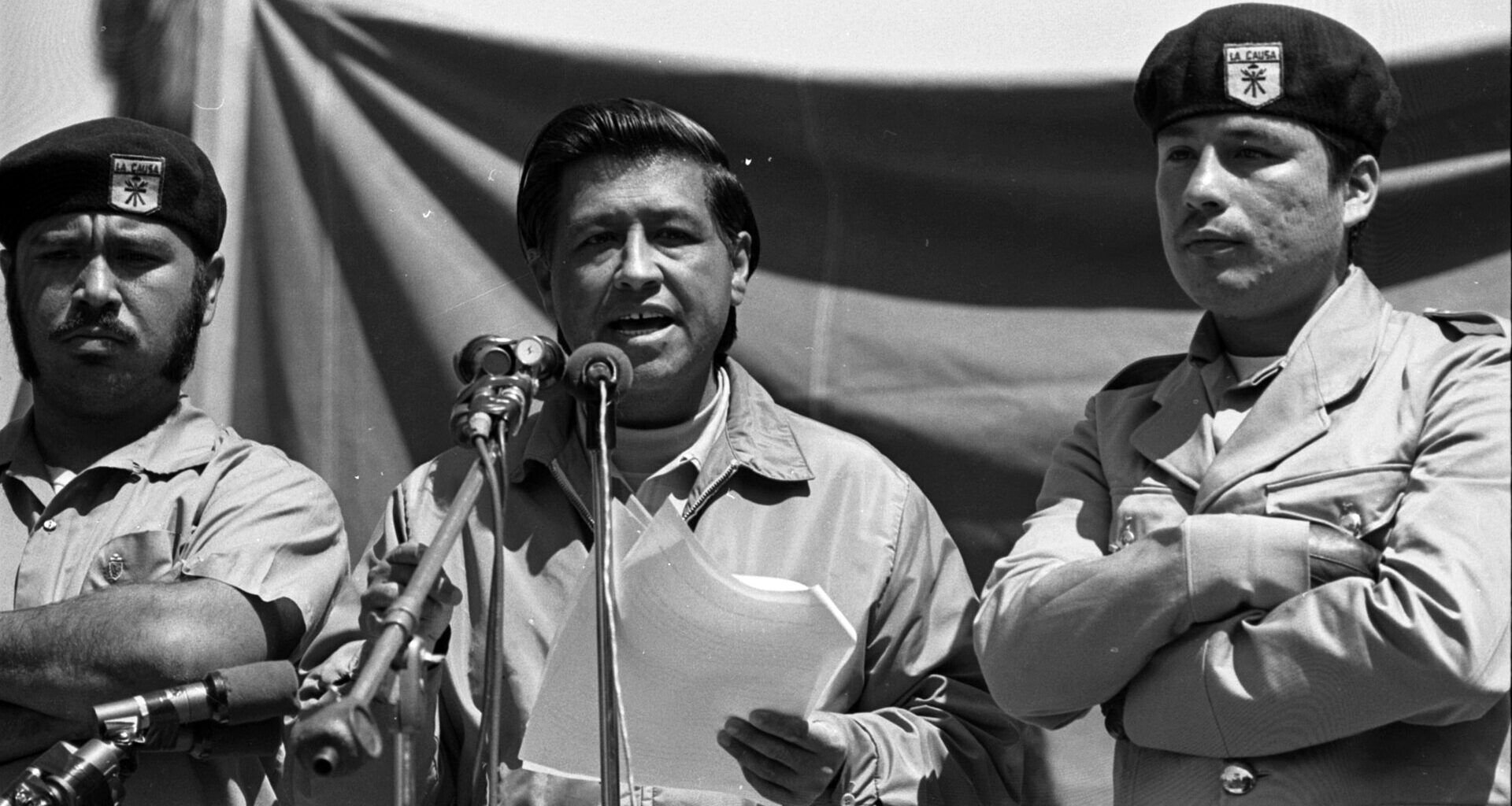
Far and wide, the country is reacting to allegations that prominent labor and civil rights activist Cesar Chavez sexually assaulted at least two underaged girls, as well as labor and civil rights activist Dolores Huerta, allegations first made public by a New York Times investigation.
Chavez is one of the most celebrated and recognized Latinos in modern U.S. history. Across the country, celebrations, parks, streets and schools all carry his name. In Fresno, Fresno Adult School operates at the Cesar E. Chavez Adult Education Center which is run by the Fresno Unified School District.
Former President Barack Obama proclaimed a U.S. federal commemorative holiday honoring Chavez in 2014 which led to several states, including California, now recognizing it as a state holiday.
Fresno educators and community members recently gathered to march and celebrate Chavez on March 15. Around 40 people started from Farber Educational Campus and marched to the Jr. Exhibits Building inside the Fresno Fairgrounds.
The event was organized by El Concilio de Fresno and the Southeast Fresno Community Economic Development Association.
National fallout over revelations about Chavez
The Times investigation includes interviews with those assaulted, marking the first time they have publicly shared their experiences.
In an official statement made by Huerta, she said she survived encounters with Chavez. The first time she was “manipulated and pressured into having sex with him,” and the second time she was “forced, against my will, and in an environment where I felt trapped,” in 1966. Huerta became pregnant from both encounters and later arranged for the children to be raised by other families.
“I carried this secret for as long as I did because building the movement and securing farmworker rights was my life’s work,” Huerta said. “The formation of a union was the only vehicle to achieve and secure those rights and I wasn’t going to let Cesar or anyone else get in the way. I channeled everything I had into advocating on behalf of millions of farmworkers and others who were suffering and deserved equal rights.”
The Dolores Huerta Foundation was not available for comment Wednesday.
United Farm Workers (UFW) first issued a statement on March 17 announcing that the union would not take part in any Cesar Chavez Day activities. The statement also said the organization had not received any direct reports and had no firsthand knowledge of the allegations.
However, it said the claims were serious enough to warrant urgent steps to learn more and to provide space for people who may have been harmed to seek support and share their stories if they choose.
Antonio de Loera, spokesperson for the UFW, told Fresnoland on Wednesday that movements can create space to both reckon with historical accountability and continue moving forward.
“We just need to be able to do both,” de Loera said. “We need to be able to learn from our past and support victims, while also recognizing that the work needs to continue, and that farmworkers today are worth fighting for, now more than ever.”
The organization is partnering with the Cesar Chavez Foundation to create a safe and confidential process for those who wish to share their experiences. The foundation also publicly commented about the allegations on March 17.
In an email statement shared with Fresnoland from the foundation, his family said they are “shocked and saddened” to learn the news about their father.
“As a family steeped in the values of equity and justice, we honor the voices of those who feel unheard and who report sexual abuse,” Chavez’s family said. “This is deeply painful to our family.”
Unpacking Chavez’s complicated legacy
While Wednesday’s news set off shockwaves, particularly in California labor circles, many others noted that Chavez was no stranger to criticism and controversy during his life, aspects of his life that tended to get left out in many historical retellings.
From 1974 to 1975, Chavez initiated what he called the “Illegals Campaign,” aimed at reporting undocumented workers to federal authorities.
Viewing undocumented immigrants as strikebreakers who undermined the union’s efforts, Chavez directed UFW members to report them to the Immigration and Naturalization Service. “Wet lines” were also established along the Rio Grande, where UFW members actively discouraged immigrants from crossing into the country.
The effort, led in part by Chavez’s cousin Manuel Chavez, saw reports emerge of Mexican immigrants being threatened, beaten, and robbed while attempting to cross into the United States. At its peak, the operation employed around 300 people and cost the United Farm Workers roughly $80,000 per week.
As a result of Chavez’s work, in 2018, a resolution was introduced in Congress, but never advanced, which proposed designating March 31, Cesar Chavez’s birthday, as National Border Control Day.
Alina R. Méndez, assistant professor of the Chicanx and Latin American Studies at Fresno State, said she was “shocked and horrified” by the news and “hopes that the survivors and their loved ones receive all the support they deserve.”
Méndez, along with other Chicanx studies educators, have spent several years working to reframe how the history of UFW is taught, pushing back against the tendency to focus on just a few leaders.
She said much of the historical attention has focused on Chavez’s charisma and leadership, often overshadowing the larger collective of people who made the movement possible. This includes the “kind of inevitable way” in which the media of the 1960s, followed by biographers and later historians, concentrated almost exclusively on Chavez.
Only in the last 10 to 15 years, she said, have historians and scholars in Chicanx and ethnic studies begun to question why so much attention has been paid to a single leader—and what has been lost by doing so.
“When we focus on just one man or a few leaders, we lose focus on the larger collective that made these movements possible,” Méndez said. “I hope that other instructors around the country take these allegations seriously and take this moment as an opportunity to discuss difficult questions with their students.”
She pointed to several works that reframe the focus from one man to the broader community that fueled the movement. Miriam Pawel’s “The Union of Their Dreams” highlights the lives and contributions of multiple UFW leaders beyond Chavez.
Frank Barneke’s “Trampling Out the Vintage” and Matt Garcia’s “From the Jaws of Victory” critically assess Chavez’s leadership, documenting both his accomplishments and his problematic decisions.
Christian O Paiz’s “The Strikers of Coachella” centers on rank-and-file members, emphasizing the grassroots organizers whose efforts were essential to the union’s success.
Méndez also stressed that the conversation about Chavez’s legacy should not obscure the contributions of thousands of farmworkers who sacrificed for the movement. Renaming streets, schools, or other landmarks could honor this collective effort rather than focusing solely on one figure.
“I hope that they can be renamed in ways that still celebrate the great achievements that farm workers were instrumental in making possible and achieving,” Méndez said.
She noted that, in Fresno, institutions and community members are already beginning to reconsider Chavez’s legacy, noting the university’s announcement about removing Chavez’s statue.
Méndez pointed to her parents’ meeting through UFW organizing as an example of the movement’s lasting influence. She emphasized that countless former participants carried the lessons and energy of the UFW into careers in community organizing, education, and public service.
Even as Chavez’s legacy comes under scrutiny, she said, the movement’s spirit and impact continue to endure.
Fresnoland’s Julianna Morano contributed to this report.
Support our hyperlocal reporting with a donation today.
Every week we bring you deeply reported stories about the essential issues facing our region. Please help us continue our work by becoming a monthly member.
Related