
On Wednesday morning, children at Cesar Chavez Elementary School marched through southeastern San Diego as they do every year to honor the influence of the man whose name their school bears and the movement he led for farmworkers’ rights.
“I am a student that can help change laws, make things fair, like Cesar Chavez did for us,” wrote the students of Room D202 in a poem performed for their classmates.
They did not know that hours earlier, The New York Times had published bombshell allegations that the late Chicano and labor hero — whose name and influence are inescapable in California — had for years sexually abused young girls and raped union co-leader Dolores Huerta.
The revelations shocked San Diego’s political leaders and Latino community, prompted an outpouring of support for victims and led to efforts to cancel events planned and rename institutions named in his honor.
They also underscored how inescapable Chavez’s name and legacy are across the region, particularly in the weeks leading up to Cesar Chavez Day, a federal commemorative holiday observed on March 31, his birthday. In San Diego County alone, his namesakes include a park, a highway, a recreation center and multiple schools.
Mayor Todd Gloria called the news “shocking and disturbing,” and his spokesperson Dave Rolland said the city would consider renaming all city-owned properties that bear Chavez’s name, including Cesar Chavez Parkway and a community center in San Ysidro.
“It’s a feeling of betrayal,” said Assemblymember David Alvarez, who represents South County.
Alvarez’s father was a farmworker, and he himself grew up admiring Chavez. Alvarez served on the now-defunct San Diego Cesar E. Chavez Commemoration Committee about 20 years ago, organizing festivals and parades in Chavez’s honor.
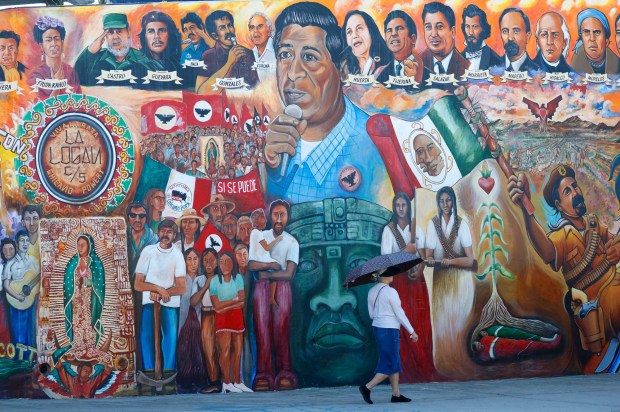 A historic mural honoring Cesar Chavez and other Latino leaders — including United Farm Workers co-founder Dolores Huerta, who says Chavez raped her decades ago — is seen in Barrio Logan on March 18, 2026, in San Diego. (K.C. Alfred / The San Diego Union-Tribune)
Other Latino elected officials in the South Bay issued calls Wednesday to remove Chavez’s name from positions of honor.
San Diego City Councilmember Vivian Moreno urged the city to remove his name from all city properties and holidays.
“Even our heroes have their day of reckoning, and we should not safeguard their heinous actions,” she wrote in the memo to the mayor.
And county Supervisor Paloma Aguirre called for renaming the upcoming holiday for Dolores Huerta, who co-founded the United Farm Workers with Chavez.
“We have a duty and responsibility to confront the full truth of our history,” she said. “The farmworker movement is bigger than one person.”
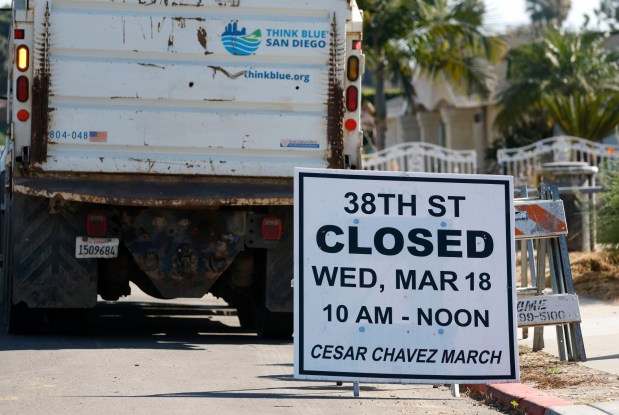 A traffic sign is displayed for a Cesar Chavez march near Cesar Chavez Elementary School on March 18, 2026, in San Diego. (K.C. Alfred / The San Diego Union-Tribune)
The county scrubbed his name from a webpage promoting labor-rights events.
At Southwestern College, the school’s Chicano Latino Coalition canceled a scholarship breakfast named for Chavez that had been planned for Thursday. UC San Diego canceled its April 2 kickoff event for a Chávez celebration month and was re-evaluating related events.
Two community colleges were considering renaming centers named for Chavez — San Diego Community College’s Cesar Chavez Campus, a small tuition-free center in Barrio Logan, and Southwestern College’s student services center.
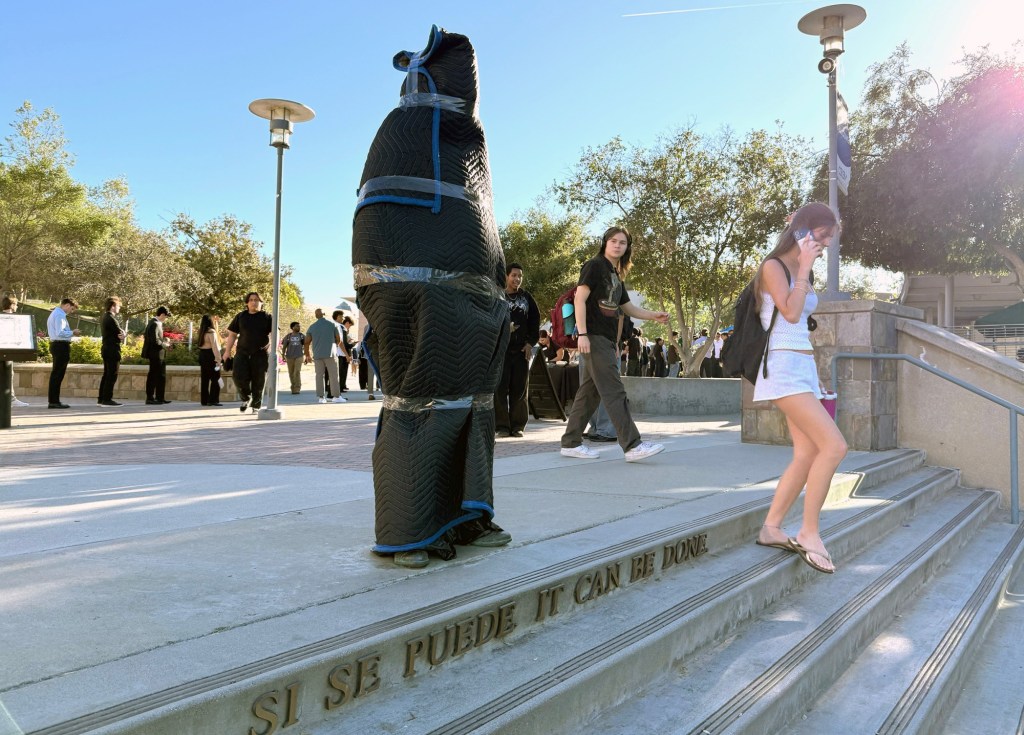
And at Cal State San Marcos, a central statue of Chavez was shrouded in moving blankets Wednesday.
That statue was an important symbol for students from farm-working families in North County, said Karla Reyes, the operations manager at the Centro Cultural de la Raza and ethnic studies lecturer at MiraCosta College.
She hopes any replacement can still honor the movement. “We can’t make one person a movement,” she said.
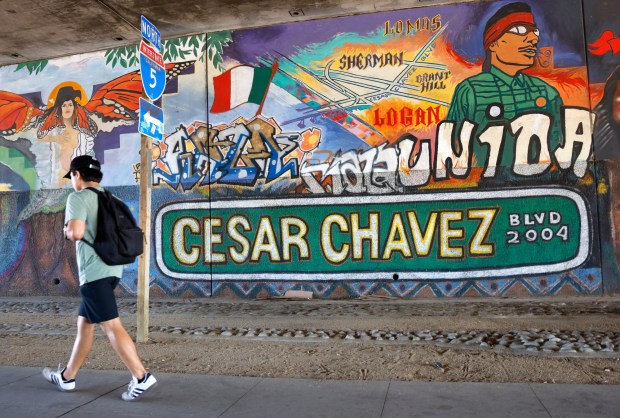 A mural honoring Cesar Chavez in Barrio Logan is shown on March 18, 2026, in San Diego. (K.C. Alfred / The San Diego Union-Tribune)
Not every organization immediately moved to cancel events or cut ties.
Neither San Diego Unified nor Oceanside Unified school districts had yet decided what to do about their schools named for him.
And the founders of the Cesar Chavez Service Clubs, a San Diego nonprofit that teaches leadership skills to young people and hosts annual educational tours to Washington, said they would move forward with their annual fundraising breakfast next week.
“In light of these issues, our upcoming breakfast has taken on an even greater significance,” Linda and Carlos LeGerrette said in their statement. “This is a time for us to come together as a community and make space for one another and process this news collectively.”
Other local Chicano cultural and movement leaders were also reflecting on what to do next, and on the need for solidarity with victims.
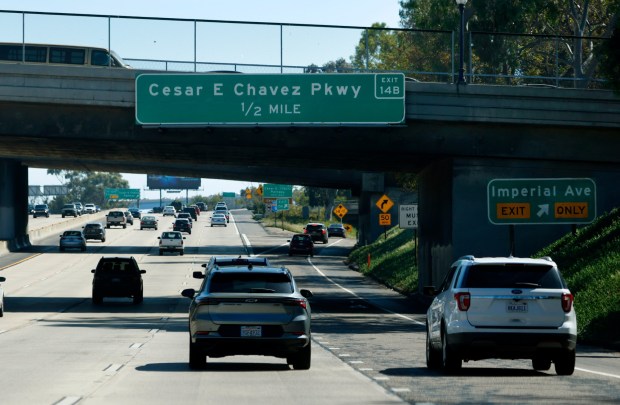 A freeway sign on Interstate 5 shows an offramp for Cesar E. Chavez Parkway on March 18, 2026 in San Diego, CA. (K.C. Alfred / The San Diego Union-Tribune)
For Ana Hernandez, the executive director of the Centro Cultural de la Raza, the revelations about a Chicano hero were particularly painful because they were so timely.
Her institution just opened an exhibition in honor of international women’s month about the collective rage of exploited women and queer people.
“I’m absolutely horrified to hear yet another story of … a man who is revered and was considered to be a leader perpetrating these kinds of acts,” Hernandez said.
To other San Diegans in the Chicano movement, the news was a wake-up call.
“What it’s told me is… you need to do better,” said Alberto Pulido, a professor of ethnic studies at the University of San Diego and a longtime leader in the Chicano movement in San Diego. “You need to be active and vocal in supporting women’s rights, because you put this guy up on a pedestal, and you make up this messianic person.”
Staff writers Jemma Stephenson, Gary Robbins, Jeff McDonald and Lucas Robinson contributed to this report.